How event marketing materials are evolving to boost networking and brand recall

Traditional promotional merchandise underperforms at industry events, with attendees retaining minimal brand recall from low-cost novelties. Businesses are shifting to larger-format, high-impact branded materials to address this ROI challenge and extend engagement beyond the event, Bagmasters reports.
 Bagmasters
Engaging Attention and Influencing Memory
The argument that larger-format, creatively designed branded materials have a greater effect on attracting the attention of event attendees and improving subsequent recall of a given company is backed by research. One study in the Journal of Retailing confirms that merchandise that is unique, bespoke, sustainable, and artistic rather than just commercial, enables brands to establish an identity and build stronger relationships with target audiences.
In terms of scale, bigger branded materials also hold sway over attention and recall. A study from The Journal of Vision proved that visual salience (size, contrast, and surface area) directly dictates automated attention capture. Larger physical objects bypass conscious processing and are processed immediately by the visual cortex, forcing the brain to register the stimulus before an individual even consciously decides to look at it.
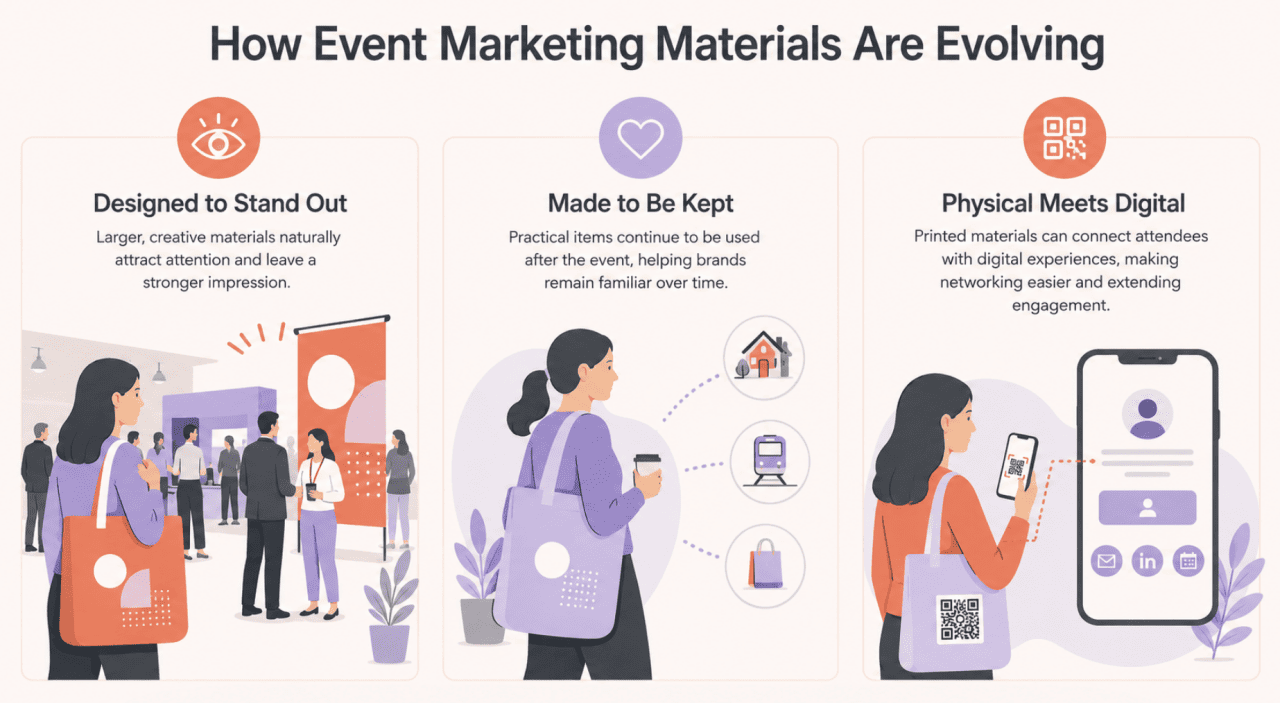
Brands are learning that tiny, disposable event novelties generate minimal brand recall, so strategies are shifting toward larger visual real estate, such as custom tote bags emblazoned with logos and slogans. When these marketing materials are disseminated at trade shows or consumer expos, other attendees pay attention to them in the same way they would a static billboard.
Implementing Ownership to Extend Engagement
The shift from inexpensive, ineffectual event marketing materials to merchandise that bolsters brand recall and offers some utility to attendees has advantages beyond the conference center. Physical items like branded shoulder bags, reused over extended periods, double susceptibility to future brand interactions compared to media-based marketing alone.
The evidence for this doubling comes from a BMJ Open paper, with the focus here being on susceptibility to alcohol use among young people with branded merchandise from alcohol brands. While the report’s aim is primarily to draw attention to the problems that alcohol brand marketing materials can cause for young adults from a drinking perspective, the findings are nevertheless relevant to demonstrating the wider impact of branded merchandise in other contexts.
There’s also data from ASI Research revealing the influence of promotional product ownership on brand recall: 75% of respondents to its most recent survey said they view branded merch positively, while 85% said they remember which specific advertiser supplied them with any logo-bearing item they have in their possession.
The same report indicated the positive benefits of branded tote bags in particular, with a single $6 item in this category generating an average of 4,900 impressions during its usable lifespan. That equates to a cost-per-impression of a tenth of a cent, making the cost easy for brands to justify.
Even for costlier merch, like wearable tops, the CPI reaches as low as four-tenths of a cent, largely due to the usefulness of such products, which 78% of consumers cite as the main motivation to keep promotional materials for the long term.
Combining Physical and Digital Experiences
A third factor driving this shift is the recognition of the role that digital experiences play in establishing and perpetuating brands, and that this must be achieved in person as much as via online platforms. In particular, modern event design treats marketing materials as functional infrastructure to solve the friction of networking.
Integrating QR codes into physical merch is the clearest and most commonplace example. A 2025 Uniqode report found that 98% of companies that deployed QR codes saw improvements in their marketing efforts, while 95% singled out the data-collection potential of these codes as another major upside.
Moreover, linking to digital experiences through promotional materials enables a hybrid of the two, allowing brands to establish their identity through landing pages and web apps while encouraging attendees to sign up for future communications. Thus, the overlap between in-person networking and its digital equivalent converges on event marketing materials.
In light of data supporting the evolution of event marketing materials, businesses seeking to improve networking outcomes and enhance brand recall should implement this trend. Event attendees, meanwhile, can expect to receive more creative and innovative examples of merchandise.
This story was produced by Bagmasters and reviewed and distributed by Stacker.
The post How event marketing materials are evolving to boost networking and brand recall appeared first on News Channel 3-12.