Click on the Manage Content for adding and managing content.
Click on the Rotator Settings and choose what and how it will be displayed.

No college degree, no problem? Not so fast

Kraig Pakulski 0 109 Article rating: No rating

Cherri McKinney rides the bus home from her office in Denver using an EcoPass, a free monthly RTD pass, provided to Colorado state employees.

Sara Hertwig for The Hechinger Report


DENVER — On a bus headed downtown, Cherri McKinney opened a compact mirror and — even as the vehicle rattled and blinding morning sun filled the window — skillfully applied eyeliner.

McKinney is a licensed aesthetician. She went into bookkeeping after graduating from high school in 1992, then ran a waxing salon for years. Later, she shifted into human resources at a homeless shelter. But stepping off the bus, she started her work day as a benefits and leave administrator for Colorado’s Department of Labor and Employment.

She wouldn’t have made it past some hiring managers.

“My background is kind of all over the place,” McKinney said. “You might have looked at my résumé and thought, ‘Wow, this girl doesn’t have a college education.’”

In fact, Colorado’s state government was looking for workers just like her. In 2022, Gov. Jared Polis signed an executive order directing state agencies to embrace “skills-based hiring” — evaluating job seekers based on abilities rather than education level — and to open more positions to applicants without college diplomas. When McKinney interviewed with the state in the summer of 2024, she said, she was asked practical questions about topics like the Family Medical Leave Act, not about her academic background.

For a decade, workforce organizations, researchers and public officials have pushed employers to stop requiring bachelor’s degrees for jobs that don’t need them, explains The Hechinger Report. That’s a response to a hiring trend that began during the Great Recession, when job seekers vastly outnumbered open positions and employers increased their use of bachelor’s degree requirements for many jobs — like administrative assistants, construction supervisors and insurance claims clerks — that people without college diplomas had capably handled. The so-called “paper ceiling,” advocates say, locks skilled workers without degrees out of good-paying jobs. Degree requirements hurt employers, too, advocates argue, by screening out valuable talent.

In recent years, at least 26 states, along with private companies like IBM and Accenture, began stripping degree requirements and focusing hiring practices on applicants’ skills. A job seeker’s market after COVID

Small business holiday trends to watch in 2025

Kraig Pakulski 0 110 Article rating: No rating

A female business owner arranging stock clothing for her store's window display.

Monkey Business Images // Shutterstock


2024 was a rebound year for small businesses. Not only did performance exceed expectations across the board, but 79% of respondents in Bluevine’s Business Owner Success Survey conducted in November 2024 entered 2025 confident that their businesses would beat expectations again. Their customers, on the other hand, have felt far more cautious about their economic future, but they also aren’t planning to spend less this holiday season—in fact, the average American household will spend 5.7% more on holiday expenses in 2025 than in 2024, according to Simon-Kucher’s summer 2025 survey.

Yes, while shoppers from all income brackets reported they’d be cutting back on nonessential spending, 65% of households plan to match or increase last year’s holiday budget, McKinsey’s August 2025 ConsumerWise survey found. This percentage climbs with household income, as 84% of households earning $75,000 or more plan to do the same, per Optimove’s July 2025 survey of higher-income households.

What’s going on? While survey respondents may be honestly reporting overall cutbacks, most still plan to celebrate holiday traditions like gathering and gift-giving, and will be more generous in spending on gifts than on themselves, according to surveys from PwC and Mailchimp and Canvas8. This means that, while overall holiday spending is projected to grow in 2025 (relative to last year), according to Simon-Kucher, your customers will be spending more selectively, and seeking out sales, deals, and value more intentionally than ever before.

To help you navigate the long and delicate holiday season ahead, Bluevine compiled insights from 12 different customer analytics reports to help you understand your customers’ mindsets, take advantage of peak sales periods, and execute a holiday marketing strategy that will steer your business confidently into 2026.

Key insights

  • Americans plan to spend as much as they did on last year’s holidays, but more intentionally.
  • Tariff anxiety will drive some early spending as shoppers rush to beat price increases.
  • Customers will increasingly ask AI for gift recommendations this year and beyond.

Key actions

  • Capture high-value customers before Cyber Week, which will dominate seasonal sales.
  • Provide options to last-minute and post-Christmas shoppers to establish loyal customers.
  • Optimize your business websit

Job market for highly skilled workers remains volatile as AI redefines demand across sectors

Kraig Pakulski 0 100 Article rating: No rating

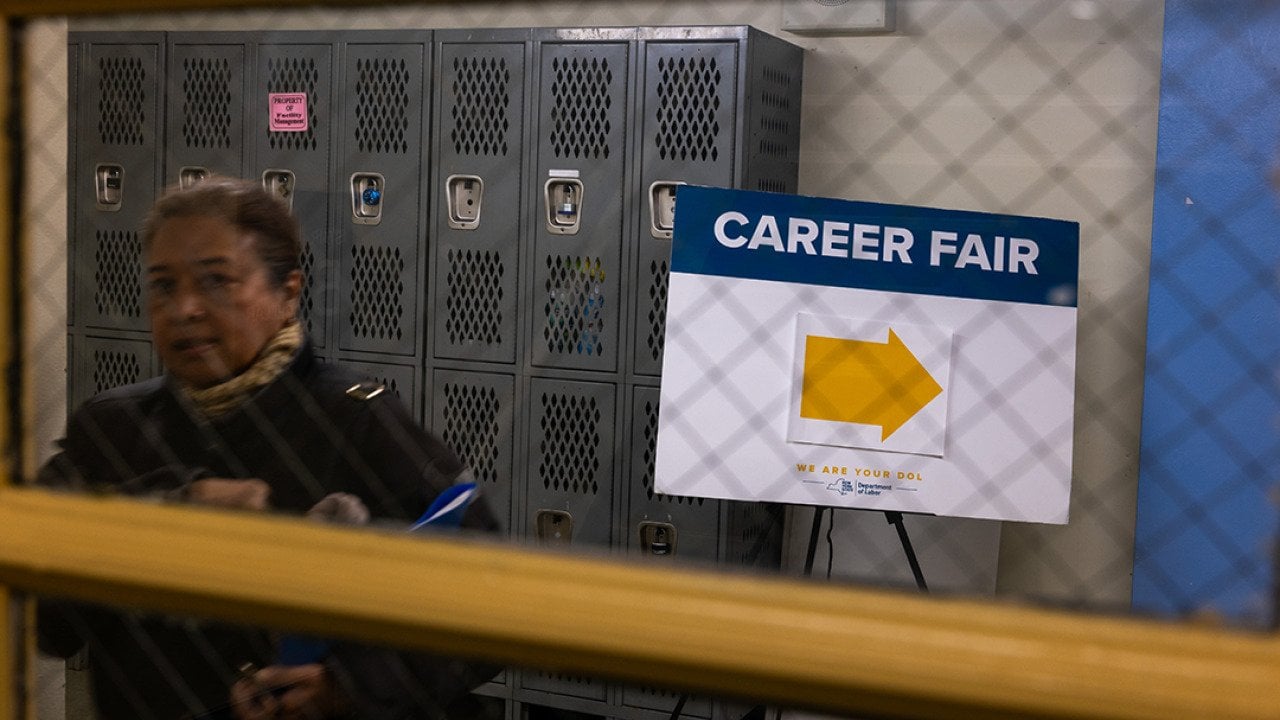
A window view of a jobseeker and a signage with an arrow pointing to where a career fair is situated in New York City.

Spencer Platt // Getty Images


While the November jobs data from the U.S. Bureau of Labor Statistics is delayed until December 16, a new job report shows that hiring remains turbulent and contradictory, even as layoffs have slowed. Toptal’s “High-Skilled Job Report for November 2025” found that demand for experienced technology and professional services personnel decreased month over month in November, while year-over-year demand increased slightly.

This data further cements the current hiring environment as a challenge for candidates navigating tight competition and employers struggling to fill key roles during a period of accelerated transformation. It also reveals that volatility has become the new normal, due in part to widespread AI adoption, which is prompting companies to reassess their business models, product strategies, and the types of talent they require.

Demand for Senior Remote and Hybrid Talent Slips Month to Month but Maintains Upward Trajectory

The report utilizes a scoring system that takes new job postings and advertised compensation into account, based on raw data from labor market analytics company Lightcast. The scores are based on roles that require five or more years of experience, and because Toptal is itself a remote company, the data is filtered for remote and hybrid positions whenever possible.

Month-over-month jobs data is notoriously unstable, and November 2025 was no exception, with demand for remote or hybrid technology and professional services talent with five or more years of experience falling 13% month over month but rising 2% year over year. The volatility was largely driven by the U.S. government shutdown and the Thanksgiving holiday.

However, for the general job market, which includes all professions and levels of experience, the story is reversed: November saw an increase in global job postings and a decrease in technology layoffs compared to October, while year-over-year data showed layoffs remained elevated and job postings were down.

Although the broader global job market is marked by instability, the analysis highlights distinct pockets of resilience. Highly skilled, senior-level professionals are faring better than generalists or entry-level workers: The experienced technology and professional services market continues to outperform the broader job market, which includes workers at all experience levels.

In terms of specific areas of expertise, trends in job postings and pay varied widely, with significant year-over-year increases for marketing experts (+18% YoY) and product managers (+16% YoY), for example, but large decreases for designers (-60% YoY) and information security experts (-40%YoY).
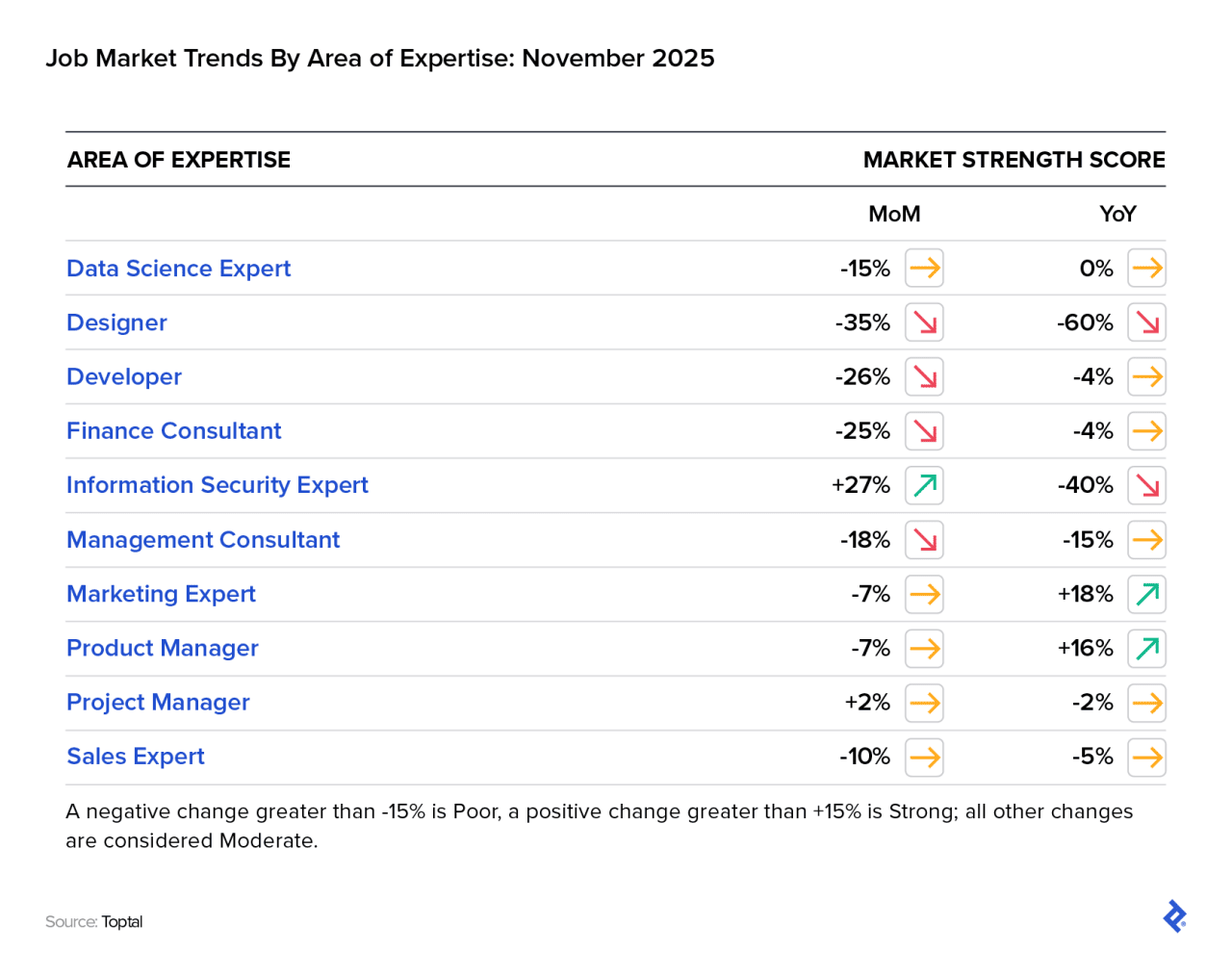
A table listing areas of expertise and their market strength scores.Read more

Why 95% of enterprise AI projects fail to deliver ROI: A data analysis

Kraig Pakulski 0 113 Article rating: No rating

A data analyst reviewing dashboards.

Andrey_Popov // Shutterstock


American enterprises spent an estimated $40 billion on artificial intelligence systems in 2024, according to MIT research. Yet the same study found that 95% of companies are seeing zero measurable bottom-line impact from their AI investments.

The pattern is remarkably consistent across industries. Companies invest millions in AI infrastructure, train models on internal data, deploy systems to assist sales teams or automate marketing workflows—and then watch as adoption stalls or results disappoint. The technology works in demos but fails in daily operations.

MIT’s Project NANDA calls it the “GenAI Divide”—just 5% of integrated AI pilots extract millions in value, while the vast majority remain stuck with no measurable profit and loss impact.

A data bar graph showing that only 5% of custom enterprise AI tools reach production.

Andrey_Popov // Shutterstock

A 2025 ZoomInfo survey of go-to-market professionals found that while chatbots and simple customer relationship management (CRM) assistant tools have achieved the widest adoption in sales and marketing, over 40% of AI users report dissatisfaction with the accuracy and reliability of their AI tools.

The Consumer AI Paradox

The most successful AI tools on the consumer market are often the least suited for business impact. Mass-market applications like ChatGPT have become fixtures of daily work, but their design creates fundamental problems when deployed in enterprise environments.

“The same users who integrate these tools into personal workflows describe them as unreliable when encountered within enterprise systems,” MIT’s Project NANDA study notes.

The reason lies in how these systems are designed. Consumer chat applications are essentially rewarded for generating plausible-sounding answers rather than admitting uncertainty—a trait that leads to “hallucinations” and fabricated information. In personal use, these errors are annoying. In business-critical workflows where AI agents operate autonomously, errors compound faster than humans can intervene.

A 2024 PwC survey found that 80% of business leaders don’t trust agentic AI systems to handle fully autonomous employee interactions or financial tasks, citing concerns about accuracy and reliability.

The Structured Data Blind Spot

Research from MIT’s Computer Science and Artificial Intelligence Laboratory identifies what they call “the 80/20 problem” in enterprise AI deployments. Corporate databases capture approximately 20% of business-critical information in structured formats—the neat rows and columns that AI systems easily process.

The remaining 80% exists in unstructured data: email threads, call transcri

RSS
First43264327432843294331433343344335Last