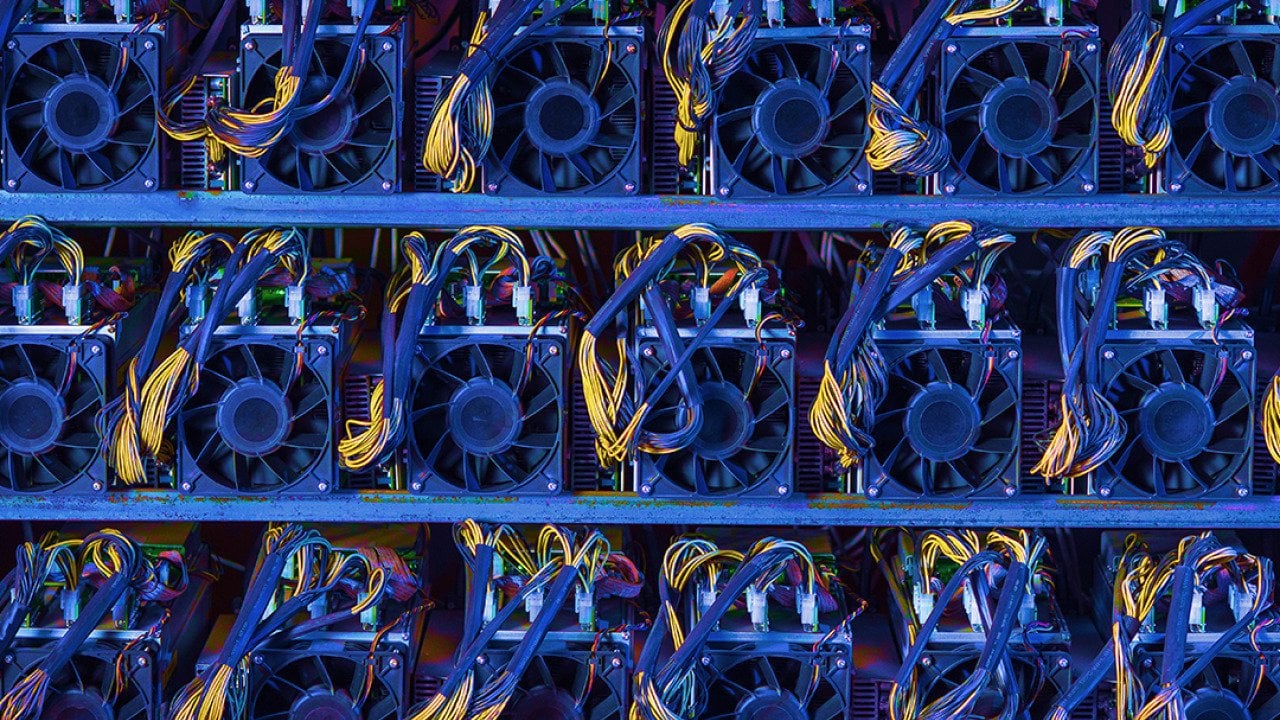
Mark Agnor // Shutterstock
For someone who cares about climate change, Matt Carlsson had what seemed like a dream job: teaching clients how to decarbonize buildings. But he was frustrated. He could give customers the tools to improve energy efficiency and phase out fossil fuels, but if they couldn’t easily turn his guidance into cost savings, they’d simply ignore him.
“Most of these people are not going to take action,” he realized, “because there’s not going to be a business case.”
Carlsson decided that he’d need to find a job where he could make the case for energy efficiency on economic terms. This led him somewhere surprising: Bitcoin.
Mining Bitcoin generates a significant amount of heat. That’s because the “mining” in question refers to the energy-intensive computational process by which Bitcoin transactions are verified. In a typical transaction, a boxy computer attempts to solve what’s essentially a very complex math problem. If it can do this before any of the other “miners” working on the problem across the world, the miner is rewarded with Bitcoin of its own.
This process takes a whole lot of power; overall, Bitcoin mining accounted for an estimated 0.5% of global electricity use in 2024. The more complex the task at hand, the more electricity is needed — and the more heat is created. Essentially, as long as it’s lucrative to mine Bitcoin, it’s going to spit out a lot of extra heat as a byproduct. The question becomes: Can that heat be put to beneficial use?
That’s where Carlsson comes in. He’s now helping to heat the homes of 80,000 residents in Finland with waste heat from local cryptocurrency miners, as a part of a project run by his new employer, the Bitcoin mining company MARA Holdings, Grist reports.
Water runs through MARA’s miners, which are stored in black metal units in the center of the towns, cooling them off before coming out at a scalding 122 to 172 degrees Fahrenheit (50 to 78 degrees Celsius). From there, the water is pumped underground through the cities’ existing district heating systems, drastically cutting down the need for traditional boilers. As a result, MARA’s two Bitcoin districts have avoided greenhouse gas emissions roughly equivalent to those produced by 700 U.S. homes since its first project came online in 2024.
Carlsson thinks this model could be expanded to cities and buildings across the world — and he’s not the only one. Joint Bitcoin mining and heating operations are popping up across Finland, an ideal location because of its cool climate and existing district heating systems that companies can easily plug into. Terahash Energy’s “Genesis” project, for example, is sending waste heat from Bitcoin mining to be used in an industrial area in the Nordic nation, plus some nearby homes. The global Bitcoin mining infrastructure firm Hashlabs hosts six sites connecting miners to district heating sy