
ART STOCK CREATIVE // Shutterstock
In America, fraud is no longer a static threat. It has instead become an evolving ecosystem, continually powered by artificial intelligence, automation, and an ever-expanding digital footprint. Consumers have spent much of the past decade reacting to the latest scam of the month, whether that be a phishing text, bogus charges, or something else. However, with 2026 on the horizon, scams are set to become more adaptive, personalized, and embedded in the very systems we rely on daily.
Forward-looking insight has never been more important. By identifying the next wave of fraud before it reaches its full scale, consumers can start to operate from a place of anticipation rather than damage control. Lifeguard has analyzed the top trends across cybersecurity and early-warning research to compile four prominent emerging fraud trends to help you get ahead of the new year’s most dangerous threats.
Four emerging fraud trends
To navigate 2026 safely, it helps to know what’s coming. Here are four fraud and scam trends that are already shaping up to be a part of the next generation of threats:
1. AI “fraud agents” and the hyper-personalized deepfake
Generative AI is no longer just a science fiction concept. Deepfakes and attacks using synthetic documents are expected to surge drastically as cybercriminals continue to learn how to twist artificial intelligence to their advantage. This allows fraudsters to generate convincing voice, video, and document forgeries that impersonate communications from loved ones, colleagues, institutions, and more, making traditional trust signals unreliable.
As outlined by Finra, a nonprofit composed of industry and public regulators, effective strategies to combat generative AI include using biometric verification, enabling multi-factor authentication, and using identity-theft protection services.
2. Synthetic identity fraud: The “Frankenstein” profile
Rather than stealing an existing person’s identity, fraudsters are beginning to create synthetic identities. These aliases merge real social security numbers or personal information about individuals with fabricated names, addresses, and credentials. According to TransUnion’s 2025 fraud report, which analyzes leading fraud trends across the globe, identity-data exposure is shifting more towards quality over quantity. This makes synthetic identities more effective.
Fake identities can quietly damage your credit or open accounts in your name. What’s new (and dangerous)is the fact that these false identities can tie back, in part, to your real data. This means that real-world damage can surface years later. To be proactive, monitor your credit report and freeze all household credit at the first sign of any type of misuse.
3. The “roach motel” subscription and data trap
Bilanol // Shutterstock
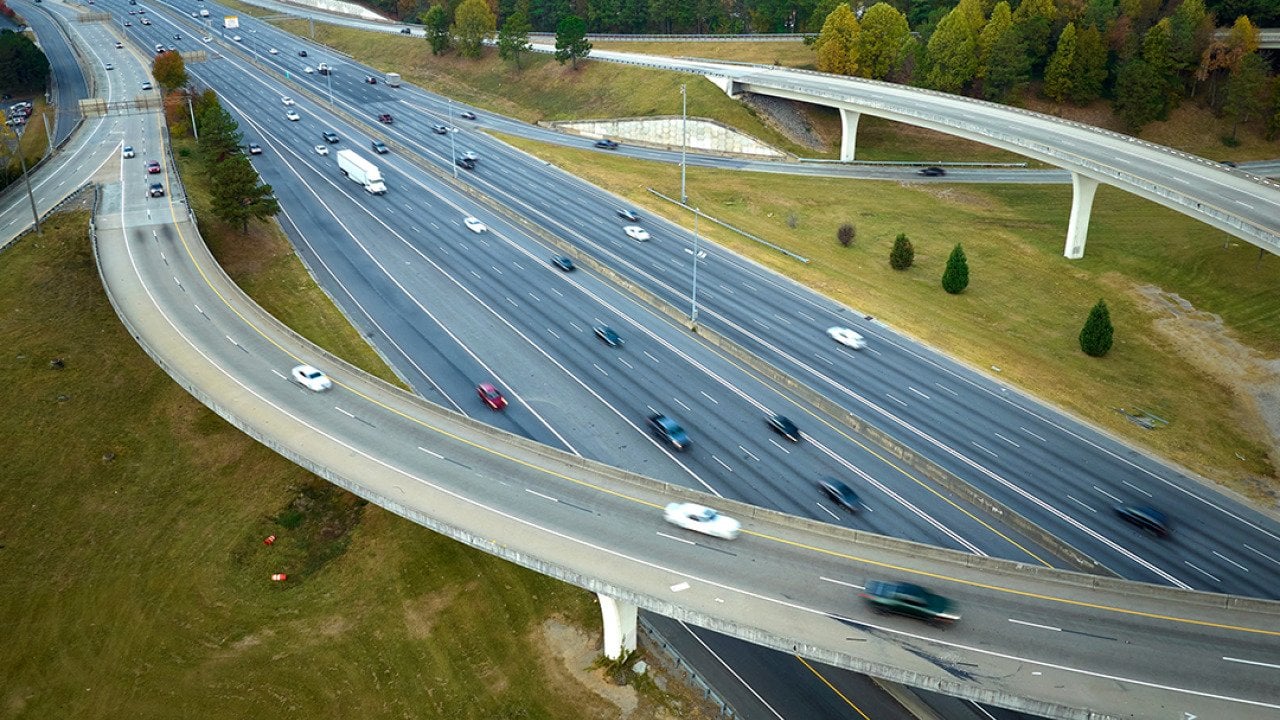
In 2023, roughly one-third of all U.S. traffic fatalities (33%) happened between 3 p.m. and 9 p.m., with the single deadliest three-hour block from 6 p.m. to 9 p.m. (18% of all deaths). Those hours straddle the evening commute, when roads are crowded, daylight fades, and impairment risks rise. That pattern shows up year after year in federal crash data.
Traffic deaths nationwide have risen sharply over the past several years, even as overall vehicle miles traveled have fluctuated. While weather, road design, and vehicle safety technology all play a role, federal crash records show that the time of day is one of the strongest predictors of fatal risk on the road. And that the riskiest hour varies significantly by state.
The following analysis, conducted by THE702FIRM Injury Attorneys, a personal injury law firm based in Nevada, uses data from the National Safety Council and National Highway Traffic Safety Administration’s Fatality Analysis Reporting System (FARS) to identify when fatal crashes are most likely to occur across the country, and which states see the highest concentration of deadly collisions during night, rush hour, and weekend periods.
National Safety Council
Evening hours are the deadliest nationwide
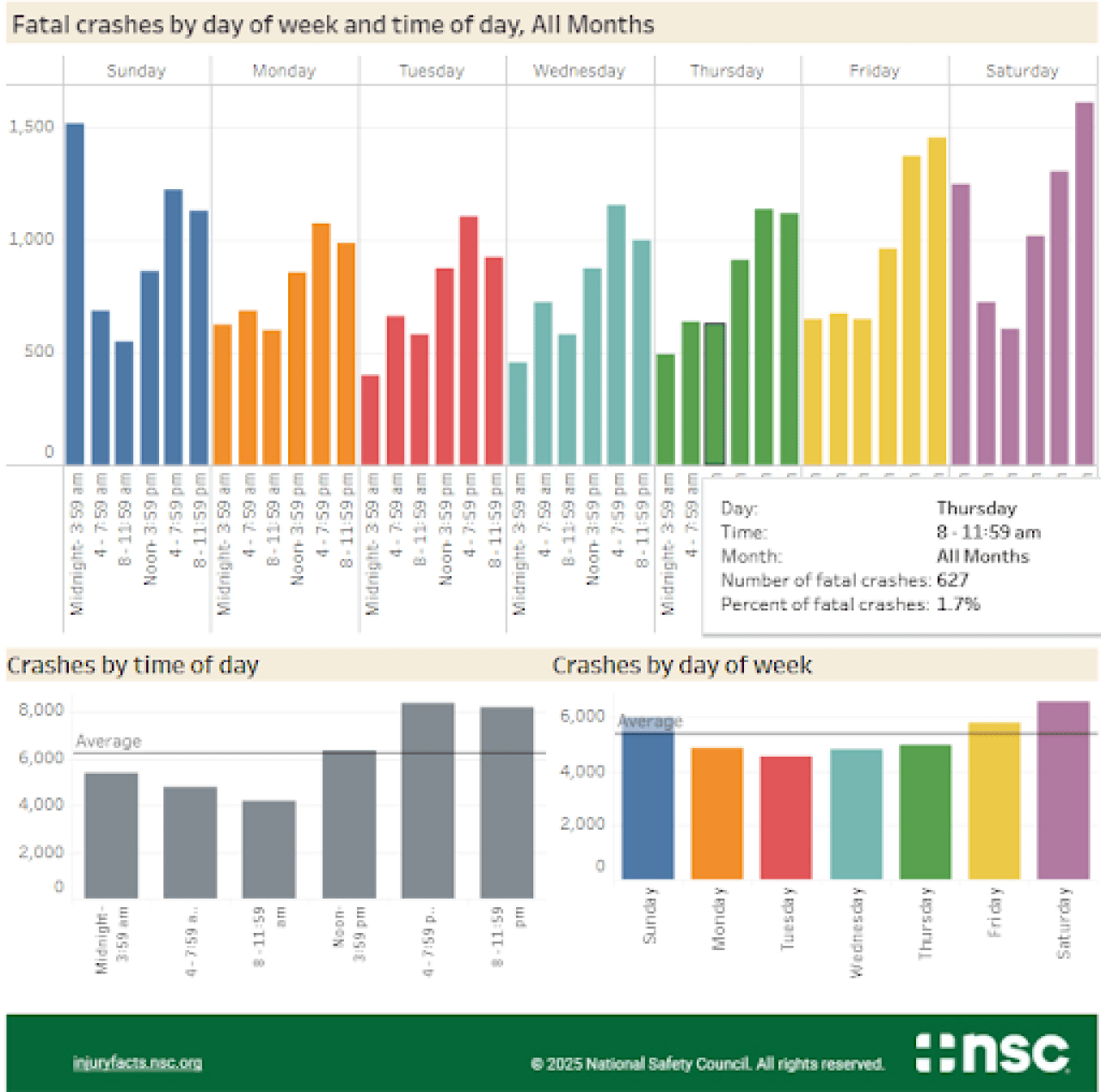
Fatal crashes in the U.S. are most likely to occur in the early evening, with the 4 p.m. to 7:59 p.m. time block recording the highest death totals across every day of the week, National Safety Council data shows. The period coincides with the end of the workday, heavier traffic on major routes, and the start of evening social activity.
Risk remains elevated into the night. Crashes between 8 p.m. and 11:59 p.m. make up the next-highest share of fatalities, even though overall traffic volume drops. Reduced visibility, faster travel speeds on open roads, and a higher proportion of impaired drivers are key factors.
Fridays and Saturdays show the sharpest increases, reflecting the overlap of weekend travel and nighttime recreation.
Per state breakdown of peak crash times
Analysis of the National Highway Traffic Safety Administration’s time-of-day crash dataset shows 6 p.m. to 9 p.m. as the deadliest three-hour window, but state-level patterns are not uniform. In some states, the peak shifts earlier into the late-afternoon commut
CNN
By Kevin Liptak, CNN
(CNN) — President Donald Trump unveiled a new “Trump class” of Navy battleships Monday, describing them as a superior war fighting vessel to replace an “old and tired and obsolete” US fleet.
“They’ll help maintain American military supremacy, revive the American ship building industry, and inspire fear in America’s enemies all over the world,” Trump said in revealing the new category of vessel from the library at Mar-a-Lago.
Flanked by renderings of the “Trump class” battleships at sea, Trump said he would take an active role in their design. The president made the announcement Monday afternoon in Florida with Defense Secretary Pete Hegseth and Secretary of State Marco Rubio, who is also national security adviser. He didn’t use the term “Trump class” in his remarks.
The “Trump class” ships will form part of the new “Golden Fleet” that the president has ordered up for the Navy, meant to better counter China and other adversaries and to more closely adhere to Trump’s aesthetic standards.
“The US Navy will lead the design of these ships along with me because I’m a very aesthetic person,” Trump said.
Fitted with “guns and missiles a the highest level,” hypersonic weapons, electric rail guns, cruise missiles and the “most sophisticated lasers in the world,” the new battleships will be the largest ever built, Trump said.
They will each weigh between 30,000 and 40,000 tons, he said, and will be built in the United States. “They’ll be very AI controlled,” he said, without explanation.
“We envision that these ships will be the first of a whole new class ships to be produced in the years to come,” he said.
Initially, the Navy will build two of the “Trump class” ships, quickly followed by eight more. Trump said he envisioned 20-25 of the vessels, which he said would become the “flagship of the American Naval fleet.”
He also said he would work to update American aircraft carriers as part of the “Golden Fleet” update for the US Navy.
Trump had previously complained about the look of some US ships.
“I’m not a fan of some of the ships you do. I’m a very aesthetic person and I don’t like some of the ships you’re doing aesthetically,” Trump told an assemblage of military brass gathered at Quantico earlier this year.
“They say, ‘Oh, it’s stealth.’ I say that’s not stealth. An ugly ship is not necessary in order to say you’re stealth,” he said.
Naming a class of ships after Trump could mean his name will also be affixed to an actual vessel – though such a move would likely be years away.
Each class of ships represents a new design and is traditionally named after the first ship of that design produced. If Trump designated the class with his own name and the US Navy followed that convention, it would mean the first ship built with the design announced by Trump on Monday would be the USS Trump.
However, posters at the event showed the ship named the USS Defiant.
The Navy announced Friday it would commission a new class of frigates, built in