Keep getting texts about job offers? Don’t fall for this common scam

Kraig Pakulski 0 202 Article rating: No rating

A person about to hit send to a message on their phone that says,

Celia Ong // Shutterstock


Scammers love to prey on hope, and with a 4.3 percent unemployment rate in the U.S. as of August 2025, they’ve got a lot of hopeful job seekers to pounce on. No matter the economic environment, though, job offer scams are a perennial favorite of sketchy grifters — the latest model just so happens to come in the form of a fake job text message, and it can seem rather convincing, too.

Got a text out of the blue about a potential job at your dream company? If it’s an opportunity that sounds too good to be true, that’s because it probably is. Spokeo explains how to know for sure.

Key Takeaways:

  • Text-based job offer scams are on the rise.
  • The latest job offer scams pose as recruiters or dream companies offering cushy jobs.
  • They’re actually phishing scams out to get your valuable private information.

Job Text Scams: How They Work

The latest string of job offer scams has gotten so prevalent that the Federal Trade Commission issued a warning to help keep job hunters from getting their hearts broken and their bank accounts drained. The most recent popular iteration of the scam is a fake job text message from a phony “recruiter” or a dream job-worthy company. Here’s how it works:

  1. Victims get an unsolicited text, seemingly out of the blue.
  2. Said text claims to be from a job recruiting service, such as Indeed or ZipRecruiter, or from a popular company with dream job vibes (think Netflix or Apple) and often describes a cushy-sounding gig with a nice pay rate.
  3. The job description will be vague and suspiciously easy to fulfill. Slate describes a common example seeking “remote product testers” who only need to work for an hour or two a day to earn up to $400 daily by “reviewing new products or services online.” NPR, meanwhile, came across one that offered pay just for listening to songs on Spotify. Both are bogus.
  4. Once you apply, the scammers will let you know you’ve been “hired” (spoiler: everyone gets the “hired”), at which point they will ask for all sorts of sensitive private information (bank info, social security number, etc.).
  5. Alternatively, the link is just a phishing link, aimed at gathering your private information or installing malware onto your device.

What Do They Want?

Crooks aren’t sending out fake job text messages for fun. By and large, job offer scams are designed to obtain your valuable private information as a form of phishing. If you get lured in and respond to a job text scam, the scam

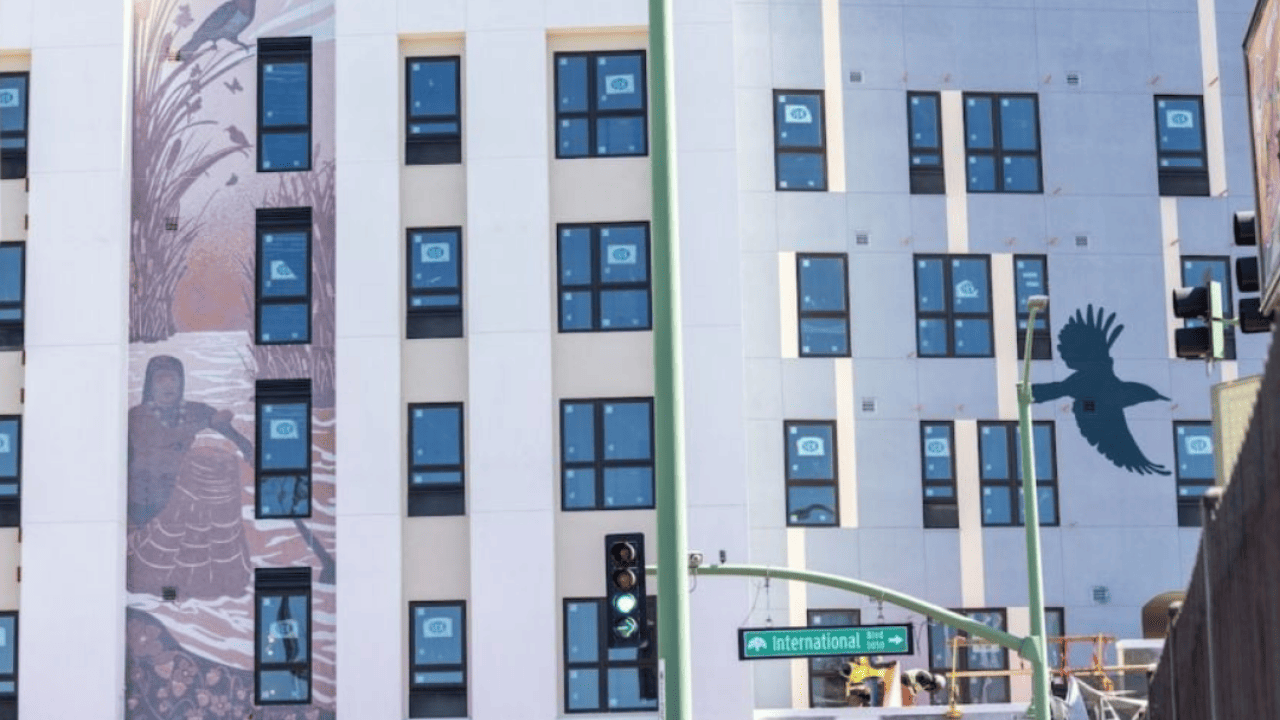
A Native American health center is building housing in the Bay Area. Here’s why.

Kraig Pakulski 0 213 Article rating: No rating

Native American Health Center spearheaded the development of Flicker, a 14,000 square-foot community and clinical facility in Oakland's Fruitvale neighborhood.

Courtesy of the Native American Health Center


Along International Boulevard in Oakland, California, a metal fence surrounds a sealed-off block. There are the typical signs of ongoing construction: skeleton frames, workers and trucks full of supplies rolling in and out of the area. Come next year, however, the dilapidated site will transform into affordable housing units and a dental clinic.

The future five-story building, named Flicker, will have 32,500 square feet of space. The ground floor will feature a cultural community center and a dental clinic with 20 patient rooms. Above, 76 brand new apartments will be built for local families in need. The completed project is expected to bring more than 50 long-term jobs to the community.

It’s an initiative spearheaded by the Native American Health Center (NAHC) in collaboration with Satellite Affordable Housing Associates, a Berkeley-based affordable housing developer. Housing advocates say Flicker’s arrival provides much-needed relief to Oaklanders as the city, and wider Bay Area, grapples with rising income inequality among residents and skyrocketing housing prices.

Chirag Patel, NAHC’s director of planning and development, says many of NAHC’s members who need affordable health care also struggle to find a stable place to live. Oakland is especially in need of more affordable housing options, he told Next City.

“As an Oakland resident, you see tent cities, and all these [housing concerns] happening in the community,” he says. “I see the need out there growing and compounding year after year.”

A rendering of Flicker, currently under construction.

Courtesy of the Native American Health Center

The NAHC is a nonprofit that serves the Bay Area’s Native population and other underserved communities. The region’s population of Indigenous people native to the Bay Area is currently around 18,500, and is projected to grow over the next few decades, according to U.S Census data. The center provides a mix of health, vision, behavioral and dental care for 15,000 members annually across its 17 facilities in Alameda, San Francisco and Contra Costa counties.

In the past few years, the Bay Area has seen real estate prices rise due to high market demand but limited housing options. Residents say they are struggling to afford even the simplest apartments and rental spaces. In Oakland, for instance, city data reveals almost half of all rental households are rent-burdened, meaning they spend more than 30%

Affordable luxury cars for 2026

Kraig Pakulski 0 215 Article rating: No rating

Front view of black Genesis G70 driving on a road in winter with snow and trees in background.

Genesis


Although “affordable luxury car” may seem like an oxymoron, the reality is that there are several appealing vehicles from prestige brands that come in under the average cost of a new vehicle. These are eight of Edmunds’ highly rated affordable cars from luxury brands, each with a starting price of less than $45,000 and each offering a blend of comfort, technology and performance to suit the badges on their hoods.

Affordable luxury cars can be found in a variety of vehicle sizes and body styles, ranging from subcompact sedans to sporty two-door coupes, with at least one hatchback and one midsize four-door providing some added space and practicality, if that’s a priority.

There are also several affordable luxury SUVs, which are covered in this article, if a higher stance and all-weather capability are important to you.

2026 Acura Integra

Although it shares most of its mechanical bits with the Honda Civic hatchback, the Acura Integra sets itself apart from its more plebeian corporate sibling with distinctive styling, impressive cabin materials, and a long list of standard equipment. It’s also the most affordable luxury car on the market today, with a starting price of $34,595 including destination for the base model, which still includes heated seats, keyless entry and push-button start. There’s also an A-Spec with Technology trim level that offers a six-speed manual transmission and a limited-slip differential, all for less than $41,000, which turns the five-door Integra into a worthy athletic follow-up to the sport-compact nameplate.

Starting price: $34,595

2026 Cadillac CT4

Cadillac’s cheapest offering is the CT4, a sporty four-door sedan that splits the difference, size-wise, between the subcompact Audi A3 and BMW 2 Series Gran Coupe and the compact Audi A4 and BMW 3 Series. And yet it’s less expensive than any of them, with a starting price of just over $37,000 with destination and handling. For that cash, the CT4 comes with a reasonably powerful 237-horsepower 2.0-liter turbo-four, and rear-wheel drive and a stiff chassis give it dynamic, enjoyable handling. Just remember that some of its rivals have more interior space despite smaller exterior dimensions, and the Caddy does have some lackluster interior materials.

Starting price: $37,095

2026 BMW 2 Series Gran Coupe

BMW’s entry-level m

25 maintenance stats you need for 2026: Predictive maintenance data, AI trends, and more

Kraig Pakulski 0 226 Article rating: No rating

Two welders with protective masks welding metal, with sparks flying around.

Bogdan VASILESCU // Shutterstock


In this article, MaintainX shares a collection of useful stats and insights about preventive maintenance, predictive analytics, artificial intelligence, and other trends that impact maintenance teams. Additionally, read on to find out what this data says about the year ahead and how you and your team can optimize your maintenance operations.

Key takeaways

  • While downtime incidents are decreasing, downtime costs are rising: Maintenance teams are facing rising cost pressures despite making progress in eliminating reactive maintenance and unplanned downtime, mostly due to aging equipment and parts costs.
  • Preventive maintenance still dominates maintenance strategies … in theory: A majority of maintenance professionals say preventive maintenance is their primary strategy, yet most facilities spend the majority of their time on unplanned maintenance.
  • Predictive maintenance adoption is rising steadily, but still faces obstacles: While predictive maintenance (PdM) adoption is on the rise, its growth is still stalling at many facilities due to costs and internal skills gaps.
  • The use of sensors and IIoT devices is growing: More than a third of maintenance professionals say they use sensors extensively, and more are testing them, creating a need for processes, people, and technology that can act on the asset data collected.
  • AI is crossing the chasm: More than two-thirds of maintenance teams say they will adopt AI by the end of 2026 despite budget, skill, and security barriers.

Maintenance by the numbers: Stats to know for 2026

Maintenance strategy and adoption

  • Preventive maintenance is the most commonly used maintenance strategy among maintenance teams, with 71% of maintenance professionals reporting its use. This is followed by reaction/run to failure (38%), predictive maintenance (27%), condition-based maintenance (18%), and reliability-centered maintenance (16%).
  • 58% of facilities spend less than half their time on scheduled maintenance, while less than 35% spend a majority on preventive maintenance tasks. Predictive maintenance adoption decreased slightly, going from 30% in 2024 to 27% in 2025.
  • Predictive maintenance can reduce maintenance costs up to 25% and increase uptime by 10% to 20%.

Downtime and maintenance costs

  • 74% of maintenance leads reported less or the same amount of unscheduled downtime in 2025.
  • 31% of maintenance and operations managers said downtime costs increased in 2025, while 20% said they decreased.
  • 55% of maintenance professionals said that paying more for parts was the main reason for higher downtime costs.
  • Unplanned equipment downtime alone costs the average Fortune 500 company $2.8 billion every year, which is about Read more

How the One Big Beautiful Bill affects your healthcare

Kraig Pakulski 0 206 Article rating: No rating

A senior woman getting her blood pressure checked using a digital monitor.

Yanya // Shutterstock


On July 4, 2025, President Donald Trump signed into law the budget reconciliation package known as the One Big Beautiful Bill Act (OBBBA). This law makes some of the most significant changes to the U.S. healthcare system in years, and it affects Medicaid, Medicare, Affordable Care Act (ACA) coverage, and employer-sponsored benefits.

Some people may face new rules to keep their health insurance. Others may gain more flexibility through tax-advantaged accounts. Understanding what’s changing — and when — can help you avoid coverage gaps and unexpected healthcare costs, GoodRx, a platform for medication savings, reports.

Key takeaways:

  • The One Big Beautiful Bill Act makes major changes to Medicaid. These include new work requirements, tighter eligibility checks, and new cost-sharing copays.
  • New verification rules will require some Affordable Care Act (ACA) marketplace enrollees to reverify eligibility. Also, repayment caps for excess subsidies will be removed, and the law did not extend enhanced ACA subsidies, which are scheduled to expire after 2025.
  • Several other healthcare changes are also on the horizon. These include more ACA marketplace plans becoming HSA eligible and updates to Medicare drug price negotiation rules.
  • Most changes go into effect from 2026 to 2028.

How does the Big Beautiful Bill affect health insurance?

The OBBBA makes major changes to how people get and keep health insurance, especially through Medicaid and ACA marketplace coverage.

Medicaid is a joint federal-state program that provides free or low-cost health coverage to more than 70 million low-income adults, children, older adults, and people with disabilities. ACA marketplace coverage refers to private health insurance plans purchased through HealthCare.gov or state exchanges. This often includes income-based premium tax credits.

Health policy researchers and federal budget analysts expect that the law’s insurance-related provisions could lead to millions of people losing coverage over the next decade. The biggest impacts are expected to come from new Medicaid work requirements, stricter eligibility and verification rules, and the expiration of enhanced ACA subsidies.

Estimates from the Congressional Budget Office and other health policy researchers suggest the following impacts:

  • Medicaid work requirements. More than 5 million people could lose health insurance by 2034 as a result of new work and reporting requirements.
  • More frequent eligibility checks. About
RSS
First53235324532553265328533053315332Last