Click on the Manage Content for adding and managing content.
Click on the Rotator Settings and choose what and how it will be displayed.

The US issues the most EB-1 visas to professionals from these countries

Kraig Pakulski 0 34 Article rating: No rating

The border of a US visa vignette.

Mehaniq // Shutterstock


Each year, thousands of the world’s highest achievers apply for the EB-1, a U.S. visa category designed for people with extraordinary ability, outstanding researchers, and multinational executives.

Despite its high bar for eligibility, the EB-1 remains a popular Green Card pathway, with the U.S. Citizenship and Immigration Services receiving almost 13,000 initial I-140 petitions each quarter.

That may be because it’s one of the fastest routes available to a Green Card and long-term residency in the United States.

For many applicants, that means skipping years of uncertainty tied to temporary work visas — and moving more quickly toward the stability of permanent status, including the freedom to change jobs, build a company, or plan a future in the U.S. without constantly worrying about renewals. Manifest Law examines data from USCIS and the State Department to examine where the biggest proportions of successful EB-1 visa applicants are from.

Leading professionals from these 10 countries receive the most EB-1 visas

Not every country sends the same number of EB-1 talent to the U.S. The top 10 nations below account for over 68% of EB-1 visa issuances abroad between June 2024 and May 2025, the most recent month for which the State Department has released data.

Mainland China accounts for the majority of new EB-1 visas, outpacing Russia by more than fivefold.

But State Department visa issuances are only one part of the EB-1 process. Its data reflects EB-1 visa stamps issued at U.S. consulates abroad, not the number of EB-1 Form I-140 approvals. U.S. Citizenship and Immigration Services (USCIS) tracks that data instead. And unlike the State Department, they include applications filed by people already living in the U.S.

That’s why USCIS’s data tells a different story. Each year, India takes the No. 1 spot of approved Form I-140s, with mainland China following closely behind. Last year was no different.

What the EB-1 data shows

Manifest principal attorney Nicole Gunara says the discrepancy between these two agencies’ data sets isn’t surprising. That’s because many Indian nationals enter the U.S. on a nonimmigrant visa, with the H-1B being especially popular. “In fiscal year 2024 alone, 71% of H-1B visa approvals came from India,” she says. “That could be why they’re not showing up in the State Department’s data. As long as they remain in valid status, an Indian H-1B worker can apply for an EB-1 Green Card within the U.S.”

Gunara says another possible explanation could be due to increased scrutiny from the State Department. “There’s no official document source that says mainland Chinese nationals categorically cannot get a nonimmigrant visa as easily as other people, but there are policy trends that suggest they face additional administrative hurdles,” she says. “That can deter someone from applying for a nonimmigrant visa before filing an EB-1 petition.”

Socioeconomic factors may also play a factor as to why so many Chinese nationals qualify for the EB-1 — particularly under the EB-1B “outstanding professor and

Why Utah’s Silicon Slopes hiring feels like it’s at a standstill: ‘It’s taking a toll.’

Kraig Pakulski 0 27 Article rating: No rating

Various office building that make up Silicon Slopes are seen in Lehi on Friday, January 23, 2026.

Bethany Baker // The Salt Lake Tribune


Cody Scott’s foray into the tech sector began at Snow College, where the then-football player and some of his friends built an app to help fellow students find events and parties. The startup went on to get early accolades, and it planted a seed for Scott.

He found he was good at this type of work, designing software and products for real people, “being very empathetic to the problems that the user’s facing.”

He knows it sounds “cheesy,” but he started to see tech as a relatively quick way to earn a high salary, support his family and achieve the American dream.

“As long as you have the skillset and you understand how to work within that culture, you can sort of climb the ladder,” he said, “which is what I’ve been doing.”

As he jumped to different tech jobs over the years, his income provided everything for his wife and their two kids, he said.

Until November 2024, when Scott lost his remote job as a senior product designer and spent more than a year searching for another. His wife, who was studying nursing, had to get a job. They had to work with their mortgage lender to pause payments so they didn’t lose their home.

“We were OK,“ he said, “but we were literally just scraping by throughout the whole year.”

Cody Scott, who recently found work after losing his job last year, stands for a portrait in Silicon Slopes in Lehi on Friday, January 23, 2026.

Bethany Baker // The Salt Lake Tribune

It’s not just Scott. Many others told The Salt Lake Tribune a similar story — filing job application after job application, seemingly into the void. 

Hiring and job growth are slowing nationwide as economic uncertainty remains high, and the national unemployment rate increased to around 4.4%, according to the most recent U.S. Bureau of Labor Statistics report, up a tenth of a percentage point from November. Utah’s is lower at 3.6%, but still up from a year ago.

The tech industry has been hit particularly hard, all as artificial intelligence proliferates and the torrent of investments that once flooded the field have slowed with higher interest rates. 

A data graph of the U.S. Econo</div>
	<div class=Read more

Why one geologist thinks we should all pay more attention to rocks

Kraig Pakulski 0 25 Article rating: No rating

Close up of a migmatite boulder of the Natal-Namaqua metamorphic belt.

Marieke Peche // Shutterstock


Marcia Bjornerud loves rocks. Not just under a petrographic microscope, but as animated entities with properties and personalities born from their long, eventful lives. “I’ve reached a point in my career where I’m not going to hold back from talking about rocks in an affectionate way,” she said.

Bjornerud, a professor of geology at Lawrence University in Wisconsin, has spent years studying the intricate processes that shape our planet and its deep history. From the smallest grains of metamorphic rock to tectonic plates that span continents, she argues we have much to gain from better understanding the building blocks of the place we call home. It’s why she wrote her newest book, “Turning to Stone,” which examines the ways in which rocks keep the planet functioning. The book is, in many ways, a love letter to rocks—and to the possibility of reconnecting with Earth’s deep wisdom. Rocks, she says, are storytellers, archivists that hold clues to Earth’s histories. Understanding their narratives could inspire us to act with both the patience and foresight that life on this planet demands.

Never has this been more urgent. The climate crisis is fuelled by our misconception that we exist apart from nature, that we dominate it rather than belong to it. But understanding our place within Earth’s long and intricate history could shift this perspective, argues Bjornerud in her earlier book “Timefulness.” In an age of short-term thinking and quick-fix solutions, Bjornerud posits that contextualizing our existence within geological time, which spans billions of years, offers both perspective and hope.

Here, Bjornerud speaks with Atmos about the scale—and wonder—of Earth’s foundations, the spiritual costs of binary thinking, and why time literacy is essential for creating an equitable climate future.

Daphne Chouliaraki Milner:

How can the study of geology help us appreciate the interconnectedness of micro and macro systems on Earth?

Marcia Bjornerud:

Having taught geosciences for more than 30 years, I’ve realized that the most essential thing we can teach our students is the capacity to zoom in and out of scales in time and space, to look at a rock sample under the microscope and make inductive inferences on a regional scale. The geologic mindset requires this polyfocal capacity because all Earth systems are operating at these scales, too. Feeling comfortable traveling back and forth across scales is really central to the geologic worldview.

DCM: I love the word “polyfocal” because it also accurately describes the work that we’re trying to do at Atmos. Climate storytelling has for so long been restricted to one focus, but to fully understand the climate crisis, we need to nurture intersectional, polyfocal thinking. What’s an example of a seemingly small geological process that has a profound macroscale impact on our planet?

MB: Microbes are in charge of global biogeochemistry. The Earth is, in many ways, a microcracy. It’s ruled by the very tiny. We, macroscopic creatures, think we’re the top of the food chain. But the reality

Fear over farmland loss is slowing renewable energy development in rural areas

Kraig Pakulski 0 29 Article rating: No rating

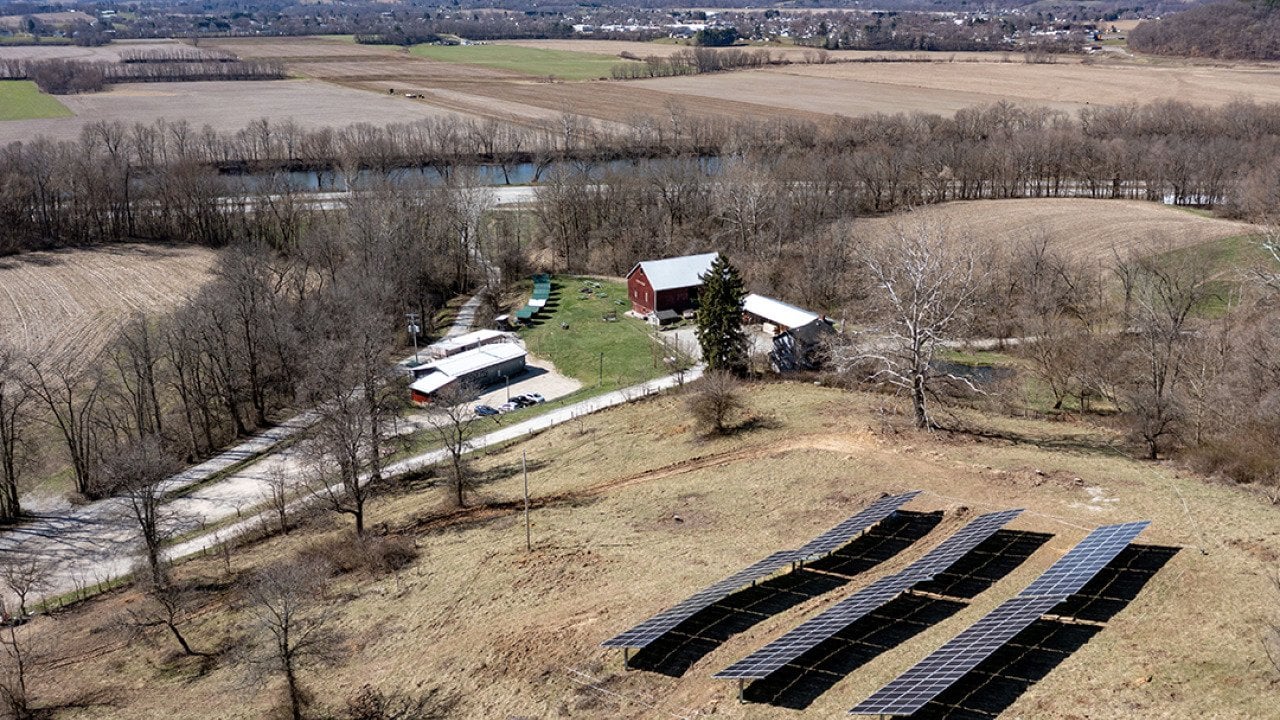
Solar panels at the Wooly Pig Farm Brewery in Fresno, Ohio.

Jim West // UCG / Universal Images Group via Getty Images


When Chad Raines took over his family’s Texas cotton farm in 2008, he thought the going would be easy. That’s because their first year was relatively profitable — but the success was short-lived.

“The next 11 years was just loss after loss after loss,” Raines said in a Daily Yonder interview. “We just kept digging our hole deeper.” Raines soon began to question whether he should continue running the farm, or pivot to something else.

Then came a third option, one in the form of solar panels and sheep: a type of farming called agrivoltaics. Now, he raises 3,000 head of sheep on about 8,000 acres throughout west Texas, and all under solar panels.

Raines is contracted by the solar companies to graze his sheep under their panels, keeping the vegetation short and feeding his sheep at the same time. He is one of a growing number of farmers leasing out their own land to renewable energy companies or grazing livestock on land already in use for solar or wind.

Scientists say widespread renewable energy development — the vast majority of which will be located in rural America — plays a key part in decreasing the country’s carbon emissions, but pushback from the Trump administration has stalled progress on many solar and wind projects.

In August of 2025, the U.S. Department of Agriculture (USDA) ended funding to loan programs that supported solar projects on farmland. The agency pointed to rising farmland prices as its primary reason for shutting down these projects.

“Our prime farmland should not be wasted and replaced with green new deal subsidized solar panels,” said Secretary of Agriculture Brooke Rollins in a press release. The USDA defines prime farmland as land with the “best combination of physical and chemical characteristics for producing food, feed, forage, fiber, and oilseed crops.” These characteristics include a region’s growing season, soil properties, and water supply.

“Subsidized solar farms have made it more difficult for farmers to access farmland by making it more expensive and less available,” Rollins said.

Whether this claim is true is up for debate. Land use experts say the real threat to farmland is urban sprawl into rural areas, not solar development.

“Thousands of acres [of farmland] are going to [urban development], and that’s completely taking it out of commission,” said Jeff Risley, executive director of a new organization called the Renewable Energy Farmers of America. The group helps farmers negotiate land leases with solar and wind companies.

Once an area is turned from farmland into parking lots or apartment buildings, the likelihood of it returning to agricultural land is extremely low. “Solar and wind, it’s a 30 to 40 year commitment, but it can also go back to agriculture land at the end of that time,

How to ensure data security with online registration software

Kraig Pakulski 0 28 Article rating: No rating

A user filling out the personal information part of an online survey using a smartphone.

Tero Vesalainen // Shutterstock


If your company handles registrant data in any way, you need robust practices in place to ensure sensitive and personal information is protected. From automated reporting to integrated payment processing, numerous features of online registration software help secure your registrants’ data.

This guide from Regpack explores how you can ensure data security with online registration software, covering what makes data security important, ways to leverage registration software for ultimate data protection, and more.

Why Is Data Security Important for Registration?

For any company that receives, stores, or utilizes customer data, it is imperative that data security protocols are in place. Data breaches can pose a range of common security threats to registration systems, impacting both your company and registrants, including financial losses, severe reputational damage, and a loss of consumer trust.

Here’s why ensuring data security is paramount.

An infographic listing reasons why data security is important for registration.

Regpack

Protect Sensitive Client Information

Data security protocols aim to protect the sensitive information of your registrants and customers, including personally identifiable information (PII), financial data, biometric data, business-sensitive data, and personal attributes information.

Online registration software should integrate security measures that can help you protect sensitive information and:

  • Prevent identity theft: Many registration forms require personal and personally identifiable information, which, when accessible to cybercriminals, can be used to commit identity theft. Identity theft can cause significant financial and emotional issues for your registrants.
  • Reduce the risk of financial fraud: When registrants share their card details and financial information through your online forms, their data must be comprehensively protected to avoid unauthorized transactions.
  • Limit emotional distress: When inadequately protected, clients’ sensitive information can be used in ways that cause stress and impact their emotional well-being.
  • Build trust: If your organization can effectively protect client information, you are more likely to build trust with your consumers and foster lasting relationships.

Comply With Legal and Regulatory Requirements

If your company deals with personal or sensitive data in any way, yo

RSS
First29622963296429652967296929702971Last