
Click on the Manage Content for adding and managing content.
Click on the Rotator Settings and choose what and how it will be displayed.

Survey: Why Americans say their health improved significantly in 2025

Kraig Pakulski 0 82 Article rating: No rating

A sporty young man standing outdoors with hands on hips, smiling after an exercise.

TetianaKtv // Shutterstock


For those who vowed to be healthier in 2025, there’s reason to celebrate, according to the results of a recent Hims study. The survey asked Americans how healthy they consider themselves to be, and 64 percent answered that they felt “healthy” (a 4 or 5 on a 5-point scale), up from 58 percent at the start of the year. Furthermore, “healthy” is now the number-two word Americans use to describe themselves, up from number six in January.

Notably, the word “healthy” increased two to three times more than other words that also saw an uptick. For example, “attractive” gained three percentage points, and “happy” gained two percentage points, as compared to “healthy,” which gained six percentage points.

The Top Words Americans Use to Describe Themselves in 2025

In January of 2025, the survey asked Americans how accurately 25 words — including “happy,” “patriotic,” “lonely,” and more — described them. In August, Hims checked back in. “Healthy” was one of the few words that saw a significant uptick at the end of the eight-month testing period.

Below, check out the top 10 words Americans say describe them in January versus August.

Q: On a scale of 1 to 5, where 1 is “Not at all me,” and 5 is “Very much me,” how much do you feel each of the following words describes you, personally?

Results reflect the percentage of people who answered either 4 (describes me) or 5 (very much describes me) on a 5-point scale.
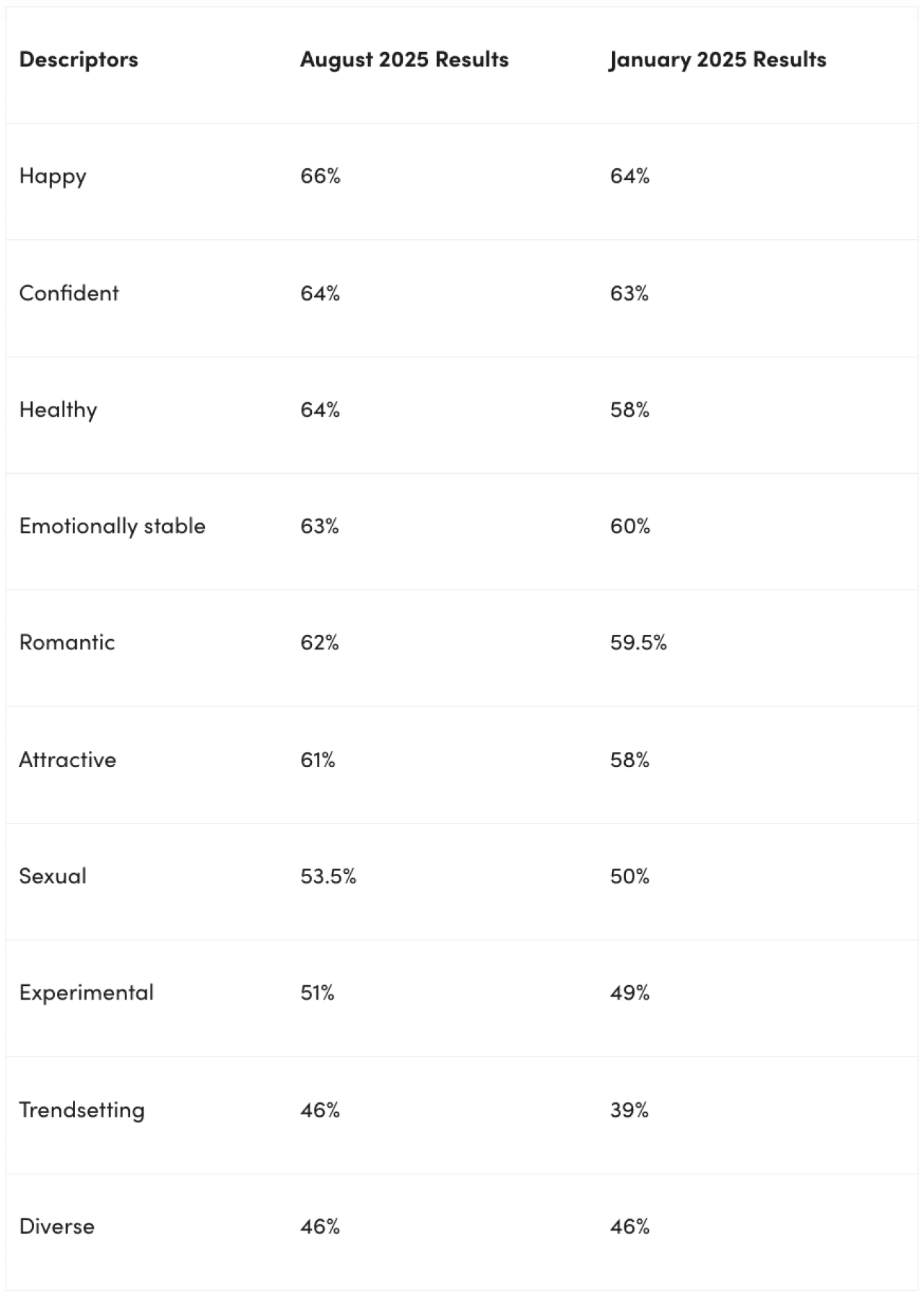
A table listing descriptors and the percentage of people who agreed it describes them.

Hims

Americans Are Prioritizing Mental Health And Sleep

While it’s difficult to say exactly what has bolstered Americans’ perceptions of their own health, some answers may lie in their health priorities. For example, 30 percent of Americans say they are focusing on their mental health — up from 23 percent in January — making it the country’s top health priority. This heightened focus on mental health not only includes therapy and prescription medications but also participating in hobbies that alleviate stress. To that end, 69 percent of respondents report they’ve taken up a new hobby this year to improve their mental health or alleviate stress. Top stress-reducing hobbies, according to survey results, include listening to music (41 percent), walking (37 percent), cooking (28 percent), gaming (24 percent), and reading (23 percent).

Americans are also prioritizing more and better sleep. For 27 percent of respondents in the latter half of 2025, it was a goal to “sleep more,” compared to 17 percent who indicated the same at the start of the year. “Sleeping more” also ranked as the number three way Americans believe they can increase their lifespan, according t

9 strategies to use when negotiating contracts with vendors

Kraig Pakulski 0 63 Article rating: No rating

Three business people sit at a table. One smiling person shakes hands with another person, who is mostly out of view.

PeopleImages // Shutterstock


How would you sum up your vendor negotiations today? Are these negotiations bringing you added value, or are they leaving untapped potential on the table? Asking these critical questions can define your company’s competitive edge in an era where vendor management mastery is paramount.

Despite the clear link between negotiation prowess and financial performance, a concerning trend persists. Many organizations continue to view vendor negotiations through an outdated, adversarial lens, fixating on price reductions at the expense of broader value creation. This myopic approach not only leaves money on the table but also squanders opportunities for innovation, quality improvements, and strategic partnerships.

So, what distinguishes the elite vendor negotiators from the rank and file? How can you elevate your strategies from merely effective to truly transformative? And how do you flip a well-negotiated contract into a dynamic, mutually beneficial relationship that drives ongoing success?

In this article, Brex explores these questions and more, offering a comprehensive guide to the art and science of vendor negotiation. From laying a strong foundation and employing advanced negotiation tactics to managing post-negotiation relationships and overcoming common hurdles, these insights can elevate your vendor management strategy. Whether you’re a procurement veteran or new to the field, prepare to challenge your assumptions and adjust how you negotiate with vendors.

What is vendor negotiation?

Vendor negotiation is the process of discussing and reaching agreements with suppliers to establish mutually beneficial business relationships. It goes beyond just price haggling; it’s a strategic process that helps establish terms, conditions, and expectations for products or services. Effective vendor negotiation requires thorough preparation, clear communication, and a calculated approach to demonstrate value as a client. The goal is to transform potentially transactional encounters into collaborative problem-solving sessions, creating partnerships that can lead to favorable contract terms, improved service quality, and long-term business advantages.

The importance of a strong start in vendor negotiation

You really never get a second chance to make a first impression. In the intricate dance of business relationships, the opening moves often set the tone for the rest of the performance. Getting off to a strong start in your vendor negotiations isn’t just beneficial, it’s critical. But what does a “strong start” really mean in this context, and why does it matter so much? It’s about establishing a foundation of mutual respect and understanding from the opening bell. It’s about demonstrating early and often that you’re not just another client, but a potential partner who brings value to their business as well. This approach can shift the dynamics of your negotiations, heading off any potentially adversarial encounters and setting the stage for more of a collaborative problem-solving session.

A strong start in vendor negotiation is fundamentally about

How gas prices have changed in the U.S. in the last week Dec. 22, 2025

Kraig Pakulski 0 78 Article rating: No rating

Istvan Csak // Shutterstock


CheapInsurance.com compiled statistics on gas prices in the U.S. using data from AAA. Gas prices are current as of December 22.

U.S. by the numbers
– Gas current price: $2.85
– Week change: -$0.05 (-1.8%)
– Year change: -$0.19 (-6.1%)
– Historical expensive gas price: $5.02 (6/14/22)

– Diesel current price: $3.59
– Week change: -$0.04 (-1.2%)
– Year change: +$0.08 (+2.3%)
– Historical expensive diesel price: $5.82 (6/19/22)

Metros with the least expensive gas
#1. Amarillo, TX: $2.15
#2. Lubbock, TX: $2.16
#3. Casper, WY: $2.16

Read on to see which metros have the most expensive gas prices.

Elen Nika // Shutterstock

#5. San Luis Obispo-Atascadero-Paso Robles, CA

– Regular gas price: $4.48

Daniel Avram // Shutterstock

#4. San Diego, CA

– Regular gas price: $4.51

Rangsarit Chaiyakun // Shutterstock

#3. Napa, CA

– Regular gas price: $4.51

jittawit21 // Shutterstock

#2. Hilo, HI

– Regular gas price: $4.63

Christian Mueller // Shutterstock

#1. Lihue (Kauai), HI

– Regular gas price: $4.96

This story was produced by CheapInsurance.com and reviewed and distributed by Stacker.

The post How gas prices have changed in the U.S. in the last week Dec. 22, 2025 appeared first on News Channel 3-12.

Respectful dating due diligence: 10 quick checks to do before you meet IRL

Kraig Pakulski 0 70 Article rating: No rating

Two people sitting across from each other at a table in a cafe with water, a piece of cake, a mug in front of them. Just one person's smiling face is partially in view.

Rawpixel.com // Shutterstock


Meeting someone new for the first time can be an exciting experience but also a nerve-racking one. In the digital age, where many connections first begin online, a bit of premeet verification has become a matter of both common sense and common courtesy. Despite common belief, taking the time to research someone before meeting in real life is not about distrusting the other person. It’s about ensuring that all parties feel safe, confident, and genuinely ready to enjoy a date.

Spokeo assembled 10 premeet checklist items developed by reviewing data from Rape, Abuse & Incest National Network, Business Insider, and other top sources to ensure you stay safe while having fun.

Premeet checklist

Staying safe when meeting a new person requires both due diligence and communication, two focus areas aided by the following 10 tips:

1. Start with social media verification (3-5 days before)

Before the first date, it’s perfectly acceptable to do a quick social media scan to confirm whether the person you’re chatting with matches who they say they are. When looking across different platforms—including Instagram, Facebook, X, and even LinkedIn—try to find consistent details such as names, photos, and mutual connections that verify what you already know.

This step can not only help you feel more confident but also give you a chance to spot potential red flags. Try not to snoop too far and stick to just verifying the basics to give yourself peace of mind.

2. Request a brief video or phone call (2-3 days before)

Scheduling a short video chat ahead of a meetup is an easy and effective way to confirm a person’s authenticity, as well as gauge your chemistry with them. This natural step is something that most people welcome, as it typically takes no longer than five minutes. Aim to keep it casual to confirm that your match is genuine and to get a quick read on their energy.

3. Ask for their last name (if not already shared)

Exchanging last names before a first meetup is normal, not nosy, yet it’s a step many people fail to take. Even though you may be able to find it on your own by researching, asking shows strong communication and will allow you to confirm their identity with more certainty. You can keep things simple with a light, “By the way, I just realized I haven’t caught your last name yet. What is it?” If someone seems hesitant to share their last name even after meaningful conversations, it could be a sign to pause.

4. Confirm the venue and time (the day before)

The day before your date, send a brief message confirming both the time and place. This polite follow-up message will allow the other person to see your enthusiasm while also remaining confident that you aren’t going to ghost them. It also gives both of you the opportunity to adjust the plan if something unexpected happens at the last minute.

5. Share your plans with someone you trust (

A tiny land deal with giant implications

Kraig Pakulski 0 71 Article rating: No rating

An aerial view of Brian Head ski resort in winter on a clear day.

Norm Diver // Shutterstock


On Dec. 15, the Senate Committee on Energy and Natural Resources scheduled 15 bills for markup, the final stage for making amendments before voting on advancing a bill to the full Senate. Included in that slate is a modest-sounding proposal introduced last May called the Brian Head Town Land Conveyance Act.

The bill, introduced by Utah Sens. Mike Lee (R) and John Curtis (R), would transfer roughly 24 acres of the Dixie National Forest to a small Utah town with an ambitious plan for growth. “Brian Head is poised to become the next great Western ski town,” Sen. Curtis said in a news release last spring. “This bill gives local officials the tools they need—free from federal red tape—to meet their community’s growing needs.”

On paper, the bill is narrow (it weighs in at just 274 words), technical, and local—the kind of housekeeping legislation that might typically move quietly through Congress. Supporters describe the proposal as pragmatic. Brian Head (population: 151), they argue, needs land to support basic municipal services as it grows. Land transfers aren’t that uncommon, either. The Bureau of Land Management disposes of a few thousand to tens of thousands of acres every year. This parcel is much smaller than that, isolated, and of limited federal management value. From this perspective, continued federal ownership of the land surrounding Brian Head is inefficient, and local control is simply common sense.

But according to Re:Public, while the amount of land in question may be small, the implications of this bill reach well beyond the boundaries of a small Utah town. Most notably, the bill directs the U.S. Forest Service to convey the land to Brian Head at no cost. That represents a radical departure from typical federal land transfers, which normally require payment, a land exchange of equal value, or, at the very least, an administrative process that includes environmental review and public input. None of those guardrails are in place with this bill. By legislating the transfer outright, Lee and Curtis are effectively short-circuiting debate and denying compensation to American taxpayers.

A more normal land transfer would also require the parcel to be used by the town for a specific purpose, using what’s known as a “reversionary clause” to enforce the mandate. If the land isn’t used for the specific purpose outlined in the transfer agreement—a town water treatment facility, say, or a parking lot—the reversionary clause would ensure ownership of the land reverts back to the federal government.

But there’s no reversionary clause in play here. The Brian Head bill doesn’t even demand that the town use the gifted land for a public works project. Rather, it states that the land is “to be used by the Town for a public works facility or any other uses determined to be necessary by the Town.” As critics point out, without requiring a specific use, the town of Brian He

RSS
First41594160416141624164416641674168Last