Click on the Manage Content for adding and managing content.
Click on the Rotator Settings and choose what and how it will be displayed.

The ringtone throwback: Embrace 2000s nostalgia without letting your phone ruin the holidays

Kraig Pakulski 0 57 Article rating: No rating

A retro Nokia 3410 mobile phone in someone's hand with the settings menu open.

zelvan // Shutterstock


The holidays are full of sights, sounds, and scents that can evoke strong memories, from stringing lights up with the family to hearing the faint tune of “Jingle Bells.” As travel days and family dinners begin to stack up this holiday season, the last thing you want is to be pulled out of your nostalgia by the harsh ping and buzz of a modern phone. PeopleWin has put together this list of classic 2000s ringtones, along with some tips to maximize family time, so you’re sure to stay in the holiday mood this season.

Iconic 2000s ringtones

When it comes to the holidays, few ringtones evoke as many memories as some classic options from the 2000s.

1. The Nokia tune (‘Grande Valse’)

This instantly recognizable little melody comes from an excerpt from Spanish guitarist and composer Francisco Tárrega’s 1902 piece “Gran Vals,” as outlined by the popular radio station ClassicFM. Specifically, the ringtone portion comes from bars 13-16. First bundled with a Nokia handset back in 1994, this ringtone went global as the sound of a mobile phone. Today, it may cause you to reminisce on that playful and nostalgic era.

2. iPhone marimba (the original)

For many who had the first iPhone, the ringtone is instantly recognizable. The classic “marimba” default tone quickly became a part of mainstream culture. While Apple never officially credited a composer, one theory, as outlined by HowStuffWorks, posits it was produced by Apple’s in-house sound team through GarageBand. Setting this as your holiday notification can bring about a smile of recognition to many.

3. Polyphonic holiday carols (‘Deck the Halls,’ ‘Jingle Bells’)

Back in the early 2000s, before smartphones ruled, many phones offered polyphonic renditions of popular songs such as “Deck the Halls” or “Jingle Bells.” Using a simple holiday carol as your notification sound this season can be a festive twist, especially if you pair it with a ringtone that clearly begs attention but also stays on the seasonal and lighthearted side.

4. The Nextel chirp (push-to-talk)

Anyone who used a Nextel or older PTT phone remembers the distinct chirp sound of a call beginning. While the exact tone can be hard to find, recreating a short slide-chirp or buzzer-style sound can be a fun reference to the era. This nod to nostalgia will be unlikely to feel intrusive when used as a less frequent alert, allowing you to enjoy others’ company while remembering the good times.

5. Custom contact ringtones (know who’s calling before you look)

One modern upgrade to consider this holiday season is to assign specific ringtones to your most important contacts. This way, even if you silence your phone during dinner, you’ll know right away if someone important is calling if you have the breakthrough feature enabled. The tone you choose can still carry one of your nostalgic ringtones

7 of the biggest threats to small businesses in 2026 (and how to avoid them)

Kraig Pakulski 0 83 Article rating: No rating

Two business people engaged in a discussion.

Ground Picture // Shutterstock


Running a small business has its fair share of risks. To help owners and entrepreneurs understand emerging threats in 2026 and how to prepare, NEXT compiled a list with insights from experts in claims, underwriting, AI and insurance products.

This article identifies the biggest challenges you need to watch out for, what types of businesses will be most affected and the practical steps you can take right now to protect your business.

1. AI misuse and lack of governance could increase your exposure

Businesses most likely to be affected by AI risks:

  • Any business that uses AI tools to produce client-facing work
  • Businesses using AI for marketing content
  • Businesses using AI tools for proposals or quoting
  • Consultants producing deliverables or advice
  • Professional services including accountants, lawyers, IT consultants, software developers and creative professionals

This is perhaps the singular biggest blind spot of 2026: Small businesses using AI tools without governance could lead to wrong client deliverables, privacy breaches and IP leakage.

There’s no doubt that AI is helping small businesses move faster — creating marketing materials, generating invoices, interpreting data and more. But without proper oversight or controls, these tools can introduce serious risk that can lead to client disputes, reputational harm and financial loss.

“AI can be incredibly helpful, but you still need strong review processes in place to make sure its outputs are accurate, secure and aligned with what your customers expect, or you risk costly losses,” says Julie Roseland, head of commercial liability claims at NEXT.

“As more small businesses turn to generative AI for things like ads, social media posts and other content, we’ll see new vulnerabilities emerge in 2026. When those tools produce material that isn’t fully reviewed, the risk of defamation, copyright infringement, false advertising or other misrepresentations increases.”

And don’t make the mistake of thinking AI risk is limited to tech-forward companies like software developers or marketing consultants. Imagine a construction firm sending proposals, retail businesses generating automated responses to customers or restaurants using AI tools to create promotional content.

Any company that uses generative AI to draft emails, reports, invoices, marketing content or customer communications can inadvertently push out incorrect, harmful or copyrighted material.

How small businesses can mitigate AI risks and liability:

  • Train employees on privacy and data handling
  • Require human review on all AI-generated content (including review by licensed or credentialed professionals when possible)
  • Review client agreements for liability language
  • Add professional liability insurance to help protect your business from some of the costs of professional errors

2. Cyber incidents could cau

Utah's 2034 Olympics has a new — and controversial — logo

Kraig Pakulski 0 89 Article rating: No rating

A crowd watches as organizers reveal a new name and logo — Utah 2034 — at Salt Lake City International Airport, as they count down les than 3,000 days until the Olympic Winter Games return to Utah.

Francisco Kjolseth // The Salt Lake Tribune


On a Monday, Gov. Spencer Cox stood in front of a crowd at the Salt Lake International Airport as Olympic officials unveiled both the official name and the transitional logo for the 2034 Winter Games. By Tuesday morning, the governor was standing in front of a room full of reporters and joking that the Utah 2034 logo had already fulfilled its purpose.

“It’s really brought people together,” he said, “because everyone seems to not like it.”

The logo has been controversial at best, widely panned at worst. It’s designed with a blocky font that mimics shapes found in Utah’s landscape — the most obvious of which is the “A” that replicates the contour of Delicate Arch. Commenters on social media sites and news articles have quipped it’s the same font used in CAPTCHAs or their fourth-grade book reports. Others complain it’s ugly or simply difficult to read.

To which its designers say: Try looking at it through a different pair of eyes.

The creators of the Utah 2034 transitional logo conferred with athletes with vision disabilities to, they say, make it as impactful as possible for as many people as possible in as many places as possible. They’ve created a piece that they say reflects the local Olympic and Paralympic committee’s whole-state approach to the 2034 Winter Games. And, they’ve done it all while working within the strict parameters set by the International Olympic Committee for transitional logos — which, in and of themselves, are fairly new.

Plus, noted Nate Morley, the lead designer, it’s art. It’s meant to be provocative.

“Art is subjective. And some people like things, and some people don’t like things. And that’s totally to be expected, and we certainly appreciate that,” Morley, a Utahn whose company, Works Collective, also designed the LA28 Olympic logo, told The Salt Lake Tribune. “I think the intent is to learn kind of why the logo looks the way it looks — what it’s meant to represent — and build that.”

The shape inside the zero, for instance, is evocative of a pictograph, according to a website local Olympic organizers launched to explain the controversial wordmark. The curves of the number two mimic those of a winding mountain road. When stacked, its letters and numbers form a checkerboard pattern reminiscent of Utah’s street grids.

Yet the design goes even deeper than that, said Danelle Umstead, an athlete with low vision.

“Every Olympic logo gets backlash,” Umstead, a four-time Paralympian, said in a text. “People forget that logos aren’t created to be trendy — they’re designed to be recognizable for decades, across stadiums, uniforms, merchandise, tiny smartphone screens, and global broadcasts.

“A lot of the early criticism focused on aesthetics alone, without understanding that accessibility was part of the design story.”

And that is a process into whi

4 scam trends consumers must watch going into 2026 (and how to stay ahead of them)

Kraig Pakulski 0 90 Article rating: No rating

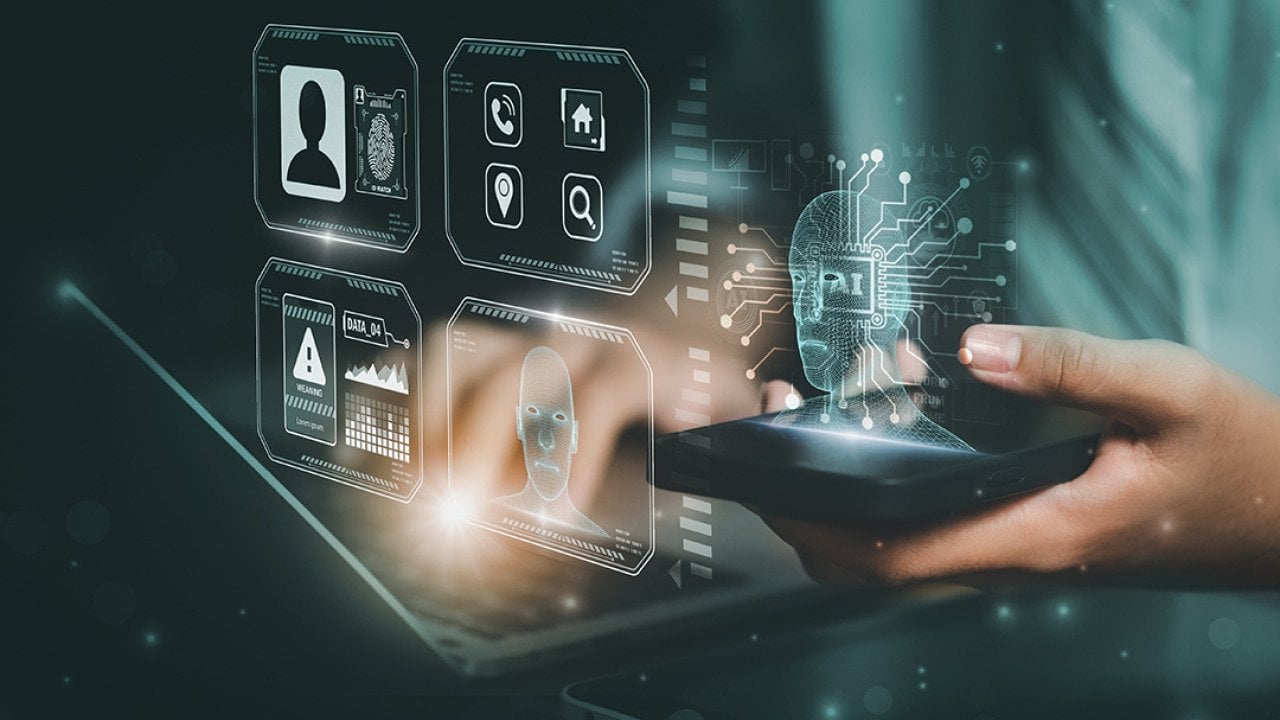
AI and facial recognition graphics illustrated over a person using a laptop and smartphone.

ART STOCK CREATIVE // Shutterstock


In America, fraud is no longer a static threat. It has instead become an evolving ecosystem, continually powered by artificial intelligence, automation, and an ever-expanding digital footprint. Consumers have spent much of the past decade reacting to the latest scam of the month, whether that be a phishing text, bogus charges, or something else. However, with 2026 on the horizon, scams are set to become more adaptive, personalized, and embedded in the very systems we rely on daily.

Forward-looking insight has never been more important. By identifying the next wave of fraud before it reaches its full scale, consumers can start to operate from a place of anticipation rather than damage control. Lifeguard has analyzed the top trends across cybersecurity and early-warning research to compile four prominent emerging fraud trends to help you get ahead of the new year’s most dangerous threats.

Four emerging fraud trends

To navigate 2026 safely, it helps to know what’s coming. Here are four fraud and scam trends that are already shaping up to be a part of the next generation of threats:

1. AI “fraud agents” and the hyper-personalized deepfake

Generative AI is no longer just a science fiction concept. Deepfakes and attacks using synthetic documents are expected to surge drastically as cybercriminals continue to learn how to twist artificial intelligence to their advantage. This allows fraudsters to generate convincing voice, video, and document forgeries that impersonate communications from loved ones, colleagues, institutions, and more, making traditional trust signals unreliable.

As outlined by Finra, a nonprofit composed of industry and public regulators, effective strategies to combat generative AI include using biometric verification, enabling multi-factor authentication, and using identity-theft protection services.

2. Synthetic identity fraud: The “Frankenstein” profile

Rather than stealing an existing person’s identity, fraudsters are beginning to create synthetic identities. These aliases merge real social security numbers or personal information about individuals with fabricated names, addresses, and credentials. According to TransUnion’s 2025 fraud report, which analyzes leading fraud trends across the globe, identity-data exposure is shifting more towards quality over quantity. This makes synthetic identities more effective.

Fake identities can quietly damage your credit or open accounts in your name. What’s new (and dangerous)is the fact that these false identities can tie back, in part, to your real data. This means that real-world damage can surface years later. To be proactive, monitor your credit report and freeze all household credit at the first sign of any type of misuse.

3. The “roach motel” subscription and data trap
The most dangerous time to drive in every state

Kraig Pakulski 0 62 Article rating: No rating

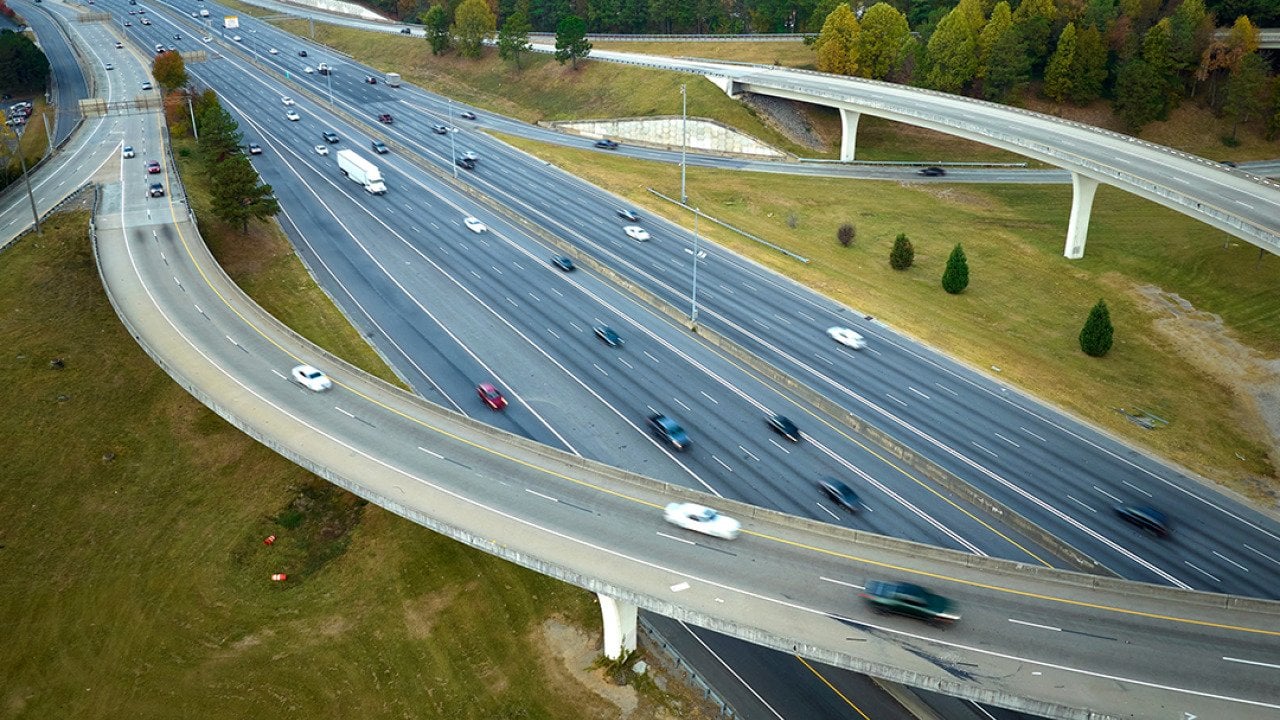
An aerial view of an American freeway intersection with fast moving trucks and cars.

Bilanol // Shutterstock


In 2023, roughly one-third of all U.S. traffic fatalities (33%) happened between 3 p.m. and 9 p.m., with the single deadliest three-hour block from 6 p.m. to 9 p.m. (18% of all deaths). Those hours straddle the evening commute, when roads are crowded, daylight fades, and impairment risks rise. That pattern shows up year after year in federal crash data.

Traffic deaths nationwide have risen sharply over the past several years, even as overall vehicle miles traveled have fluctuated. While weather, road design, and vehicle safety technology all play a role, federal crash records show that the time of day is one of the strongest predictors of fatal risk on the road. And that the riskiest hour varies significantly by state.

The following analysis, conducted by THE702FIRM Injury Attorneys, a personal injury law firm based in Nevada, uses data from the National Safety Council and National Highway Traffic Safety Administration’s Fatality Analysis Reporting System (FARS) to identify when fatal crashes are most likely to occur across the country, and which states see the highest concentration of deadly collisions during night, rush hour, and weekend periods.
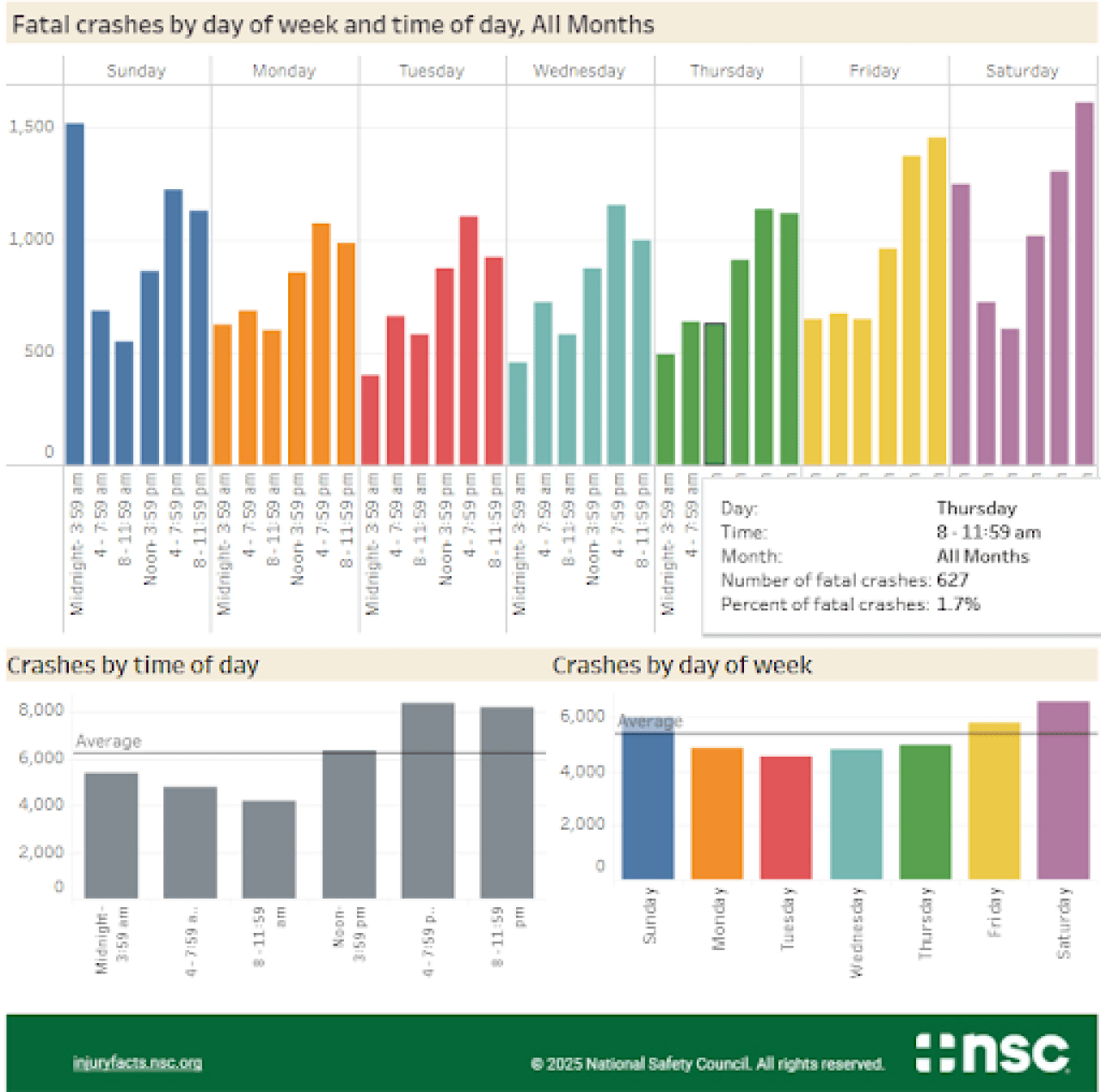
A data graphic showing fatal crashes by date of week and time of date for all months in 2025.

National Safety Council

Evening hours are the deadliest nationwide

Fatal crashes in the U.S. are most likely to occur in the early evening, with the 4 p.m. to 7:59 p.m. time block recording the highest death totals across every day of the week, National Safety Council data shows. The period coincides with the end of the workday, heavier traffic on major routes, and the start of evening social activity.

Risk remains elevated into the night. Crashes between 8 p.m. and 11:59 p.m. make up the next-highest share of fatalities, even though overall traffic volume drops. Reduced visibility, faster travel speeds on open roads, and a higher proportion of impaired drivers are key factors.

Fridays and Saturdays show the sharpest increases, reflecting the overlap of weekend travel and nighttime recreation.

Per state breakdown of peak crash times

Analysis of the National Highway Traffic Safety Administration’s time-of-day crash dataset shows 6 p.m. to 9 p.m. as the deadliest three-hour window, but state-level patterns are not uniform. In some states, the peak shifts earlier into the late-afternoon commut

RSS
First41604161416241634165416741684169Last