
Santa Barbara County News and Events

San Luis Obispo Police investigating suspicious death as potential homicide

Kraig Pakulski 0 24 Article rating: No rating

SAN LUIS OBISPO, Calif. (KEYT) – San Luis Obispo Police are investigating a suspicious death as a potential homicide after further analysis.

SLOPD officers found Veronica Beatrice Baro, 50, a transient woman in the city, dead in a homeless encampment Feb. 12 near San Luis Obispo Creek behind the Chevron at Calle Joaquin and Los Osos Valley Road.

SLOPD found Baro's body at an advanced stage of decomposition and secured the area before SLO County Sheriff's and Coroner's Office took over the investigation.

Baro's exact cause of death is pending autopsy results and her death is considered suspicious during a pending homicide investigation, according to the SLOPD.

The investigation remains active and those with more information are asked to contact Crime Stoppers at the following number.

The post San Luis Obispo Police investigating suspicious death as potential homicide appeared first on News Channel 3-12.

Special Weather Statement issued February 17 at 2:45PM PST by NWS Los Angeles/Oxnard CA

Kraig Pakulski 0 20 Article rating: No rating

At 244 PM PST, Doppler radar was tracking a strong thunderstorm 18
miles northeast of Arroyo Grande, or 20 miles east of Pismo Beach,
moving east at 25 mph.

HAZARD…Wind gusts up to 40 mph. Heavy downpour and brief weak
tornado possible.

SOURCE…Radar indicated.

IMPACT…Gusty winds could knock down tree limbs and blow around
unsecured objects.

Locations impacted include…
Carrizo Plain.
If outdoors, consider seeking shelter inside a building.

The post Special Weather Statement issued February 17 at 2:45PM PST by NWS Los Angeles/Oxnard CA appeared first on News Channel 3-12.

The national park overcrowding index

Kraig Pakulski 0 29 Article rating: No rating

Gateway Arch in St. Louis, Missouri.

Gchapel // Shutterstock


The National Park Service recorded 331.9 million recreation visits in 2024, smashing the previous all-time record. That number gets repeated in every travel headline. What doesn’t get repeated is the part that matters to anyone planning a trip: where those visitors actually went, and how much space they had when they got there.

Yellowstone drew 4,744,353 visitors last year. Gates of the Arctic drew 11,907. But raw attendance tells you almost nothing about how crowded a park feels on the ground. Yellowstone spans 2.2 million acres. Bryce Canyon covers 35,835. A park’s size, its visitor count, and the month you show up together determine whether you’re walking a peaceful trail or standing in a parking lot queue at 7 a.m.

Outwander.com built an overcrowding index for all 63 national parks to answer the only question that matters for trip planning: When should you actually go?

How the Index Works

The formula is simple. For each park, for each month, this was calculated:

Peak-Month Density = Actual Peak-Month Visitors ÷ Park Acreage

Peak-month visitor counts come from the NPS IRMA Stats, which provides actual 2024 monthly recreation visit counts for all national parks.

All 63 parks were ranked by their peak-month density score, grouped into four tiers, and flagged for visitation increase of more than 20% compared to 2019, the last full pre-COVID-19 pandemic year.

The tiers:

  • Critical Overcrowding (6 parks): Density above 5.0 visitors per acre in peak month
  • High Traffic (19 parks): Density between 1.0 and 5.0
  • Moderate (21 parks): Density between 0.3 and 1.0
  • Under the Radar (17 parks): Density below 0.3

The Rankings Aren’t What You’d Expect

The most visited park in America, Great Smoky Mountains (12,191,834 visitors), ranks 10th for crowding. Its 522,419 acres absorb those numbers better than you’d think.

Yellowstone? It lands at 41st. Grand Canyon sits at 40th. Yosemite is 32nd.

The parks topping the density rankings are the ones nobody puts on “most crowded” lists, because journalists usually just sort by total attendance. Here’s what the data says instead.
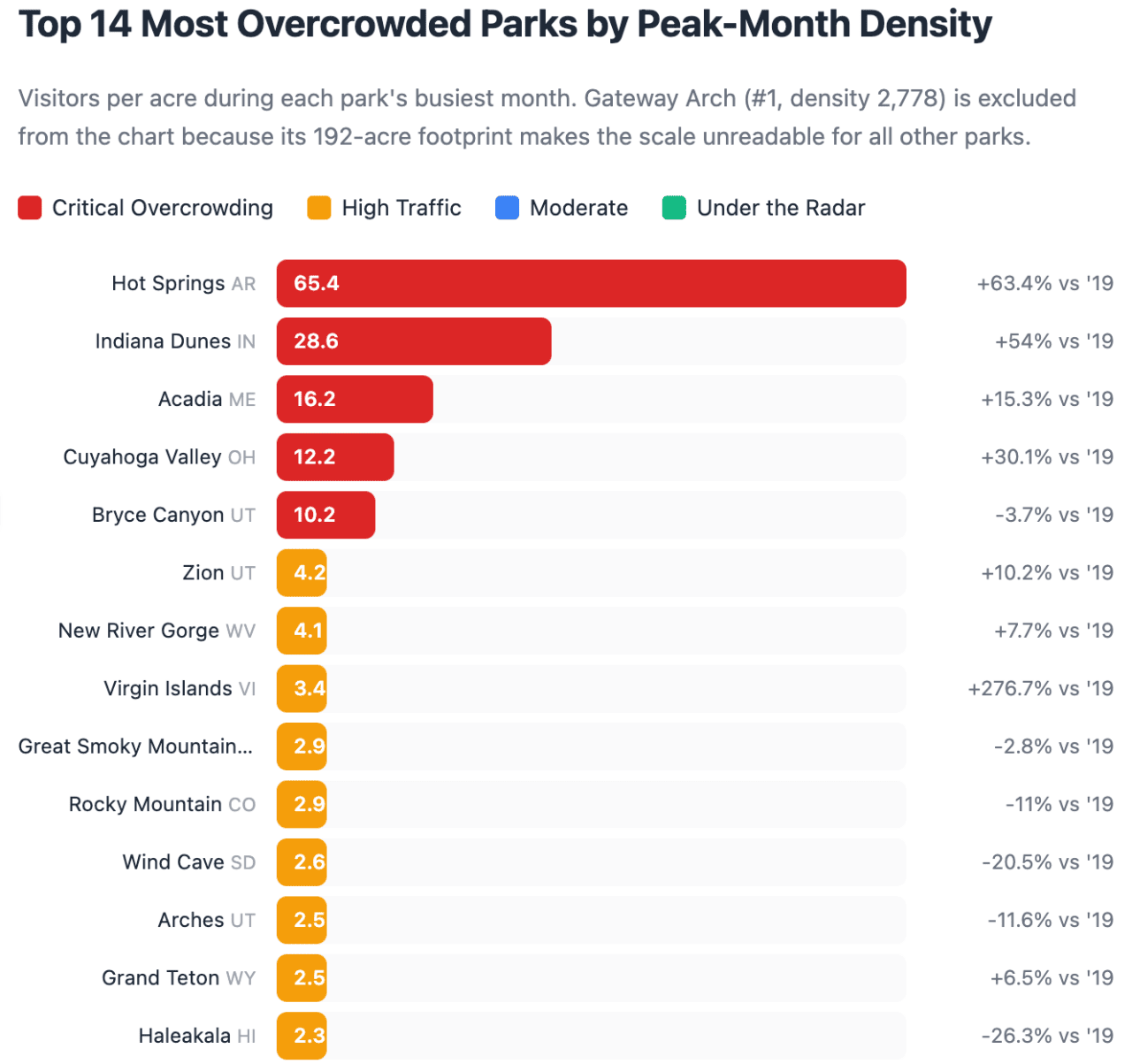
A data chart showing the top 14 most overcrowded parks by peak-month density.

outwander.com

The 6 Most Overcrowded Parks Per Square Foot

1. Gateway Arch, Missouri: 2,777.6 visitors/acre in July

At 192 acres, Gateway Arch is the smallest national park and draws 2,563,052 visitors a year. Those visitors funnel into an area smaller than a midsize shopping mall’s parkin

Senators demand answers about pre-determined EPA change to national emissions standards

Kraig Pakulski 0 23 Article rating: No rating

WASHINGTON D.C. (KEYT) – California's Senators joined 38 other members of the nation's upper chamber in announcing an investigation into the Environmental Protection Agency's (EPA) decision last week to rescind the 2009 endangerment finding.

The endangerment finding was the basis of the statutory authority of the federal government to set greenhouse gas emissions standards nationwide based on the risk they posed to public health.

The change announced last week removed the basis for current greenhouse gas emissions standards for light-, medium-, and heavy-duty vehicles as well as heavy-duty engines.

"The Environmental Protection Agency’s (EPA) final rule1 rescinding the December 7, 2009, endangerment finding marks a fundamental break from nearly two decades of settled law, science, and regulatory practice under the Clean Air Act," opened a letter to the current Administrator of the EPA and signed by 40 sitting members of the U.S. Senate. "Its repeal destroys that framework and results in a failure to faithfully execute EPA’s statutory mandate to protect human health—a mandate you acknowledged repeatedly during your confirmation hearing. But setting aside the dire implications of this final rule, the timing of and context for this entire enterprise suggest that this was a predetermined outcome, perhaps dictated more by concern for corporate interests than by an honest review of the law and science of climate change."

In 2007, the Supreme Court ruled in Massachusetts v. EPA that greenhouse gas emissions are air pollutants within the language of the Clean Air Act and in 2012, the U.S. Court of Appeals for the District of Columbia upheld the ruling.

Based on that 2007 decision in federal court, the Administrator of the EPA certified that concentrations of six greenhouse gases -carbon dioxide, methane, nitrous oxide, hydrofluorocarbons, perfluorocarbons, and sulfur hexafluoride- threatened public health in December of 2009.

"This determination had no basis in fact whatsoever," argued President Trump during a ceremony announcing the revocation of the finding last week. "On the contrary, over the generations, fossil fuels have saved millions of lives and lifted billions of people out of poverty all over the world."

Since then, Section 202(a) of the Clean Air Act empowered the EPA to set national emissions standards for new motorized vehicles and engines stating, "The [EPA] Administrator shall by regulation prescribe (and from time to time revise) in accordance with the provisions of this section, standards applicable to the emission of any air pollutant from any class or classes of new motor vehicles or new motor vehicle engines, which in his judgment cause, or contribute to, air pollution which may reasonably be anticipated to endanger public health or welfare."

"In media appearances and official communications, you framed repeal as “the largest deregulatory action in the history of the United States,” emphasizing cost savings and ideological opposition rather than engagement with the

RSS
First29682969297029712973297529762977Last