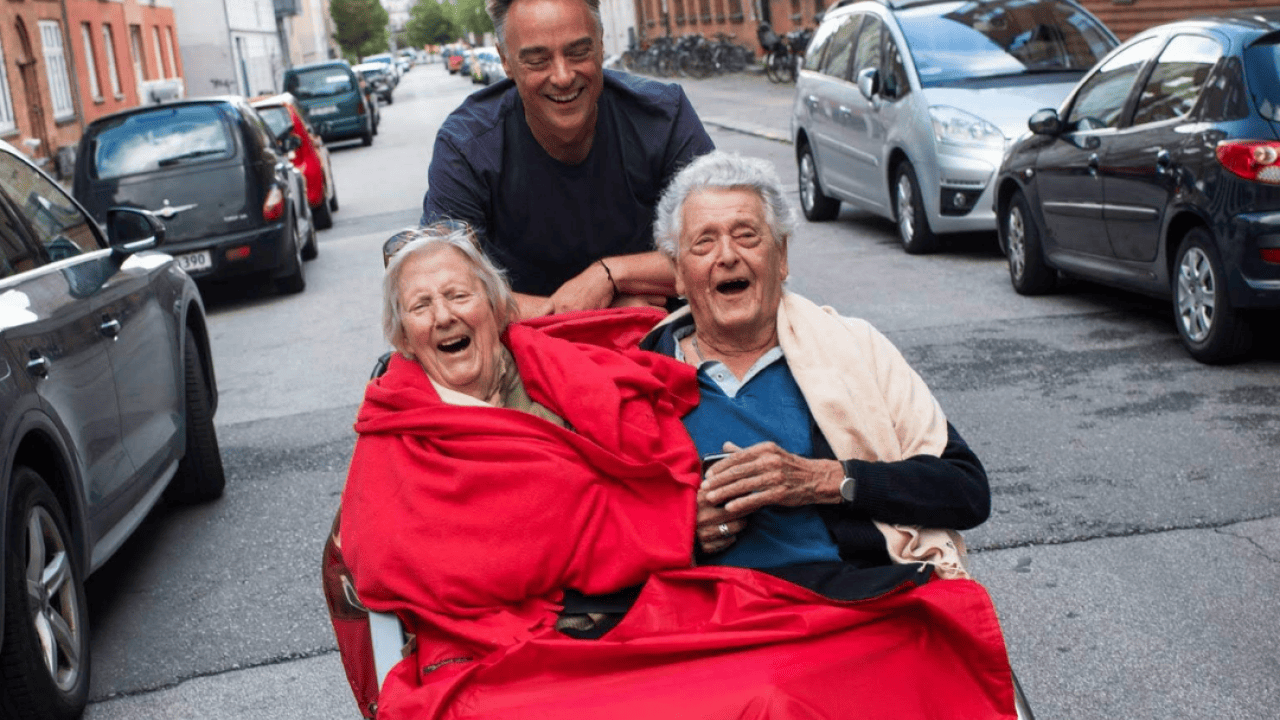
Courtesy of Cycling Without Age
As soon as John Seigel-Boettner invites passengers onto his black trishaw, a three-wheeled electric bicycle with two extra seats upfront, downtown Santa Barbara seems to smile. Pedestrians wave and call out greetings. Children stop midstride. With his silver mustache, a cheerful “Mr. Rogers” t-shirt and his favorite motto on his chest — “Believe there is good in the world” — Seigel-Boettner is a familiar sight in this coastal city.
He has been coordinating the local chapter of Cycling Without Age (CWA) since 2019. Effortlessly charming and still ferociously fit at 70 years old, he gives rides at least twice a week. Though the people who ride upfront don’t pedal, he doesn’t call them “passengers” but “riding partners” to emphasize the program’s spirit of companionship.
“Cycling Without Age is about connection,” Seigel-Boettner tells Reasons to be Cheerful. “It’s about the conversations between pilot and partner and the connection with everyone we meet along the way.”
On this particular morning, his front-seat companion is 97-year-old Elizabeth Wright, a spry and witty resident of a local senior home who has been riding with him for many years. “My name means I’m always right,” she says as she introduces herself. Winding past palm trees, through a leafy neighborhood, and out toward the beach, she waves to her favorite street musician and recalls moments from her long life as a caregiver, activity coordinator, poet and writer.
“This is where I bartended,” she says with a broad grin, pointing to a coastal pub, and tugs her blanket close in the morning breeze, her thin hands knotted with age. The ocean glints ahead. For a moment, she seems to fold into her younger self.
CWA was born in Copenhagen in 2012, when Danish management consultant Ole Kassow borrowed a rickshaw on a whim and offered an elderly gentleman from a care home a ride. Kassow had watched his father, who lived with multiple sclerosis, grow increasingly isolated. As his formerly extrovert father’s world shrank, so too did his sense of connection. When Kassow later worked in a care home, he saw a lot of the same issues his dad had been struggling with.
“Elderly people come into a nursing home,” Kassow says, “and their world gets smaller and smaller and smaller, until they just sit inside within their four walls.”
From that one act of kindness a movement spread, first across Denmark and then across the world. Today the nonprofit CWA spans more than 3,600 chapters and 50,000 volunteers in 41 countries, including in 25 U.S. states. It works in bike-friendly Copenhagen as well as in New York City. Each chapter operates somewhat differently according to local needs, but all share five guiding principles: Generosity, slowness, storytelling, relationships, without age. A visually impaired passenger called the initiative the “right to wind in your hair.”
The trishaws cost anywhere from $10,000 to $15,000 each, some modified to fit wheelchairs. “When you consider the impact of one trishaw and think about how m