
DC Studio // Shutterstock
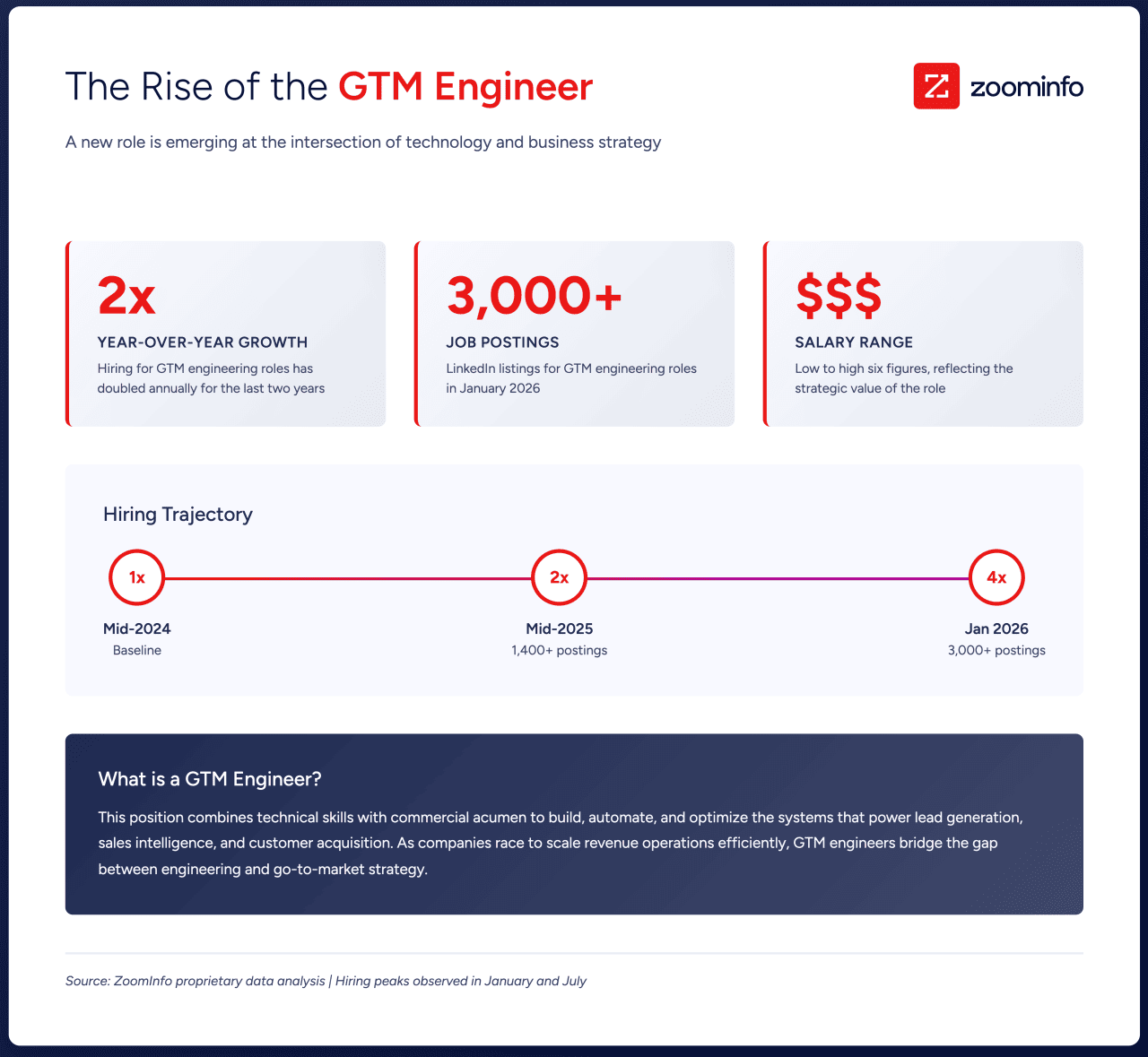
As companies race to scale revenue operations efficiently, a new role is emerging at the intersection of technology and business strategy: the GTM (go-to-market) engineer. According to ZoomInfo data, hiring for the role has doubled year over year for the last two years, with hiring peaks in January and July. In mid-2025 LinkedIn had over 1,400 postings for GTM engineering roles, with over 3,000 listed in January of 2026 and salaries ranging from low to high six figures. This position combines technical skills with commercial acumen to build, automate, and optimize the systems that power lead generation, sales intelligence, and customer acquisition.
ZoomInfo
For professionals looking to pivot into a high-impact role in 2026, GTM engineering offers a compelling opportunity. The position is in demand, commands competitive compensation, and sits at the center of how modern companies drive growth through automated lead generation and sales prospecting tools.
What Is GTM Engineering?
GTM engineering is the application of an engineering mindset to revenue operations. GTM engineers design and automate the systems that power growth—from data pipelines and workflow automation to tool integrations and AI-powered processes.
The role spans software infrastructure, data management, and workflow automation, all working together to help revenue teams move faster, stay aligned, and execute without friction.
Some describe it as revenue systems engineering. Others see it as the next evolution of revenue operations. Either way, it’s a critical function for companies building scalable, efficient, and intelligent go-to-market motions.
Wait—Isn’t This Just Demand Generation?
The short answer: no. While GTM engineering and demand generation both touch marketing systems and care about growth, they sit in fundamentally different parts of the value chain.
Demand generation has historically focused on creating top-of-funnel leads through campaigns and programs. The role centers on volume: running ads, executing email campaigns, hosting events, and optimizing channels to drive more prospects into the pipeline. Demand gen teams answer questions like “How do we get more leads?” and “Which channels drive the most pipeline?”
GTM engineering operates differently. Rather than running individual campaigns, GTM engineers build the underlying systems that make revenue generation repeatable, automated, and scalable across the entire funnel.
Here’s the distinction:
Demand generation asks: “How do we get more people in?”
GTM engineering asks: “How does the entire system work once they’re in—and how