Homeowners want more time outdoors. Most backyards aren’t planned for it.

Kraig Pakulski 0 19 Article rating: No rating

A patio with modern furniture during the afternoon.

BigDaveBo // Shutterstock


The conversation is still going, but cooler temperatures send people back inside. For many homeowners, outdoor time ends earlier than planned.

Outdoor space has taken on a new role in American homes. Once treated as a seasonal bonus, backyards, patios and decks are increasingly expected to function as true extensions of daily living rather than occasional warm-weather escapes.

A new survey of U.S. homeowners from Bromic Heating, a company specializing in infrared outdoor heating, suggests that while interest in spending time outdoors is strong, many struggle to use their outdoor spaces the way they want to.

Outdoor living is no longer just for summer

For many homeowners, leisure time no longer means packing a bag or booking a flight. Outdoor space is increasingly seen as something that can rival a vacation. In fact, 42% say they would rather invest in creating an outdoor oasis at home than take a trip away.

Outdoor space is tied to more than appearance. Nearly all (92%) homeowners say spending time outdoors is important to their mental and emotional health, and an equal share say their ideal home includes an outdoor space designed for everyday living, gathering or entertaining.

A graphic showing that 92% express an ideal home includes an outdoor space that extends everyday living to relax, entertain, and gather.

Bromic Heating

The problem is not interest. It is time cut short.

Despite strong enthusiasm for outdoor living, time outside often ends sooner than people want. Many homeowners say they wish they could spend more time outdoors at home than they currently do.

The reason is not hard to identify. As temperatures drop, outdoor spaces are often the first part of the home to go unused.

More than 3 in 5 homeowners say colder weather is a primary reason they do not spend more time outdoors at home.

Once cooler weather sets in, use declines sharply. Eighty-six percent of homeowners say they use their outdoor space much less, or stop using it entirely, during the cooler months.

A data graphic showing that 86% would spend more time outdoors if their space was usable in colder months and 67% say outdoor heating has the biggest impact on extending outdoor space use beyond warm days.

Bromic Heating

Planning decisions do not ma

The 'right to wind in your hair'

Kraig Pakulski 0 21 Article rating: No rating

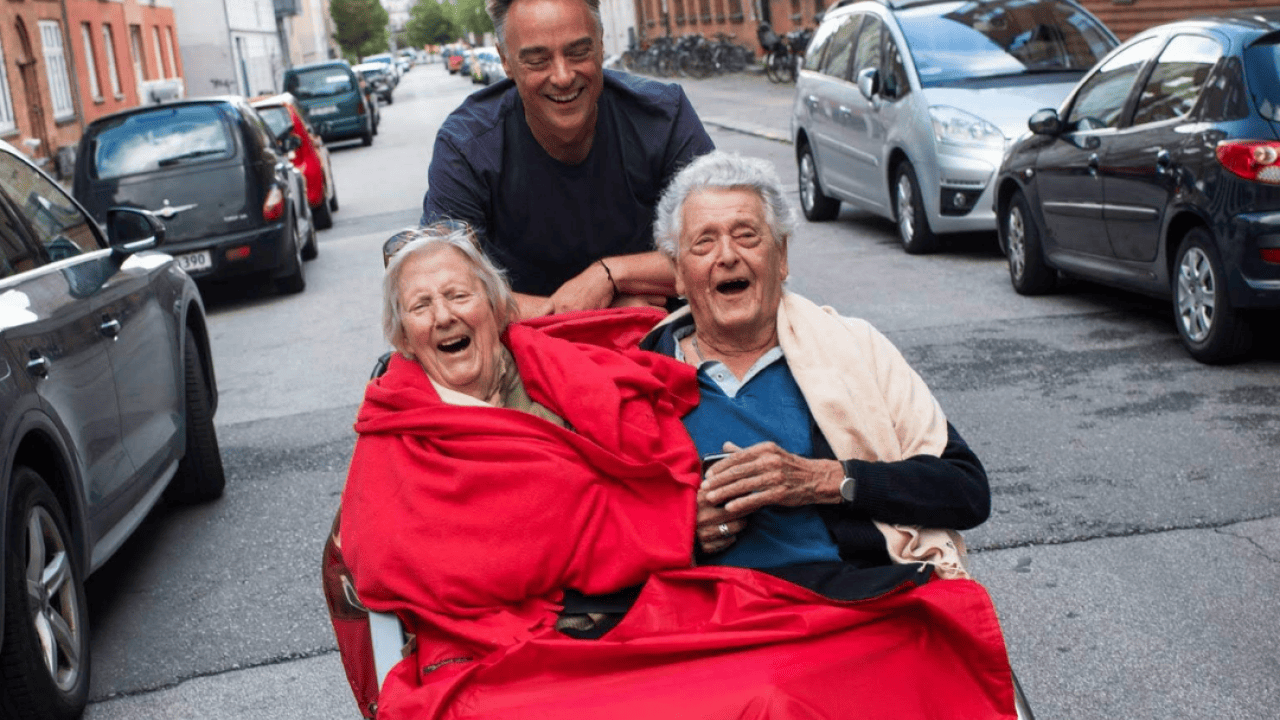
A volunteer cycles with a trishaw carrying two seated passengers who are laughing and smiling.

Courtesy of Cycling Without Age


As soon as John Seigel-Boettner invites passengers onto his black trishaw, a three-wheeled electric bicycle with two extra seats upfront, downtown Santa Barbara seems to smile. Pedestrians wave and call out greetings. Children stop midstride. With his silver mustache, a cheerful “Mr. Rogers” t-shirt and his favorite motto on his chest — “Believe there is good in the world” — Seigel-Boettner is a familiar sight in this coastal city.

He has been coordinating the local chapter of Cycling Without Age (CWA) since 2019. Effortlessly charming and still ferociously fit at 70 years old, he gives rides at least twice a week. Though the people who ride upfront don’t pedal, he doesn’t call them “passengers” but “riding partners” to emphasize the program’s spirit of companionship.

“Cycling Without Age is about connection,” Seigel-Boettner tells Reasons to be Cheerful. “It’s about the conversations between pilot and partner and the connection with everyone we meet along the way.”

On this particular morning, his front-seat companion is 97-year-old Elizabeth Wright, a spry and witty resident of a local senior home who has been riding with him for many years. “My name means I’m always right,” she says as she introduces herself. Winding past palm trees, through a leafy neighborhood, and out toward the beach, she waves to her favorite street musician and recalls moments from her long life as a caregiver, activity coordinator, poet and writer.

“This is where I bartended,” she says with a broad grin, pointing to a coastal pub, and tugs her blanket close in the morning breeze, her thin hands knotted with age. The ocean glints ahead. For a moment, she seems to fold into her younger self.

CWA was born in Copenhagen in 2012, when Danish management consultant Ole Kassow borrowed a rickshaw on a whim and offered an elderly gentleman from a care home a ride. Kassow had watched his father, who lived with multiple sclerosis, grow increasingly isolated. As his formerly extrovert father’s world shrank, so too did his sense of connection. When Kassow later worked in a care home, he saw a lot of the same issues his dad had been struggling with.

“Elderly people come into a nursing home,” Kassow says, “and their world gets smaller and smaller and smaller, until they just sit inside within their four walls.”

From that one act of kindness a movement spread, first across Denmark and then across the world. Today the nonprofit CWA spans more than 3,600 chapters and 50,000 volunteers in 41 countries, including in 25 U.S. states. It works in bike-friendly Copenhagen as well as in New York City. Each chapter operates somewhat differently according to local needs, but all share five guiding principles: Generosity, slowness, storytelling, relationships, without age. A visually impaired passenger called the initiative the “right to wind in your hair.”

The trishaws cost anywhere from $10,000 to $15,000 each, some modified to fit wheelchairs. “When you consider the impact of one trishaw and think about how m

No snow, no problem? Inside Utah’s high-stakes plan for the 2034 Olympics.

Kraig Pakulski 0 20 Article rating: No rating

Aerial view of Soldier Hollow Nordic Center in Midway on Friday, January 23, 2026.

Trent Nelson // The Salt Lake Tribune


A tangled, white ribbon wrapped around brown hills and barren shrubs at Soldier Hollow Nordic Center on Tuesday, Jan. 27. It was a little more than a week before the start of the 2026 Olympic and Paralympic Games in Milan-Cortina, Italy. It was also exactly two weeks and eight years before Utah takes the stage to host its second Winter Games.

Yet the prospect of hosting elite-level snowsport competitions here is difficult to fathom given the incessant lack of snow and persistent warm temperatures.

That’s especially true at Soldier Hollow. At an elevation of 6,000 feet, it’s the lowest base among Utah’s 2034 venues, and most at the mercy of climate change. Local organizers acknowledge the fact, and a recent study said the venue — which is slated to host biathlon and cross country races — could be too warm to reliably host both Games in the near future.

“We’ve gotten less than three inches of snow this winter, so that’s been interesting,” said Luke Bodensteiner, general manager at Soldier Hollow, which over the past three decades has averaged about 20 inches in January alone. “We’ve actually gotten more rain than snow this year,” he told The Salt Lake Tribune.

No, the snow isn’t falling at Soldier Hollow. But neither is the sky.

This warm, dry, brown winter is driving home the ripple effects a warming planet can have on the ski industry and the Olympics, said Fraser Bullock, the Utah 2034 president. Still, he said, he’s confident the state can weather similar conditions if they arise in 2034 and beyond. All it needs is state-of-the-art snowmaking, a flexible calendar and, maybe, a sprinkle of salt.

Is snowmaking the answer?

Like a slip peeking out under a skirt of snow, the brown and craggy rocks of the mountainside show on either side of the ski run. The scene could be at almost any of Utah’s ski resorts this winter. Instead, it was mid-January at Cortina d’Ampezzo, Italy, the site of the women’s downhill ski competitions for the 2026 Olympics, which began Friday, Feb. 6.

Like Utah, Italy has experienced an unusually dry and warm winter. It has been so dry that Johan Eliasch, president of the International Ski Federation, voiced concern in early January that the ski courses wouldn’t have enough snow in time for the Olympics. He also blamed Italian officials for the shortage.

Then Italy turned up its snowguns to full tilt.

“We have been very lucky with the cold weather,” Eliasch said last week, according to a report by Barron’s. “Snow production has been able to comme

Nature is the new thrill ride: Why wildlife is the travel moment Americans are chasing

Kraig Pakulski 0 22 Article rating: No rating

A humpback whale breaching water in Alaska.

Alexey Suloev // Shutterstock


The sight of a whale breaching or the Northern Lights stretching across the Alaskan sky has become a vision many Americans hope to experience. These moments, once considered bucket list extras, now stand out as the experiences travelers say matter most.

According to a new survey from Holland America Line, which has been exploring Alaska for nearly 80 years, wildlife encounters and outdoor experiences are ranking ahead of traditional theme park thrills. The survey found 43% of Americans say seeing wildlife in nature would be the most memorable family vacation experience, compared with about 12% who say meeting a character at a theme park would stand out most.

Interest in these experiences is shaping destination choices, as more than two-thirds (67%) of Americans say Alaska is a top travel priority.

A data graphic showing that 43% find seeing wildlife in nature as their most memorable family vacation experience, while 12% remember meeting characters at a theme park.

Holland America Line

The Destination Effect: Why Nature-Based Travel Resonates

Nature-focused destinations stand out for offering rare, immersive experiences. When asked about the moments that left the strongest impression, more than 41% of Americans say a nature or adventure destination produced their most lasting family memories. For many travelers, those memories are tied to being immersed in nature, where wildlife sightings, open landscapes and time outdoors shape the experience in ways traditional vacations often do not.

For families in particular, these trips offer something different than a traditional getaway, creating shared experiences that span generations and stand out as moments people remember most.

Cruising with Curiosity

Travel is not only about seeing new places. For many Americans, it is also a time to learn, explore and slow down. Cruises in particular appear to encourage that mindset.

According

RSS
First32993300330133023304330633073308Last