
How should glasses fit your face?

Kraig Pakulski 0 67 Article rating: No rating

A young woman trying on eyeglasses in a shop and taking a selfie.

PeopleImages // Shutterstock


Are your glasses so big that they have their own ZIP code? You’re not alone. Many people pick glasses without considering their face shape. Glasses should fit your facial features and proportions for maximum comfort and aesthetic quality.

Ill-fitting glasses cause sliding and pinching, which can make daily activities extra stressful. This guide from Eyemart Express will tell you exactly how to find glasses for your face shape and what to do if your glasses don’t fit.

What Factors Determine the Fit of Your Glasses?

An infographic on what factors determine the fit of eyeglasses.

Eyemart Express

Factors such as frame width, pupillary distance, frame measurements and face shape all determine how your glasses fit your face — it’s not quite as simple as two lenses in a frame. Finding the right fit of glasses means assessing the dimensions of your face and head to evaluate where the frame will sit and how it will look.

Once you’ve sorted out all these details, finding a comfortable-fitting pair of glasses becomes easier. Here’s a breakdown of these factors to help you get started.

  • Frame width: The width of your glasses frame should sit comfortably along your temples, aligning with the width of your face. If they extend too wide past the side of your head, they won’t center your eyes to the middle of the lenses. The frames are also more likely to fall off your face when you look down or walk too fast.
  • Frame measurements: There are five frame measurements used to find the perfect fit for your head and face. Three of them can be found on the inside of one of the arms of your glasses. It typically shows them in millimeters from left to right — lens width, bridge width and temple length. Including the lens height and frame width in these measurements will give you a better guideline for finding a comfortable fit.
  • Pupillary distance: Finding your pupillary distance (PD), the distance between your pupils, can come in handy when trying to ensure your eyes are at the center of your lenses. It also helps you get the most optimal vision through your glasses, helping you transition between near vision and distant zones more effectively.
  • Face shape: No two faces are the same. Each person has a unique face shape, ranging from triangular and round to oval and oblong. That means hand-me-downs aren’t going to cut it. You’ll need to find frames that suit your face shape best.

How to Find the Right Glasses for Your Face Shape

Guide to the top prescriptions for type 2 diabetes

Kraig Pakulski 0 56 Article rating: No rating

Metformin pills spilling out of a blue prescription bottle.

Nalidsa // Shutterstock


Managing type 2 diabetes often means finding the right mix of medications, lifestyle changes, and ongoing support. With many type 2 diabetes medications available today, it can feel overwhelming to compare options and understand how each one works. This guide from SaveHealth, a prescription discount/savings card website, is designed to help you navigate the most commonly prescribed oral diabetes drugs and injectable diabetes treatments, understand their benefits and side effects, and see how they fit into modern diabetes treatment options.

Understanding type 2 diabetes medications

Type 2 diabetes occurs when the body does not use insulin effectively or does not produce enough insulin to maintain healthy blood sugar levels. Medications aim to lower blood glucose, reduce A1C, and lower the risk of complications such as heart disease and kidney problems.

Doctors often tailor prescriptions based on factors such as A1C levels, weight goals, heart health, kidney function, and tolerance for side effects. The best diabetes medication for one person may not be ideal for another.

Major categories of diabetes treatment options include:

  1. Oral medications that improve insulin sensitivity or reduce glucose production.
  2. Injectable diabetes treatments, including insulin and combination products.
  3. New diabetes drugs that offer cardiovascular or weight loss benefits.

Oral diabetes drugs commonly prescribed

Oral medications are often the first step after diagnosis. They are convenient, effective for many people, and can be combined when needed.

Metformin based combinations

Metformin remains the foundation of type 2 diabetes treatment. Several combination drugs pair metformin with other agents for enhanced A1C lowering.

Examples include:

  1. Segluromet, which combines ertugliflozin and metformin.
  2. Synjardy, a combination of empagliflozin and metformin.
  3. Kazano, which combines alogliptin and metformin pairs a DPP-4 inhibitor with metformin.

These medications lower blood sugar through multiple mechanisms and may help reduce insulin resistance..

SGLT2 inhibitors

SGLT2 inhibitors help the kidneys remove excess glucose through urine. They are known for modest weight loss and cardiovascular benefits.

Notable prescriptions include:

  1. Jardiance, widely prescribed for people with type 2 diabetes and heart disease.
  2. Steglatro, another SGLT2 inhibitor used alone or in combination.
  3. Other examples that are widely used include: Farxiga (dapagliflozin) and Invokana (canagliflozin).

Many people searching for weight loss diabetes drugs learn about this class because of its additional

Gray divorce: How the splitting of older households is impacting the housing market

Kraig Pakulski 0 71 Article rating: No rating

A senior man unpacking boxes of belongings when moving to a new home.

AYO Production // Shutterstock


With longer life expectancy comes a longer “third act,” and many people in their 50+ era just don’t want to stay in the same box society has confined them to. As a consequence, the so-called gray divorce is now the most prevalent, especially in the U.S.

While overall divorce rates across the country are stabilizing or dropping, the 50+ demographic is the outlier. A report from the National Center for Family & Marriage Research shows that divorce rates for those over 50 have doubled, and rates for those over 65 have tripled since 1990.

The reasons behind older couples’ decisions to divorce are valid; everyone should have the possibility to leave a marriage in which they feel unhappy or unfulfilled. However, the couples who split in their 50+ are also the generation that holds the most real estate in the country.

Their separation after acquiring and consolidating property has an unexpected impact on the housing market. Additionally, in this article, Underwood Law examines what can happen if gray divorces maintain a similar rate in the near future.
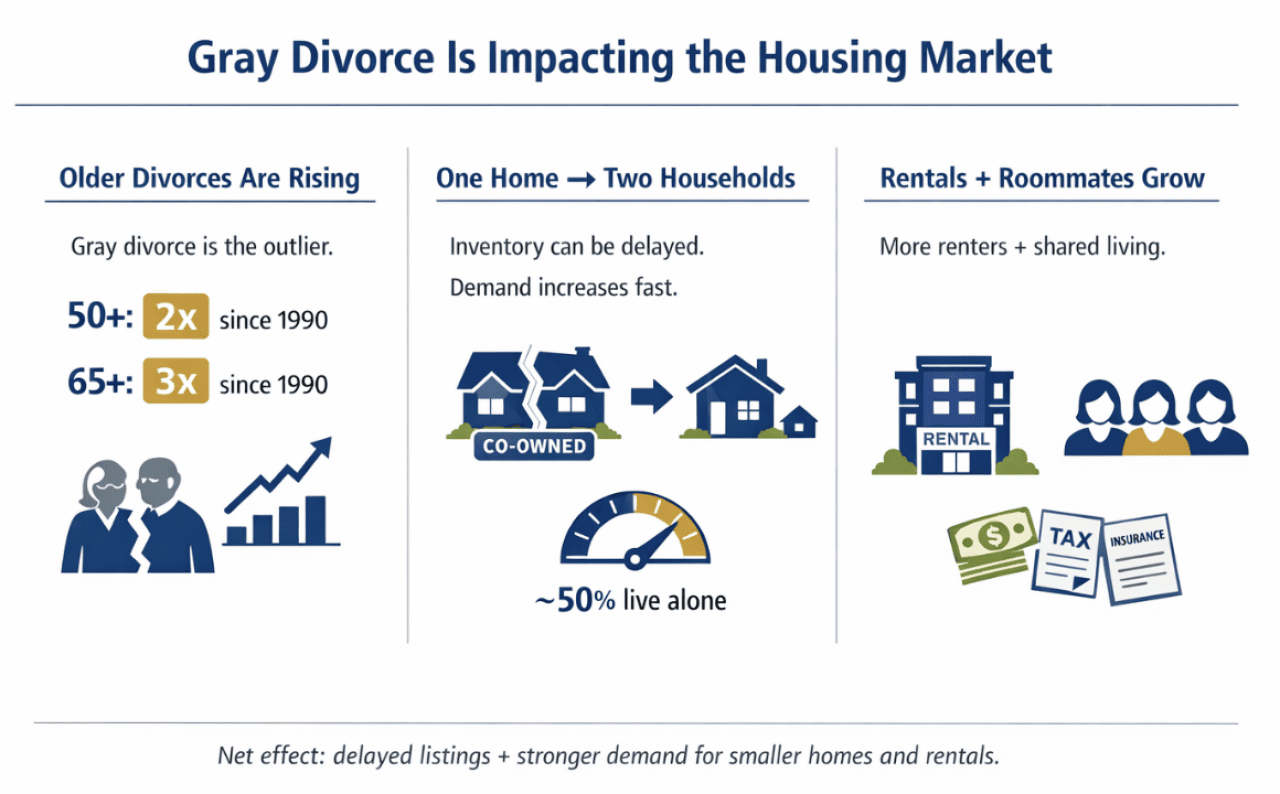
An infographic showing data on how gray divorce is impacting the housing market.

Underwood Law

The Impact on Housing Inventory and Demand

Gray divorce is a double-edged sword for housing supply, unlocking inventory while creating new, urgent demand.

First, there’s the family home, which most older couples own. In the event of a divorce, the most logical move is to sell the house, which adds inventory to the market. However, according to partition trial specialists, the situation is not always straightforward.

These homes are often large, outdated properties, located in suburban areas, and don’t sell easily. To avoid selling at a loss, many older adults divorce but agree to keep the family home co-owned for a few years, hoping for a friendlier market.

This creates a “separated under one roof” arrangement, which can lead to interesting legal issues. Many older couples don’t understand that, once the divorce decree is finalized, they become business partners co-owning a property.

Five years later, when one former spouse wants to sell to fund their retirement facility and the other spouses refuse to move, this becomes a civil partition action.

In summary, a gray divorce doesn’t immediately put property on the market. However, it may increase demand.

According to recent data, about half of U.S. adults who go through a gray divorce live alone afte

Fixing the holiday childcare gap: How businesses can support hourly and shift-based employees

Kraig Pakulski 0 66 Article rating: No rating

A young boy holding a cup of hot chocolate with his mother.

morrowlight // Shutterstock


The holiday season is upon us, and while kids may be dreaming of stockings stuffed with Labubus, electronics, and toys, their parents are more likely to be stressing over how to manage the gap in childcare.

Holiday childcare gaps occur when school closures and reduced childcare availability leave working parents, especially hourly and shift-based employees, without reliable care during their working hours. These gaps often force parents to miss work altogether and lose out on income. While the year-end holidays bring this challenge into sharp focus, similar gaps appear during summer vacation, spring break, and other school closures throughout the year.

According to Bright Horizons research, 68 percent of working parents say that juggling work and childcare responsibilities is one of their biggest stressors over the holiday season. These challenges hit especially hard for lower-income parents engaged in shift-based work; of parents who missed work due to childcare-related disruptions, at least 60 percent of them lost income as a result.

The problem is widespread: KPMG found that an average of 1.34 million workers in the U.S. were affected by inadequate childcare solutions last year. Mothers bear the brunt of the burden, representing 70% of impacted workers.

That’s not just a problem for employees, it’s also a recurring issue for their employers. These gaps often show up as last-minute absences and operational disruptions that increase overtime and strain already tight staffing plans. These unplanned absences led to $1.44 billion lost work hours last year, representing a huge amount of lost productivity. When working parents can’t find safe and effective solutions for managing childcare outside of school hours, everyone suffers.

Fortunately, some employers are developing innovative solutions to help their workers during childcare breaks, making it easier for them to maintain peak performance at home and on the job. By tracking absence rates and the reasons behind them over time, employers can better understand when childcare breakdowns are most likely to occur. Looking at this data holistically makes it easier to anticipate staffing risk during school breaks, instead of reacting to them when call-offs surge.

Workforce management platform TeamSense offers this look at some winning strategies for helping frontline employees strike a better work-life balance during school breaks and holidays.

Adopt micro-shift scheduling to support childcare gaps

In many cases, employees are able to get some coverage for their childcare needs, but it may not align to the sa

Commercial auto insurance eligibility for nonbusiness owners: A 50-state overview

Kraig Pakulski 0 69 Article rating: No rating

A figure of a small transport van protected by hands of a car insurance agent.

Jakub Krechowicz // Shutterstock


Commercial auto insurance protects vehicles used primarily for business activities by covering liability, vehicle damage, and related financial risks. While many assume that only registered businesses can obtain commercial auto insurance, most states allow individuals and non-business owners to qualify for a commercial policy as long as the vehicle is used for business purposes. This includes sole proprietors, independent contractors, freelancers, gig workers, and other individuals whose work involves driving for a living or transporting goods or equipment.

Commercial policies are triggered by how the vehicle is used rather than by the legal existence of a business entity. In this review, Cheap Insurance provides insights about commercial auto coverage for non-business owners.

How Commercial Car Insurance Eligibility Works

Commercial car insurance is fundamentally about vehicle use and liability exposure rather than the legal status of the policyholder. If a vehicle is used to conduct business, for example making deliveries, transporting equipment, or driving to client sites, then a commercial auto policy is the appropriate form of insurance coverage. Most personal auto insurance policies exclude business use, which can leave individuals financially exposed if an accident occurs during work activities.

The key eligibility considerations apply in every state:

  • The vehicle must be used in a business capacity.
  • The driver must disclose actual use during policy setup.
  • Liability coverage must meet or exceed state requirements.
  • The insurer must classify the vehicle based on business exposure rather than personal use.

Under this framework, non-business owners who meet these criteria can usually purchase commercial coverage. Formal business registration is not a universal legal requirement. The determining factor is the primary use of the vehicle for business activities.

States Where Non-Business Owners Can Qualify for Commercial Auto Insurance

The following states recognize commercial auto insurance for vehicles used in business by individuals who are not structured as formal business entities. In these states, eligibility is based on the vehicle use and underwriting standards rather than strictly business ownership status. Although carrier practices vary, the foundational rule is consistent across states. If a vehicle is used for business, it should be insured as such.

Alabama
Alaska
Arizona
Arkansas
California
Colorado
Read more

RSS
First40324033403440354037403940404041Last