
eamesBot // Shutterstock
Last week, AI disruption was a tech story. News broke about software stocks repricing rapidly as investors digested the implications of a new wave of AI tools that could replace tasks once handled by expensive enterprise platforms. The selloff was sharp, but contained.
This week, Range explains, the market decided that AI disruption is not just a tech problem anymore.
Target Practice
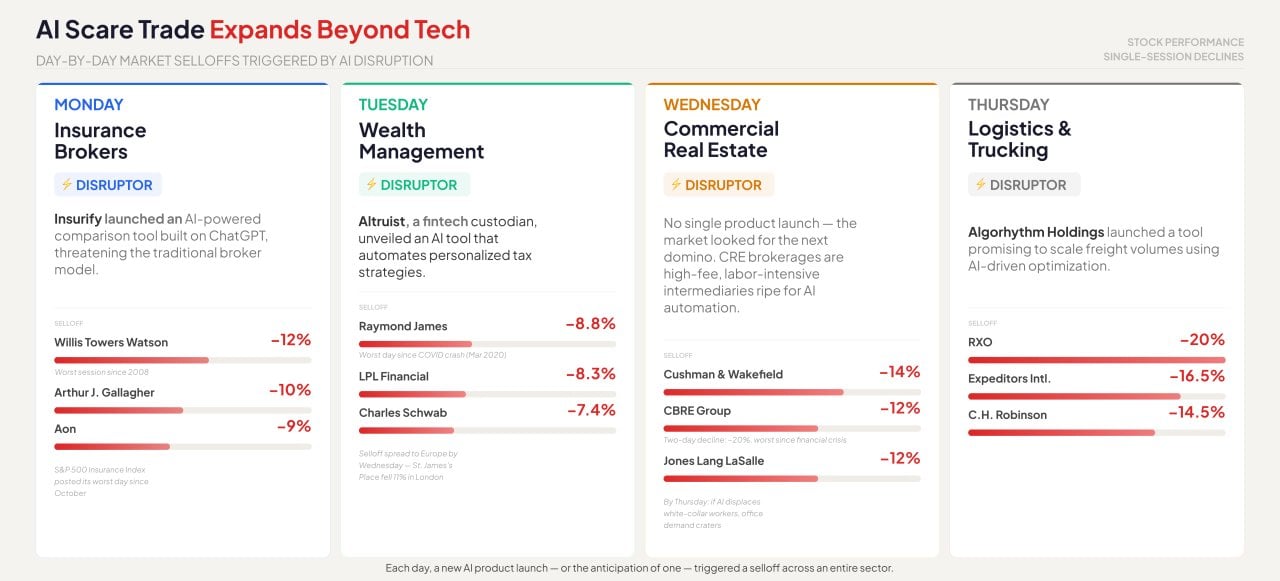
AI fears tore through sector after sector of the economy—each triggered by an AI product launch (or the expectation of one).
Range
In the span of five trading days, billions in market value were erased from industries that had nothing to do with software.
Monday: Insurify’s ChatGPT-powered comparison tool triggered a selloff in insurance brokers, with Willis Towers Watson posting its worst session since 2008.
Tuesday: The contagion jumped to wealth management after Altruist unveiled an AI tax-strategy tool, sending Raymond James to its steepest decline since the COVID crash.
Wednesday: Commercial real estate services cratered without any specific catalyst. The market had begun extrapolating—if AI could displace insurance brokers and financial advisors, the high-fee, labor-intensive world of CRE brokerage could be next. CBRE’s two-day decline hit 20%, its worst since the financial crisis.
Thursday: Freight and logistics joined the sell-off after Algorhythm Holdings demoed an AI optimization tool, with truck-broker RXO dropping 20%.
In four sessions, the “AI scare trade” evolved from a narrow disruption story into a broad referendum on the future of white-collar intermediaries. The common thread: These are businesses that sit between buyers and sellers, charging fees for expertise, access, or coordination that AI might replicate faster and cheaper.
What the Market Is Actually Scared Of
The market doesn’t expect an AI tool launched on a Tuesday to replace every financial advisor or insurance broker by Friday. The fear is about the economic structure of these businesses. Industries like insurance brokerage, wealth management, and commercial real estate services share characteristics that make them vulnerable:
- Information asymmetry leads to historically high fees. These are businesses where the provider knows more than the customer, and charges accordingly. AI compresses that gap.
- Entrenched fee structures lead to decades of stable pricing. The 1% AUM fee, 6% real estate commission, insurance brokerage