Click on the Manage Content for adding and managing content.
Click on the Rotator Settings and choose what and how it will be displayed.

As Amazon’s marketplace grows, sellers face new compliance challenges

Kraig Pakulski 0 18 Article rating: No rating

A magnifying glass over 'Amazon Seller Central' page.

IB Photography // Shutterstock


Amazon accounts for 40% of all e-commerce revenue in the United States. While the online retail giant’s dominance has continued to grow for more than two decades, the way Amazon operates its marketplace has changed significantly.

In 2010, third-party sellers (independent merchants selling products on Amazon) were responsible for roughly one-third of all units sold on the platform, according to Marketplace Pulse data. Today, 62%, or nearly two-thirds, are attributed to third-party sellers. For many e-commerce brands, Amazon has become a central sales channel rather than a supplemental revenue stream.

As the leading e-commerce marketplace, Amazon faces the ongoing challenge of policing counterfeit products and fraudulent sellers. Amazon has reported investing more than $1 billion in 2024 into AI innovation aimed at protecting customers and sellers from counterfeits and fraud. Amazon claims that these controls block more than 99% of suspected cases without requiring action from affected brands.

Amazon uses AI systems to detect counterfeit products and enforce seller policies, protecting customers and compliant sellers. However, automated enforcement and tightened requirements affect all sellers on the platform. Listings or accounts can be suspended unexpectedly, even for sellers following the rules. Some sellers violate guidelines unknowingly, while others are flagged incorrectly by automated systems. With third-party seller revenue exceeding $150 billion annually, occasional false positives are an inherent part of operations.

Rosenbaum & Segall, P.C., a law firm focused on compliance issues affecting Amazon sellers, examines how enforcement changes are affecting third-party merchants.

How Enforcement Affects Sellers

Third-party sellers have always been susceptible to Amazon’s enforcement actions, but the growth of automated compliance systems requires sellers to be more alert than ever. Since Amazon does not release public data on account suspensions, it’s difficult to assess how widespread enforcement actions are, but independent surveys offer partial insight, though results vary by methodology and sample size. Entresource reports that its survey of more than 300 sellers found that 22% have had their accounts suspended at least once. And a separate Read more

February cash collections sprint: 10 operational tactics to navigate the shortest month

Kraig Pakulski 0 18 Article rating: No rating

A small desk calendar showing February 2026.

Alekcey-Elena // Shutterstock


February is an unforgiving time of the year. With both fewer calendar and working days, and one federal holiday, the margin for error in cash collections is virtually nonexistent. Shipments can slip, approvals can compress, and payment runs that might normally fall on the 30th accidentally get pushed into early March. Revenue that is technically earned in February won’t convert to cash until weeks later regardless, but in such a short month, the run-off can further appear to distort year-end performance and put unnecessary pressure on your business’s liquidity.

However, this isn’t a structural problem. It’s an operational one and a solvable one at that. This February, focus on fine-tuning your cash collection cycle with a targeted approach that focuses on improving invoice timing, removing approval friction, and accelerating remittance before the calendar flips. To assist, Gateway Commercial Finance, an invoice factoring company, has compiled 10 key operational tactics to help you navigate this complicated process.

Why February demands a different approach

February is the shortest month on the calendar, but the operational impact goes beyond losing just two or three days. On average, each U.S. month includes 20-23 working days, depending on weekends and holidays, with February ending up on the low end of the range. When Presidents’ Day falls mid-month, as it does in 2026, it effectively removes another full processing day for banks, payroll providers, and accounts payable teams alike.

From a collection standpoint, this compression can create three main structural risks: invoices that are issued too late and miss accounts payable approval cycles, shipments completed in the fourth week don’t generate February cash, and a Net 30 model effectively becomes Net 35. However, whether your company realizes it or not, 28-day cycles actually align better with internal approval cadences when optimized properly. The only problem is that February forces this reality with no leeway.

Therefore, your solution shouldn’t be to demand faster payment, but rather to resequence your work so that invoices land earlier, cleaner, and are harder to ignore during the short month. The following 10 tips will help achieve exactly this.

Tactic #1: Ship earlier in week three

If there is a breaking point in February, it’s almost certainly during week three. Invoices that are generated in week four are disproportionately likely to be paid in March simply because of the number of days in the month and when internal approval windows close. Consider making one simple change in February: issuing invoices earlier in the month. Pricefic, a leading accounting platform built for freelancers, found that issuing invoices on Tuesday can result in 30%-40% faster payment as compared to later issuings.

To take advantage of this in February in particular, pull forward shipments and service completions that were originally planned in week four to week three wherever possible. Even just a shift of three to five days can mean the di

Why recognition pays off: The data behind retention programs and performance

Kraig Pakulski 0 25 Article rating: No rating

A business team standing and clapping together for a speaker.

Studio Romantic // Shutterstock


Employee turnover drains time, money, and resources from organizations in every industry, yet solving its key causes can be a low priority because of the perceived complexity of cultural intervention, Kudos reports.

The numbers tell a clear story: For organizations with a churn rate exceeding 15%, the cost of inaction far outweighs the cost of implementation.

According to 2024 analysis from Gallup, the implementation of a structured recognition program provides the specific “loyalty anchor” needed to stabilize teams, reducing the probability of high-performer exit by 45%.

This shift moves employee engagement from a “soft” HR initiative to a critical piece of operating expense (OpEx) management. While many leaders view recognition as a perk, the data suggests it is a fixed requirement for preventing brain drain and maintaining long-term stability.

The Overlap of Loyalty and Recognition

The link between employee loyalty and recognition is measurable rather than anecdotal. When Gallup researchers isolated the impact of “high-impact” recognition, defined as feedback that is both fulfilling and authentic, they found a direct correlation to long-term tenure.

When recognition is infrequent or poorly directed, the retention benefit evaporates. Conversely, for those within the “recognition-rich” bracket, the likelihood of actively seeking external roles within a 24-month window drops significantly, stabilizing the workforce even in volatile labor markets.

According to the Arbinger Institute’s 2024 Workplace Trends Report (as reported by Human Resources Director), job satisfaction has reached a critical low, with only 22% of employees rating their organization as excellent. 34% of respondents listed recognition and appreciation as a significant factor in their satisfaction.

This message is filtering through to business leaders, as Gallup’s ongoing research once again highlights. In 2022, just 19% of decision-makers were prioritizing employee recognition. Just two years later, 42% of execs reported accepting the value this brings to the table.

Unfortunately, while higher-ups might claim to be more on board with taking retention programs seriously, employees still think more must be done to properly crystallize recognition for their contributions. While 42% of execs now prioritize recognition, the proportion of team members satisfied with what they receive remains stagnant at 22%. This 20-point perception gap indicates that while leaders talk about culture, they are failing to execute it.

The Performance Angle

Structured recognition improves employee engagement, which in turn translates into better workplace performance. This is anecdotally true, but more than that has a proven basis in research.

Experts at MIT put together Read more

State mottos, translated: What your state’s official motto really means

Kraig Pakulski 0 33 Article rating: No rating

Welcome sign for New Hampshire.

Leonard Zhukovsky // Shutterstock


Every U.S. state has its own seal, a carefully designed emblem that is stamped on official documents, flags, and even courtroom walls. However, hidden in plain sight are also mottos that reveal each state’s values, history, and self-image. From bold declarations of independence to humble nods towards faith, nature, and even resilience, these mottos form a sort of secret code. AnyWho has decrypted this code by outlining all 50 state mottos, categorized by theme, providing insights into the story behind the seals.

50 state mottos by theme

When you line up all 50 state mottos, patterns start to emerge. Some celebrate liberty and freedom, others honor unity, progress, or nature, and some still pay homage to something more. Together, each motto forms a patchwork of American ideals that reflect the country’s regional diversity and shared spirit.

Theme 1: Liberty and freedom (14 states)

Two defining traits of the country, liberty and freedom, are recognized in the mottos of 14 states.

New Hampshire – “Live Free or Die”

  • Origin: Revolutionary War Gen. John Stark wrote this as a toast to veterans in 1809, emphasizing that freedom is worth dying for; it was officially adopted in 1945.

Virginia – Sic Semper Tyrannis

  • Translation: Thus Always to Tyrants
  • Origin: George Mason recommended this in 1776 for the state seal. The phrase warns that tyrannical rulers will inevitably fall, and is possibly attributed to Marcus Brutus after Caesar’s assassination.

Massachusetts – Ense Petit Placidam Sub Libertate Quietem

  • Translation: By the Sword We Seek Peace, But Peace Only Under Liberty
  • Origin: The Massachusetts Provincial Congress adopted this motto in 1775 during the Revolutionary War. It is attributed to English patriot Algernon Sidney from his 1659 “Book of Mottoes.”

West Virginia – Montani Semper Liberi

  • Translation: Mountaineers Are Always Free
  • Origin: This motto reflects the independent spirit of West Virginia’s mountain settlers and their resistance to outside control.

Delaware – “Liberty and Independence”

  • Origin: The state motto reflects Delaware’s role in the Revolutionary War and its status as the first state to ratify the U.S. Constitution in 1787.

Pennsylvania – “Virtue, Liberty, and Independence”

  • Origin: Pennsylvania’s motto combines moral virtue with the revolutionary ideals that shaped the state’s founding.

New Jersey – “Liberty and Prosperity”

  • Origin: The state motto balances personal freedom with economic opportunity, the core values of New Jersey’s colonial settlers.

Iowa – “Our Liberties We Prize and Our Rights We Will Maintain”

  • Origin: This motto declares Iowa’s commitment to defending personal freedoms and constitutional rights.

60 Super Bowl trivia questions and answers for your 2026 Super Bowl party

Kraig Pakulski 0 23 Article rating: No rating

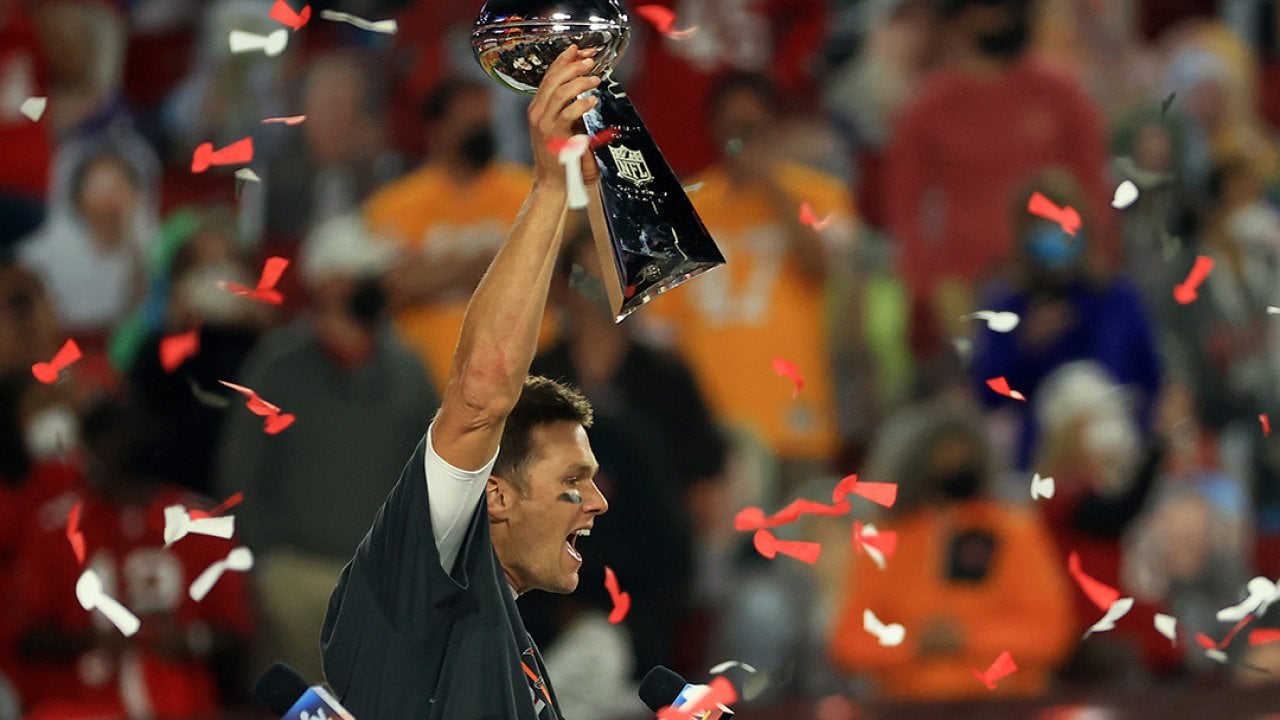
Tom Brady holding up a trophy after winning uper Bowl LV at Raymond James Stadium on February 07, 2021 in Tampa, Florida.

Mike Ehrmann // Getty Images


Hosting friends for a Super Bowl party? Super Bowl trivia is an easy way to get everyone locked in before kickoff — and figure out who actually knows ball.

From iconic plays and dynasties to halftime shows and commercials, PrizePicks shares these 60 Super Bowl trivia questions, which cover the full history of the NFL’s biggest game.

Looking back at historical stats — like passing yards, touchdowns, or memorable performances — is how fans and analysts understand what actually matters on the Super Bowl field.

The questions range from easy to genuinely tricky, making them perfect for a party game or a quick test of NFL knowledge. Each question is multiple choice, with a complete answer key included at the bottom of each section.

2026 Super Bowl Trivia Questions

Here are 60 Super Bowl trivia questions to get you ready for Super Bowl LX on Feb. 8, 2026.

All questions are multiple choice, with a full answer key included at the bottom of each section: History and Records, Iconic Plays Players and Coaches, Halftime Shows and Commercials, and Dynasties and Memorable Games.

Super Bowl History, Origins, and Records

Super Bowl history is filled with records, firsts, and defining moments that have made this game the annual spectacle it is. These questions cover the foundational facts behind the league’s biggest game, from trophies and venues to teams that defined entire eras.

1. What trophy is awarded to the Super Bowl champion?

A. George Halas Trophy
B. Vince Lombardi Trophy
C. Paul Brown Trophy
D. Mike Ditka Trophy

2. Which two cities are tied for the most Super Bowls hosted, with 11 each?

A. Los Angeles and New Orleans
B. San Francisco and Miami
C. Miami and New Orleans
D. Dallas and Los Angeles

3. Which team lost four straight Super Bowls from the 1990-1993 seasons?

A. New York Jets
B. New York Giants
C. Dallas Cowboys
D. Buffalo Bills

4. Which team did the Bears defeat in their lone Super Bowl win (Super Bowl XX, 1985 season)?

A. Kansas City Chiefs
B. Buffalo Bills
C. New York Jets
D. New England Patriots

5. Which team became the first wild card team to win the Super Bowl in 1980 (Super Bowl XV)?

A. Tampa Bay Buccaneers
B. Philadelphia Eagles
C. Oakland Raiders
D. New England Patriots

6. Which quarterback won Super Bowl VIII while completing just six passes on seven attempts?

A. Trent Dilfer
B. Bob Griese
C. Jim McMahon
D. Tom Brady

7. Which team stopped Tom Brady’s three-peat bid in Super Bowl LII (2017 season)?

A. Philadelphia Eagles
B. Tampa Bay Buccaneers
C. Atlanta Falcons
D. Carolina Panthers

8. Which quarterback became the first player to throw and catch a touchdown pass in the same Super Bowl?

A. Jim Kelly
B. Troy Aikman
C. Nick Fo

RSS
First34973498349935003502350435053506Last