
Road safety directly impacts insurance premiums, liability exposure, and infrastructure spending across the U.S.—yet fatality rates resisted improvement for years. The automotive industry faced regulatory pressure over annual deaths, spurring advances in vehicle safety features. Road design also shifted, with changes to intersections and street layouts showing measurable impact. But the real question is whether those efforts are actually working.
New traffic data from the National Highway Traffic Safety Administration and the U.S. Department of Transportation reveals they are. Recent studies show a clear downward trend in fatalities. Technology embedded in vehicles, autonomous systems coming online, and smarter road infrastructure are all factors that are impacting road safety. Triumph Law Group, a personal injury law firm in Phoenix, unpacks what the data actually shows and where the safety improvements are coming from.
 Triumph Law Group
Road Accident Statistics Unpacked
Annual figures on traffic safety are produced by the NHTSA and DOT. While the driving data for 2025 is still a statistical projection rather than containing final, firm numbers, the trend toward fewer fatalities is clear. Specifically, it’s estimated that deaths from auto collisions fell 6.7% year on year, from just over 39,000 in 2024 to 36,640 last year.
Q4 of 2025 was the 15th consecutive quarter in which a decline in fatalities was recorded, and researchers are confident that this trend represents a rebalancing of road safety following the unexpected disruption associated with the pandemic. So, while we’re not yet at historic lows, there’s clear, continuous movement in the right direction.
To further cement the improving safety conditions, the report estimates that for every 100 million vehicle miles traveled (VMT) on U.S. roads, just 1.10 fatalities occur. That’s a decline from the 1.19 fatalities per 100 million VMT calculated in 2024. Only one other year in the history of recording traffic safety statistics has had a lower average number of fatalities per 100 million VMT.
The data shows fatality reductions across all regions of the U.S.—even in areas that historically had higher rates. The East Coast saw the largest estimated reductions in fatalities, with areas including Virginia, Kentucky, Washington D.C., and North Carolina even reaching double digits.
The downtrend in road fatalities does not mean there isn’t a need for further improvement.
Technology’s Influence
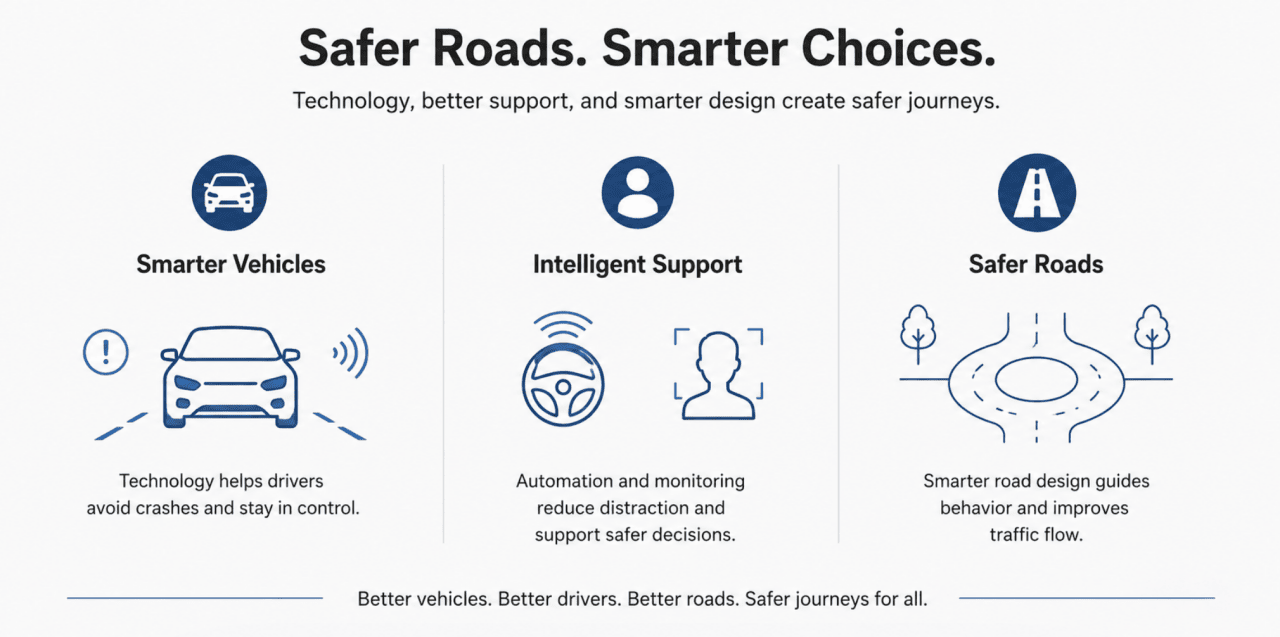
Mandatory safety tech is part of the story. Tighter vehicle regulations forced automakers to add features that actually prevent crashes. We’re entering a period in which true self-driving cars are a reality in more parts of the country, bringing the potential for even further risk reductions.
Advanced driver assistance systems (ADAS) are now standard in most new vehicles. They range from general aid to direct intervention without taking total control of moment-to-moment driving away from