Santa Barbara County News and Events

Inside the fight to save Namibia's wildlife

Kraig Pakulski 0 58 Article rating: No rating

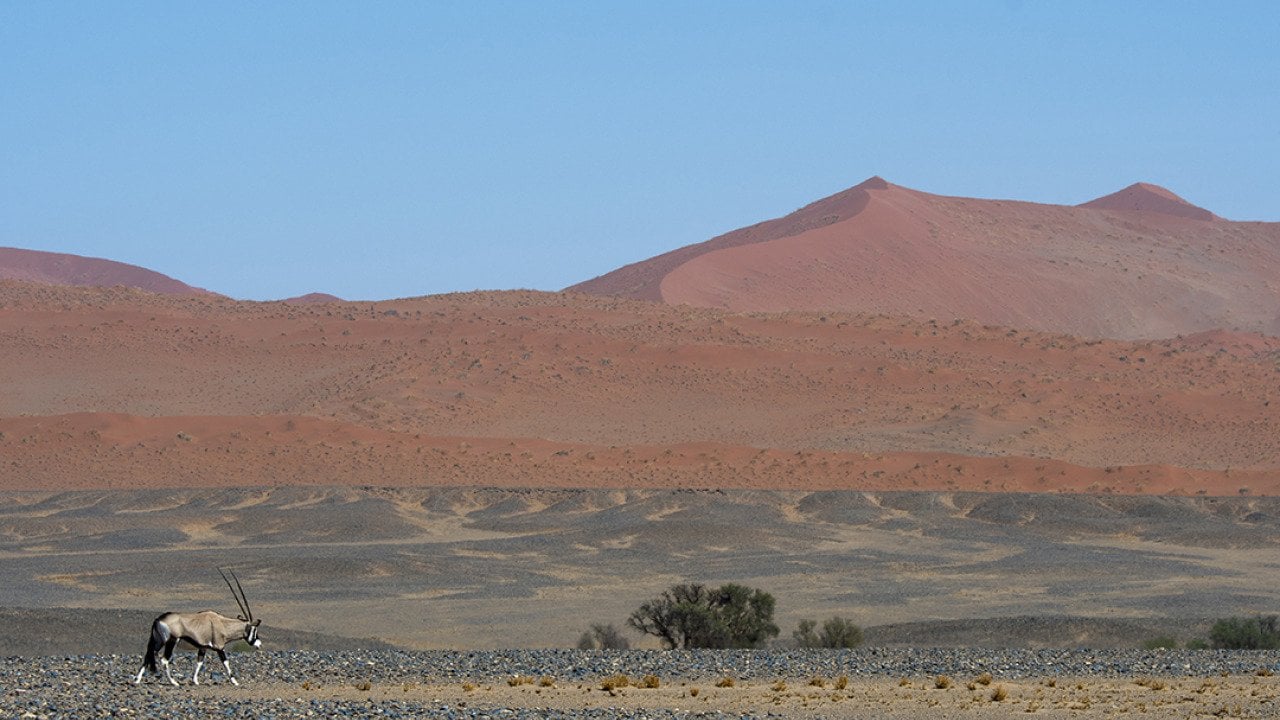
A South African oryx, also called 'Gemsbok' or 'gemsbuck' walking by a water hole in a desert area in Namib-Naukluft National Park in Namibia.

Wolfgang Kaehler // LightRocket via Getty Images


Moments before the sun set behind Namibia’s burnt-orange mountains, a large truck rumbled onto the desert landscape below. Inside were ostriches, springbok, and oryx, restless and stamping around their transport crate. Members of the local tribe and a handful of journalists watched from safari vehicles as conservationists readied the doors. Soon, the animals would charge into their new home: the Orange River Karoo conservation area.

Wildlife translocation projects don’t always go well; sometimes, the animals don’t survive the journey. For the Orange River-Karoo Conservation Area, a nonprofit working to restore 2.4 million acres in the country’s south, this inaugural release was years in the making—and they were prepared. Once the doors finally opened and each group of animals clumsily stumbled out before striding across the land as if they’d always been there, any potential worry dissolved. One emotion was unmistakable on every face: joy.

“Honestly, it was one of the happiest days ever, in terms of how many years and days have gone into getting us to where we are today,” said Andreia Pawel, cofounder of ORKCA.

The Orange River-Karoo region has been around for millennia, but its ecosystem suffered greatly in the last two centuries as southern Namibia lost 90% of its wildlife to poaching, mining, and the conversion of open land to livestock farming, according to ORKCA. Where 10,000 elephants and 3,000 hippos once roamed the region, there are now zero—the largest extinction of megafauna in sub-Saharan Africa. A robust population of 20 million springbok has dropped to just 5,000, while giraffe numbers tumbled from 6,000 to 30. These metrics are equally bleak for the land’s historic predators. There were once 2,000 leopards throughout the landscape. Today, there are just 10 remaining. Lion numbers have cratered from 3,000 to total extinction.

Even so, the story of conservation work is hardly one of defeat, Atmos reports. While many experts have completely written off the Orange River-Karoo, as is the case for many desert landscapes, ORKCA formed in 2020 when its members recognized the potential for restoration. Three years later, the Rolex Perpetual Planet Initiative, which since 2019 has committed itself to the protection of the planet, also recognized ORKCA’s vision, and decided to aid in the organization’s first wildlife release.

The unique ecology of the region spans three different biomes: the desert, the driest of biomes; the Nama Karoo, characterized by low shrubs and rugged terrain; and the Succulent Karoo, the world’s only arid biodiversity hotspot—making the Orange River-Karoo an ecotone, a natural crossroads and a “catalyst for evolution.”

“When you’re talking about research in the far south, in the desert, everyone laughs and asks you what is there?” said

A blueprint for reducing gun violence by 2040, according to experts

Kraig Pakulski 0 76 Article rating: No rating

Members of a violence prevention team gather near a hookah lounge in New York City.

Spencer Platt // Getty Images


Shootings have killed more than 800,000 people and injured over 2 million others in the United States since the start of this century. In March, dozens of violence prevention leaders convened in Chicago at the JAMA Summit on Reducing Firearm Violence and Harms to discuss steps to reduce gun violence, according to a new report in the Journal of the American Medical Association.

The report, published on Nov. 3, shows that the 60 leaders who attended the summit represented multiple disciplines. They included emergency physicians, public health scholars, psychiatrists, historians, and social workers. The summit was the first of its kind presented by the medical journal. Its purpose: to develop a roadmap for substantially curtailing the number of shooting deaths and injuries over the next 15 years.

“We’ve gained a lot of knowledge and can point to a variety of things that seem to reduce gun violence, but still, there’s a lot we don’t know, and there’s still a lot of challenges,” Daniel Webster, a public health scholar at Johns Hopkins University who has studied gun violence for over 30 years, told The Trace.

Gun violence as a major public health issue has received more attention and federal funding in recent years. In 2024, then-U.S. Surgeon General Dr. Vivek Murthy issued his office’s first-ever warning about gun violence’s far-reaching effects, reinvigorating prevention efforts.

But since President Donald Trump returned to the White House, his administration has rolled back much of that progress. Layoffs at the Centers for Disease Control and Prevention have decimated the unit responsible for studying and helping to prevent shootings, and federal funding for research and community programs has dwindled.

During the summit, leaders called for a “research revolution” on preventing gun-related harms as one of the five steps needed to improve public safety by 2040, according to the report. The other steps emphasized strengthening communities, reframing gun injury as a preventable issue, taking a whole-of-government and society approach to addressing violence, and harnessing regulatory and technological opportunities responsibly.

Dr. Stephen Hargarten, an emergency physician and professor at the Medical College of Wisconsin, has spent his career studying how regulatory and technological innovation can help reduce firearm deaths.

What emergency hardship financial aid is and how to get it

Kraig Pakulski 0 67 Article rating: No rating

A stressed young adult sitting in front of a laptop.

MAYA LAB // Shutterstock


Emergency hardship financial aid gives you fast financial support when an unexpected crisis leaves you unable to cover essential expenses. You can get this aid through government programs, nonprofits, personal resources, or cash loan options that help you stabilize your situation quickly.

You might need this type of aid after a sudden job loss, a medical emergency, or an urgent bill that hits before your next paycheck. When life feels overwhelming, and your budget can’t stretch any further, emergency aid can act as a safety net so you can focus on getting back on track. CreditNinja discusses types of emergency hardship financial aid and how to go about obtaining it.

Federal and State Agencies for Emergency Hardship Financial Aid

You may be eligible for funding from federal or local assistance. Here are a few situations in which you could get financial aid from government assistance programs.

Unemployment Insurance

If you are facing a job loss, you may be eligible for unemployment insurance. Start with unemployment insurance online. Your state will have a specific site dedicated to unemployment benefits. Once you get there, create a login and provide details about your job loss. You will not qualify for unemployment in most states if you quit your job.

If you qualify, the amount will depend on your wages and dependents.

And so, if facing a financial crisis due to job loss, start with unemployment insurance. Although it may not cover your entire wages, it can be the financial relief you need.

For small business owners, the Small Business Administration (SBA) assists business owners who need financial aid.

Financial Aid for Medical Emergencies

Medical emergencies can affect your credit if you don’t pay your bills. If you have health insurance, start with them. Your insurance should provide some aid after meeting the deductible. The deductible and the amount of coverage will depend on your health insurance policy. A dependent should also be covered if enrolled in your health insurance.

Below are alternatives to health insurance:

  • A health savings account (HSA) — An HSA is a type of savings account offered by several employers. Your HSA is essentially a savings fund used for medical expenses.
  • Low-cost medical insurance (Medicaid and CHIP) — Medicaid and the Children’s Health Insurance Program are low-cost medical insurance options provided by the federal government for families and individuals on low incomes.
  • Temporary Assistance for Needy Families (TANF) — TANF helps families on low incomes cover all kinds of costs, including medical bills and expenses.

Emergency Financial Aid for Basic Necessities

Local and federal government agencies help individuals and families who need financial relief and economic security. Here are a few:

  • TANF — As mentioned above, TANF is a federally funded program that can assist families in need. TANF helps with food, housing, health care, childcare, and other basic needs.
  • Special Supplemental Nutrition Program for

Does your dog need a winter coat?

Kraig Pakulski 0 74 Article rating: No rating

A dachshund wearing a winter coat with snowy outdoors.

Darla Khazei // Shutterstock


You spent hours searching online for the comfiest (and most stylish) winter coat for your dog, and you’re finally ready to press “add to cart” — but before you take the plunge, you probably want to know if a new jacket is something your pet really needs. The reality is, there’s no one-size-fits-all answer.

If your dog naturally has a thick, long coat — think Pomeranian or a Bernese mountain dog — they probably don’t need to worry about layering. But if your pup is slick-coated, very young, elderly, or suffering from a medical condition like arthritis, a coat can do wonders to keep them comfortable when chilly weather hits. Jackets can be especially beneficial for small dogs; it’s harder for the little guys to retain body heat.

You should also consider how long you and your dog are going to be outside. Your pup might be fine going coatless on a quick, 10-minute walk to do their business. But if you’re planning on taking your favorite hiking buddy along on a snowy winter’s day, they’ll probably appreciate some help staying warm.

There’s also the matter of actually getting your dog into the coat. If your pup’s just not having it, you’re not alone; lots of dogs are resistant to dressing up, no matter how adorable their new outfit is. But don’t worry — there are ways to train a dog to wear a winter coat. Below, Kinship breaks down everything you need to know about what kind of winter accessories your pup might need and how to make suiting up before walks stress-free.

Do dogs get cold?

Just like people, dogs can get cold, but exactly when they get cold depends on a variety of factors like their coat type and length, as well as their size. Some breeds — the Siberian husky and Alaskan malamute, for example — are bred for cold weather and may even be reluctant to come inside out of the snow, while smaller dogs may start shivering at the slightest dip in temperature.

Experiencing intense cold without the proper protection is dangerous for dogs and can lead to hypothermia, which can be fatal in serious cases. Cold weather can also cause frostbite on your dog’s paws, ears, or tail.

Is it safe to put a winter coat on my dog?

As long as you only dress your pup up at the proper time, a winter jacket is perfectly safe. That said, never put a coat on a dog when the weather is mild or when they’re indoors, because this can lead to overheating. And no matter how cute they might look, don’t rush your dog to wear a coat if they’re totally opposed. Instead, use positive reinforcement to encourage them over time.

How to decide if your dog needs a jacket

Not every dog needs a winter coat. In many cases, it depends on the dog, as well as the temperature, so it’s up to responsible pet parents to determine if dog winter clothes are necessary. Monitor your dog while they’re outside in colder tempera

AI is replacing the search box. Could accessibility decide who gets found?

Kraig Pakulski 0 66 Article rating: No rating

Concept of AI and SEO, keyword search graphics over a hand of a robot.

Summit Art Creations // Shutterstock


For more than 20 years, search engines have served as the primary gateway to the internet. Users entered keywords, algorithms ranked results, and businesses optimized their websites to appear near the top. AudioEye examines how the rise of AI tools is beginning to redefine that entry point and reshape how people discover information online.

The shift is already visible in the data. Traffic to U.S. retail sites from AI-powered platforms like ChatGPT and Perplexity surged 4,700% year over year by July 2025, according to Adobe Analytics. A Capgemini study conducted in October/November 2024 found that 58% of consumers now rely on AI tools for product recommendations, rather than traditional search engines. And broader usage patterns continue to accelerate: ChatGPT adoption grew nearly 70% in the first half of 2025, with shopping-related queries doubling during that period, according to Bain & Company reports.

Meanwhile, people are completing more of their research directly within AI-generated results, a major departure from the classic “search, click, browse” pattern of the last two decades. Google AI overviews now appear in over 60% of search queries, according to Xponent 21, fundamentally changing how information is consumed and how often users need to leave the search page.

For businesses that depend on traditional search visibility, these shifts represent a structural change. And they place new importance on something many organizations have historically underestimated: whether their websites are built in ways that AI systems can actually understand.

AEO and GEO: The New Rules of Discoverability

As AI tools begin interpreting and delivering more of the web’s information, two concepts are emerging as essential to online visibility: answer engine optimization (AEO) and generative engine optimization (GEO).

AEO and GEO focus on making information easy for AI systems to extract, interpret, and respond with. Clear headings, descriptive labeling, logical hierarchy, and consistent formatting all help AI understand the purpose and meaning of a page. Structural elements like semantic HTML, navigable layouts, well-formed links, and properly coded components matter more in an environment where models must summarize or recommend information rather than simply index it.

Together, AEO and GEO represent a shift from keyword-based optimization to comprehension-based optimization. It’s no longer enough for a page to contain relevant information. AI needs to understand that information well enough to paraphrase it, cite it, or recommend it.

This evolution puts renewed attention on the integrity of a website’s under

RSS
First41944195419641974199420142024203Last