Which Grammy nominees ranked highest based on performance data

Kraig Pakulski 0 43 Article rating: No rating

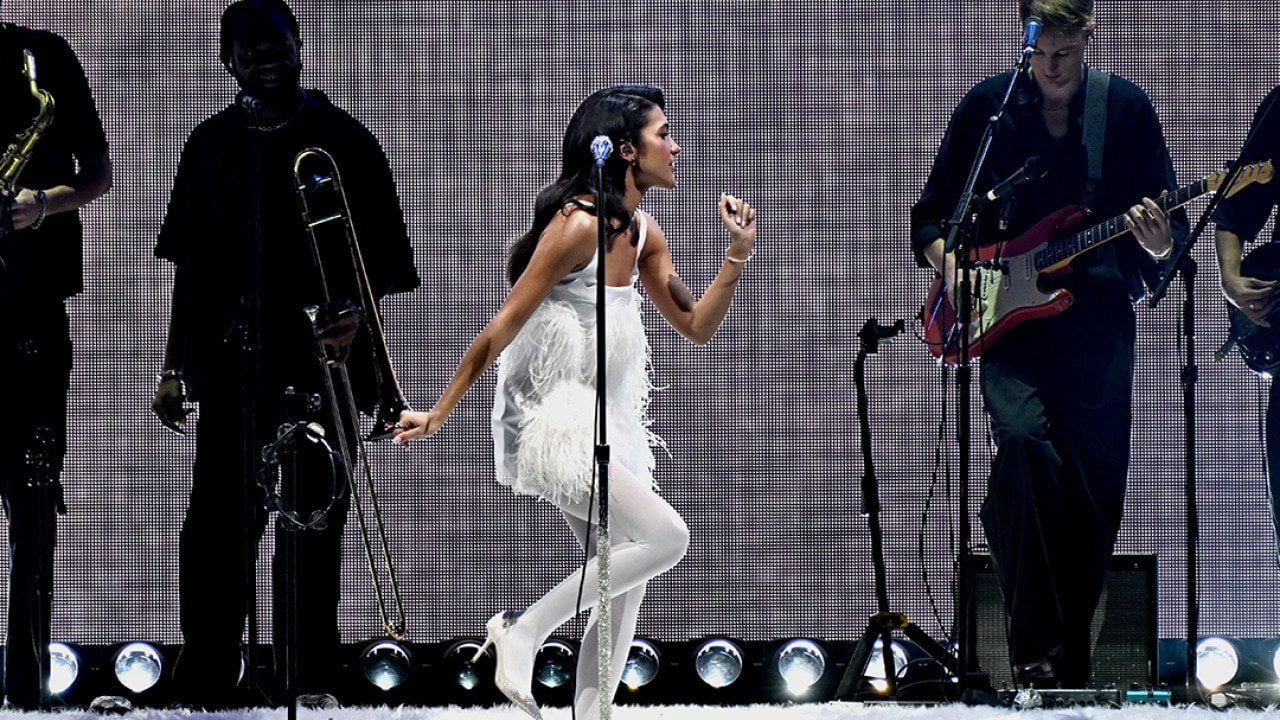
Singer Olivia Dean performs at Hot 99.5's iHeartRadio Jingle Ball 2025 at Capital One Arena, Washington, D.C.

Shannon Finney // Getty Images


Each awards season, the Grammy nominations prompt a familiar debate: which artists and songs truly defined the year in music? While critical acclaim and cultural impact dominate much of the conversation, audience behavior leaves its own trace across streaming platforms, radio playlists, and video services. Those signals, taken together, offer a clearer picture of which nominees sustained attention over time and which gained momentum as the eligibility period drew to a close.

Viberate Analytics takes a closer look at two of the Grammy Awards’ most closely watched categories — Best New Artist and Song of the Year—by comparing how nominees performed across major music platforms during the eligibility year. Rather than speculating on voting outcomes, the analysis focuses on measurable indicators of reach, growth, and consistency to show which contenders stood out in practice.

Scope of the analysis and data sources

Eight nominees were examined in each category. All artists and songs were evaluated using the same metrics to ensure comparability. The analysis draws on verified performance data from Spotify, YouTube, radio airplay, and Spotify playlists—platforms that collectively capture streaming demand, video consumption, editorial support, and broadcast exposure.

Two timeframes were used. A twelve-month window reflects overall scale and presence during the eligibility period, while a thirty-day window at the end of that period highlights late-year momentum. Daily performance patterns were reviewed to understand trend direction, but aggregated figures formed the basis for comparison. Metrics were normalized within each nominee group so that no single platform disproportionately influenced the results.

Best New Artist: performance signals across platforms

The Best New Artist category brings together performers whose profiles expanded most visibly over the past year. The eight nominees included in this analysis are: 

  • KATSEYE
  • Olivia Dean
  • Alex Warren
  • sombr
  • The Marías
  • Addison Rae
  • Lola Young
  • Leon Thomas

Across the group, performance varied sharply depending on platform. Some artists built their following primarily through video, accumulating hundreds of millions—or even billions—of YouTube views, while others showed steadier gains through streaming and playlist exposure. Radio airplay added another layer, revealing which acts translated listener interest into broader industry support.

Among the nominees, Olivia Dean emerged as the most balanced performer across metrics. Over the twelve-month period, she posted the strongest growth in monthly Spotify listeners within the group, pointing to sustained audience expansion rather than a short-lived spike tied to a single release. Her music also reached the largest audience through Spotify playlists, benefiting from consistent placement in both editorial and algorithmic selections.

Radio data reinforced this trajectory. While several nominees accumulated higher total spin counts earlier in the year, Olivia Dean’s airplay in

Step-by-step business startup checklist

Kraig Pakulski 0 34 Article rating: No rating

A team of young cafe workers pose in front of their shop's front bar.

Dmytro Zinkevych // Shutterstock


If you want to start a small business or launch a startup, this business startup checklist can be your roadmap for every step. It can help walk you through researching and validating your idea, estimating your startup costs and protecting yourself with the right business insurance for your industry and your size. You’ll also learn more about necessary permits, paperwork and business operations, as well as how to market your new business to attract customers. Whether you’re opening a retail shop, selling your professional services, or planning to work from home, ERGO NEXT has a checklist for startup businesses that can help you stay organized and build momentum.

1. How to research your new business idea

Before you launch your business, you’ll want to determine if it is viable: Does it have the potential to become successful? After all, you wouldn’t want to pour your heart and efforts into a business idea with very little chance of profit.

How do you know if your business idea is viable?

Before you launch, take time to confirm your idea has real potential. Early market validation helps you understand whether customers want what you plan to offer — and whether your business could be profitable. Start by identifying the problem you’re solving, who needs that solution and if they’re willing to pay for it.

What does your local market look like?

Every business operates within a specific community, so look closely at local market demand and any startup requirements. Get information about:

  • Who your potential customers are and what problems you’re going to solve for them.
  • The preferences of these potential customers. How will they find you, and how do they like to communicate? What do they like and dislike?
  • Who are your competitors, and what are their strengths and weaknesses?
  • What is it like to start a business in your area? What are the steps and regulations?

For example, if you’re opening a landscaping business, you might research how many homes in your area hire yard services and what competing companies charge.

Check whether similar products or services already exist, what competing businesses do well and where gaps might be. Tools like the U.S. Census Business Builder and County Business Patterns can help you understand local demand and customer demographics in your area.

TIP: A small business class — through the Small Business Association (SBA) or a local community college — can help first-time entrepreneurs navigate this early research stage.

This early research sets the foundation for the rest of your business startup checklist and helps you move forward with clarity.

2. How to estimate startup costs for a startup business

Once you confirm your idea is viable, the next step is understanding what it will cost to get y

Before ICE shooting, immigration agents repeatedly used deadly force

Kraig Pakulski 0 23 Article rating: No rating

ICE officers breaking a car window to remove a woman from her vehicle on January 13, 2026 in Minneapolis, Minnesota.

Octavio JONES // AFP via Getty Images


When an Immigration and Customs Enforcement agent shot and killed 37-year-old Renee Nicole Good in Minneapolis on Jan. 7, it was not the first time that federal officers have killed civilians since the Trump administration launched its aggressive immigration enforcement campaign.

Federal officers have fatally shot at least three other people in the last five months, according to news reports reviewed by The Marshall Project. In September, Silverio Villegas González, a father originally from Mexico who worked as a cook, was killed while reportedly trying to flee from officers in a Chicago suburb, WBEZ reported. In December, a border patrol agent killed a 31-year-old Mexican citizen while trying to detain him in Rio Grande City, Texas. And on New Year’s Eve, an off-duty ICE agent used his service weapon to shoot a man in Los Angeles, California, according to CBS News. Authorities said the man had raised a rifle at the officer.

Agents have also shot other people. The Trace, the nonprofit news organization covering gun violence, has counted more than a dozen such shootings. In some cases, the victims survived, including a woman who suffered multiple bullet wounds in an incident in Chicago in October. The Border Patrol officer who shot her appeared to brag about it in a text message, later presented in court evidence. The message reportedly read, “I fired 5 rounds, and she had 7 holes. Put that in your book boys.” That shooting happened as part of Operation Midway Blitz, an immigration enforcement campaign in which federal agents fanned across Chicago, similar to what they are doing in Minneapolis now. The administration has also conducted large-scale blitzes in Los Angeles, Portla

Crypto all-time highs by year: When the market set new records

Kraig Pakulski 0 27 Article rating: No rating

Gold crypto coins on a wooden surface.

Diego Thomazini // Shutterstock


In 2017, JPMorgan (JPM) CEO Jamie Dimon called bitcoin a “fraud.” Now, his company is building its own blockchain and believes the current crypto downturn will be short-lived. Bitcoin’s price history helps explain why. According to StatMuse, BTC has grown by over 20,000% since 2016 and set 11 new highs in 2025.

But raw percentage growth only tells part of the story. To better understand when crypto enters true price-discovery mode, Finder.com tracked how often the top five cryptocurrencies by market cap reach new price records. Let’s explore crypto all-time high (ATH) activity by year.

How often crypto hits new all-time highs

2021 reigns supreme as the year with the most all-time highs, coming in at a whopping 147. Another banner year was 2017, which hit just under 120 ATHs. Together, they account for more than half of the decade’s total all-time highs.

A table listing new crypto all-time highs since 2015 to 2025.

Finder.com

By contrast, 2022 and 2023 collectively saw no new records set at all, at least not by these top five coins. If you know crypto history, this lack of ATHs lines up with the crypto winter that followed a series of high-profile failures in the digital world — most notably, the collapse of crypto exchange FTX.

The periods between these peak markets and deep downturns featured moderate record-setting activity. The years 2016, 2020 and 2024 all had ATHs in the 20s, with 2018 and 2019 in the teens. These mid-cycle years usually represent growing momentum after a crash.

Which coins set the most all-time highs?

It’s probably no surprise that the OG crypto, bitcoin (BTC), takes top prize as the coin that set the most records over the last decade. Coming in at 163, it holds the lead with nearly double the ATHs of second place.

Table listing types of coin and total ATH events since 2015.

Finder.com

The next three — ether (ETH), solana (SOL), and BNB — fall into a clear middle band, each recording 70-84 all-time highs. While all three coins have seen strong growth, all were l

11 numbers that capture the Trump effect on education

Kraig Pakulski 0 29 Article rating: No rating

: Protestors participating in a 'study-in' in front of the US Department of Education building on March 21, 2025 in Washington, D.C.

Kayla Bartkowski // Getty Images


About 1.5 million people teach on college campuses in the United States, and nearly 4 million teachers work in its public elementary and secondary schools. More than 15 million undergraduates attend U.S. colleges and universities. There are more than 50 million school-age children across the country.

They all have one thing in common: Federal education policy affects their lives.

President Donald Trump and Education Secretary Linda McMahon say they want to close the Department of Education and return control of education to the states. At the same time, however, they have aggressively and rapidly wielded federal power over schools.

The Hechinger Report takes a look at some key data points from the first year of Trump’s second term that represent the outsized effect this presidency has had on the nation’s educational institutions and the people within them.

— 15 —

Number of executive orders Trump signed that exclusively address colleges or schools

In 2017, the first year of his first term, Trump signed two executive orders related to education. This year, he signed three times that number on just a single day in April.

Among his most notable executive orders was one early in his term requiring the Department of Education to begin dismantling itself. He also established an Artificial Intelligence Education Task Force and asked cabinet members to provide him with a plan to end “radical indoctrination” in schools. Other executive orders have addressed school discipline, transgender athletes, registered apprenticeships and foreign influence on college campuses.

Another set of executive orders indirectly affected schools. For instance, the Department of Education interpreted an order about undocumented immigrants to require limiting access to some adult and career and technical education programs. And separately, in a

RSS
First36183619362036213623362536263627Last