
Click on the Manage Content for adding and managing content.
Click on the Rotator Settings and choose what and how it will be displayed.

What emergency hardship financial aid is and how to get it

Kraig Pakulski 0 67 Article rating: No rating

A stressed young adult sitting in front of a laptop.

MAYA LAB // Shutterstock


Emergency hardship financial aid gives you fast financial support when an unexpected crisis leaves you unable to cover essential expenses. You can get this aid through government programs, nonprofits, personal resources, or cash loan options that help you stabilize your situation quickly.

You might need this type of aid after a sudden job loss, a medical emergency, or an urgent bill that hits before your next paycheck. When life feels overwhelming, and your budget can’t stretch any further, emergency aid can act as a safety net so you can focus on getting back on track. CreditNinja discusses types of emergency hardship financial aid and how to go about obtaining it.

Federal and State Agencies for Emergency Hardship Financial Aid

You may be eligible for funding from federal or local assistance. Here are a few situations in which you could get financial aid from government assistance programs.

Unemployment Insurance

If you are facing a job loss, you may be eligible for unemployment insurance. Start with unemployment insurance online. Your state will have a specific site dedicated to unemployment benefits. Once you get there, create a login and provide details about your job loss. You will not qualify for unemployment in most states if you quit your job.

If you qualify, the amount will depend on your wages and dependents.

And so, if facing a financial crisis due to job loss, start with unemployment insurance. Although it may not cover your entire wages, it can be the financial relief you need.

For small business owners, the Small Business Administration (SBA) assists business owners who need financial aid.

Financial Aid for Medical Emergencies

Medical emergencies can affect your credit if you don’t pay your bills. If you have health insurance, start with them. Your insurance should provide some aid after meeting the deductible. The deductible and the amount of coverage will depend on your health insurance policy. A dependent should also be covered if enrolled in your health insurance.

Below are alternatives to health insurance:

  • A health savings account (HSA) — An HSA is a type of savings account offered by several employers. Your HSA is essentially a savings fund used for medical expenses.
  • Low-cost medical insurance (Medicaid and CHIP) — Medicaid and the Children’s Health Insurance Program are low-cost medical insurance options provided by the federal government for families and individuals on low incomes.
  • Temporary Assistance for Needy Families (TANF) — TANF helps families on low incomes cover all kinds of costs, including medical bills and expenses.

Emergency Financial Aid for Basic Necessities

Local and federal government agencies help individuals and families who need financial relief and economic security. Here are a few:

  • TANF — As mentioned above, TANF is a federally funded program that can assist families in need. TANF helps with food, housing, health care, childcare, and other basic needs.
  • Special Supplemental Nutrition Program for

Does your dog need a winter coat?

Kraig Pakulski 0 74 Article rating: No rating

A dachshund wearing a winter coat with snowy outdoors.

Darla Khazei // Shutterstock


You spent hours searching online for the comfiest (and most stylish) winter coat for your dog, and you’re finally ready to press “add to cart” — but before you take the plunge, you probably want to know if a new jacket is something your pet really needs. The reality is, there’s no one-size-fits-all answer.

If your dog naturally has a thick, long coat — think Pomeranian or a Bernese mountain dog — they probably don’t need to worry about layering. But if your pup is slick-coated, very young, elderly, or suffering from a medical condition like arthritis, a coat can do wonders to keep them comfortable when chilly weather hits. Jackets can be especially beneficial for small dogs; it’s harder for the little guys to retain body heat.

You should also consider how long you and your dog are going to be outside. Your pup might be fine going coatless on a quick, 10-minute walk to do their business. But if you’re planning on taking your favorite hiking buddy along on a snowy winter’s day, they’ll probably appreciate some help staying warm.

There’s also the matter of actually getting your dog into the coat. If your pup’s just not having it, you’re not alone; lots of dogs are resistant to dressing up, no matter how adorable their new outfit is. But don’t worry — there are ways to train a dog to wear a winter coat. Below, Kinship breaks down everything you need to know about what kind of winter accessories your pup might need and how to make suiting up before walks stress-free.

Do dogs get cold?

Just like people, dogs can get cold, but exactly when they get cold depends on a variety of factors like their coat type and length, as well as their size. Some breeds — the Siberian husky and Alaskan malamute, for example — are bred for cold weather and may even be reluctant to come inside out of the snow, while smaller dogs may start shivering at the slightest dip in temperature.

Experiencing intense cold without the proper protection is dangerous for dogs and can lead to hypothermia, which can be fatal in serious cases. Cold weather can also cause frostbite on your dog’s paws, ears, or tail.

Is it safe to put a winter coat on my dog?

As long as you only dress your pup up at the proper time, a winter jacket is perfectly safe. That said, never put a coat on a dog when the weather is mild or when they’re indoors, because this can lead to overheating. And no matter how cute they might look, don’t rush your dog to wear a coat if they’re totally opposed. Instead, use positive reinforcement to encourage them over time.

How to decide if your dog needs a jacket

Not every dog needs a winter coat. In many cases, it depends on the dog, as well as the temperature, so it’s up to responsible pet parents to determine if dog winter clothes are necessary. Monitor your dog while they’re outside in colder tempera

AI is replacing the search box. Could accessibility decide who gets found?

Kraig Pakulski 0 66 Article rating: No rating

Concept of AI and SEO, keyword search graphics over a hand of a robot.

Summit Art Creations // Shutterstock


For more than 20 years, search engines have served as the primary gateway to the internet. Users entered keywords, algorithms ranked results, and businesses optimized their websites to appear near the top. AudioEye examines how the rise of AI tools is beginning to redefine that entry point and reshape how people discover information online.

The shift is already visible in the data. Traffic to U.S. retail sites from AI-powered platforms like ChatGPT and Perplexity surged 4,700% year over year by July 2025, according to Adobe Analytics. A Capgemini study conducted in October/November 2024 found that 58% of consumers now rely on AI tools for product recommendations, rather than traditional search engines. And broader usage patterns continue to accelerate: ChatGPT adoption grew nearly 70% in the first half of 2025, with shopping-related queries doubling during that period, according to Bain & Company reports.

Meanwhile, people are completing more of their research directly within AI-generated results, a major departure from the classic “search, click, browse” pattern of the last two decades. Google AI overviews now appear in over 60% of search queries, according to Xponent 21, fundamentally changing how information is consumed and how often users need to leave the search page.

For businesses that depend on traditional search visibility, these shifts represent a structural change. And they place new importance on something many organizations have historically underestimated: whether their websites are built in ways that AI systems can actually understand.

AEO and GEO: The New Rules of Discoverability

As AI tools begin interpreting and delivering more of the web’s information, two concepts are emerging as essential to online visibility: answer engine optimization (AEO) and generative engine optimization (GEO).

AEO and GEO focus on making information easy for AI systems to extract, interpret, and respond with. Clear headings, descriptive labeling, logical hierarchy, and consistent formatting all help AI understand the purpose and meaning of a page. Structural elements like semantic HTML, navigable layouts, well-formed links, and properly coded components matter more in an environment where models must summarize or recommend information rather than simply index it.

Together, AEO and GEO represent a shift from keyword-based optimization to comprehension-based optimization. It’s no longer enough for a page to contain relevant information. AI needs to understand that information well enough to paraphrase it, cite it, or recommend it.

This evolution puts renewed attention on the integrity of a website’s under

GLP-1 medications compared: Benefits and differences

Kraig Pakulski 0 90 Article rating: No rating

Multiple GLP-1 injection pens.

Gecko Studio // Shutterstock


GLP-1 medications have rapidly become some of the most influential treatments for Type 2 diabetes and weight loss. As more people look into these prescriptions, there is growing curiosity about how the medications compare, which ones work best, and how much they cost. Since most GLP-1 drugs are expensive, people often look for savings resources.

In this guide, SaveHealth, a prescription discount/savings card website, breaks down the most commonly used GLP-1 medications, including Ozempic and Trulicity, to help you understand their differences, benefits, and what to consider before starting a prescription.

How GLP-1 Medications Work

GLP-1 receptor agonists mimic the body’s natural GLP-1 hormone, which helps signal the body to release more insulin when blood sugar is high. This will slow the stomach to empty, which acts on the brain to reduce appetite and increase fullness. This hormone plays a key role in regulating appetite, digestion, and insulin response. As a result, GLP-1 medications can improve blood sugar control and encourage weight loss.

Key effects of GLP-1 medications

  • Encourage insulin release when blood sugar rises
  • Slow stomach emptying to improve digestion and increase fullness
  • Reduce appetite
  • Lower post-meal glucose spikes
  • Support sustainable weight loss efforts

Because many GLP-1 drugs come with high monthly costs, people often use price comparison resources to get a sense of price ranges before deciding which option to pursue.

Most Common GLP-1 Medications

Below is a comparison of today’s most prescribed GLP-1 medications, including Ozempic and Trulicity, both widely used for Type 2 diabetes and increasingly discussed for weight support.

GLP-1 Medications
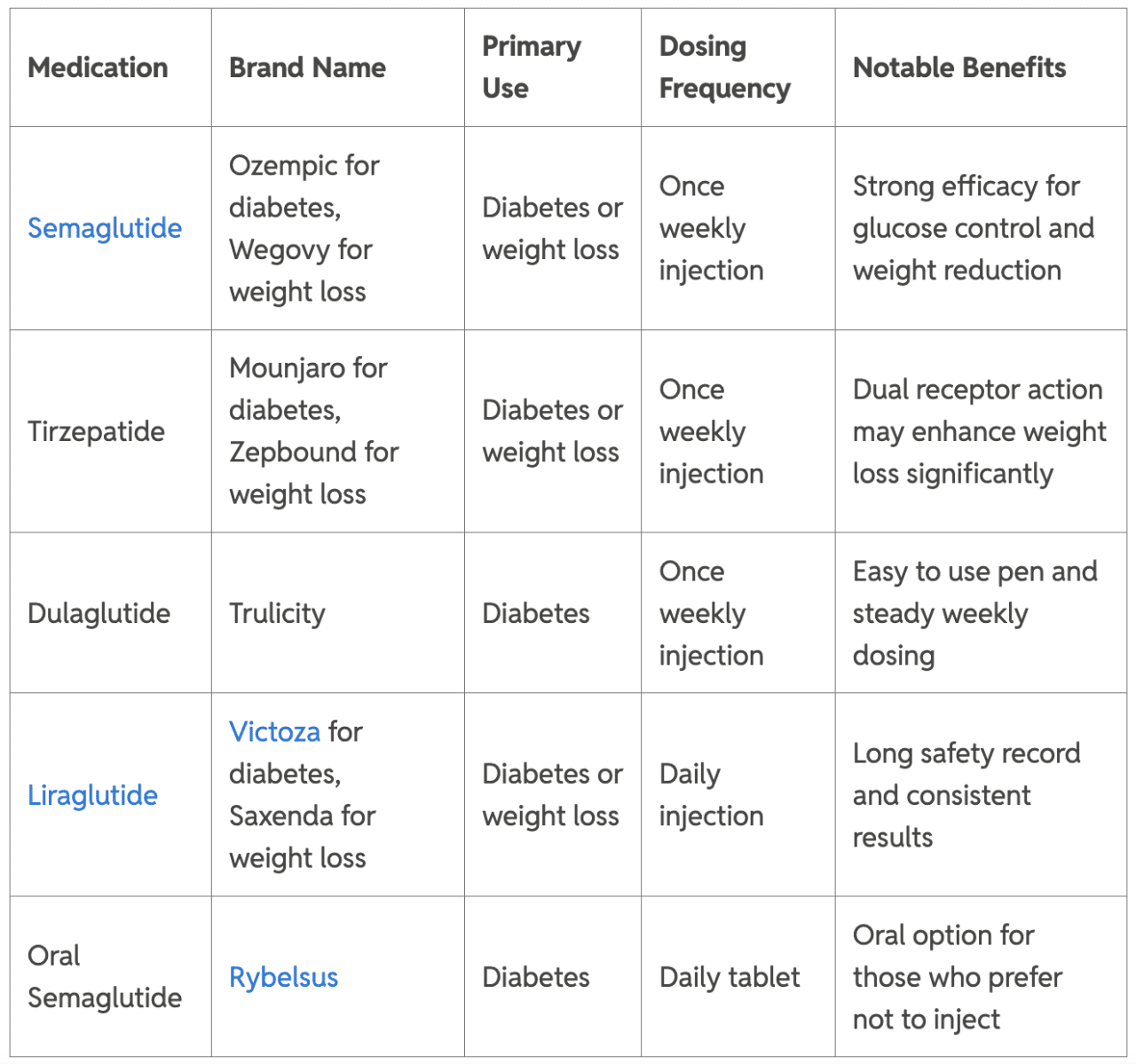
A table listing medications and their brand name, primary use, dosing frequency, and notable benefits.

SaveHealth

Patients choosing between these medications often look at factors such as cost, insurance coverage, dosing preference, and weight loss expectations.

Ozempic GLP-1 Overview

Ozempic contains semaglutide and is one of the most well-known GLP-1 medications. It is FDA-approved for Type 2 diabetes but is sometimes prescribed off-label for weight loss.

Benefits

  • Significant A1C reduction
  • Reliable weekly dosing
  • Strong weight loss results in many patients
  • Heart health benefits for individuals with cardiovascular risk

Considerations

Capital gains tax: 2025-2026 rates, brackets and state guide

Kraig Pakulski 0 110 Article rating: No rating

A row of stacked coins with an estate construction site background.

Pisit.Sj // Shutterstock


Investors who sell an investment at a profit in a taxable account incur a capital gain that they must report on their tax returns. For investments held longer than one year, the long-term capital gains tax applies. In both the 2025 and 2026 tax years, federal tax laws impose three different rates on long-term capital gains based on income. The major tax changes enacted through the One Big Beautiful Bill Act earlier in 2025 had no impact on long-term capital gains taxes, and the changes to the income thresholds for long-term capital gains tax rates are the result of inflation-related adjustments, The Motley Fool reports.

Note: Tax rates are always subject to change. There have been numerous occasions when the U.S. Congress and state lawmaking bodies have made changes to tax laws in the middle of a year or even retroactively to a previous year. Be sure to check the latest sources at the IRS and your state tax department for the most up-to-date information.

What is a capital gain?

A capital gain is the increase in value between what you paid for a capital asset and what you received when you sold it, subject to adjustments in certain cases. Most of the things you own count as capital assets, including investments, real estate, and personal property.

What is capital gains tax?

The federal government imposes taxes on capital gains for assets held in taxable accounts, like a brokerage account. Sales of assets inside tax-deferred accounts, such as IRAs and employer-sponsored retirement plans like 401(k)s, don’t generate capital gains tax.

Capital gains tax: Short-term vs. long-term

Federal tax laws break down capital gains into two categories based on how long the owner held the asset. Short-term capital gains tax applies to sales of assets held for one year or less. For assets held longer than a year before sale, the federal government imposes long-term capital gains tax.

What is the long-term capital gains tax rate?

Long-term capital gains tax at the federal level is taxed at three different rates: 0%, 15%, and 20%. The tax rate applied to each taxpayer depends on the amount of long-term capital gains and other gross income, as well as the taxpayer’s filing status.

Long-term capital gains tax rates for 2026

These are the rates and income brackets governing federal taxes on long-term capital gains for assets sold during the 2026 tax year and reported on the 2026 tax returns due in April 2027.
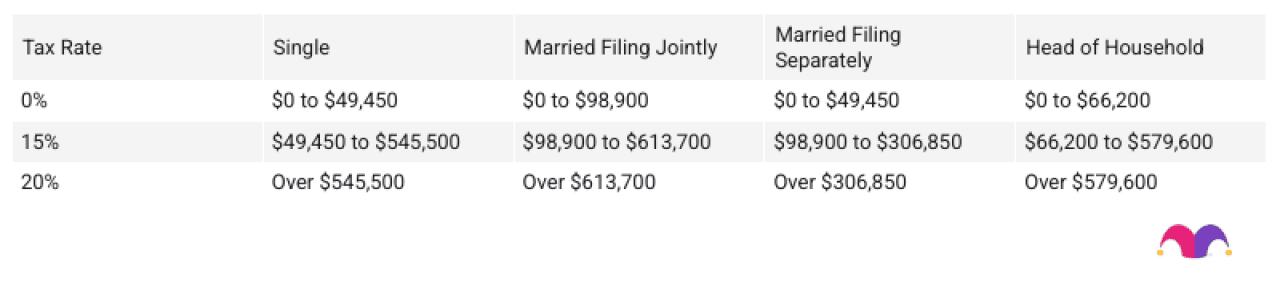
A table listing long-term capital gains tax rates for 2026.

RSS
First41954196419741984200420242034204Last