Santa Barbara County News and Events

New data shows early planning is reshaping home remodeling outcomes

Kraig Pakulski 0 0 Article rating: No rating
New data shows early planning is reshaping home remodeling outcomes


Globally, spending on home renovations exceeds $2 trillion, and in the U.S. alone, there’s north of $500 billion injected into remodeling domestic properties each year, with Grand View Research reporting that the market is growing 4.6% annually.

A paper published in Physica A states that delays occur in 75% of construction projects. More than that, the median delay duration is between 20% and 40% of a given project’s total timeline. In other words, holdups are almost inevitable and can be protracted.

An infographic showing the top outcomes or benefits of early planning in home remodeling.
CMK Construction

The Cost of Indecisiveness

Data from Houzz’s 2026 U.S. Houzz & Home Study includes a survey of homeowners who’ve undergone projects of this type in the past 12 months. When exploring the reasons behind budgetary overruns, researchers found that 37% of projects exceeded their originally planned costs, while just 3% completed their renovations under budget.

One-quarter of respondents admitted that they had not even decided on a specific budget before beginning the remodeling work. Such a lack of foresight creates the conditions in which overspending and delays are incredibly likely.

The homeowners who created budgets during the planning phase but didn’t stick to them cited a few reasons for the mistake: 35% went over budget because they chose higher-end materials midproject instead of locking them in early, while 32% cited unanticipated project complexity, and 31% outright changed the project or design scope during construction. Early planning eliminates many of these midproject expenses. Finalizing decisions in advance allows time to assess viability and check affordability. It also ensures material orders are placed with a sufficient window to account for last-minute supply chain delays.

According to CMK Construction, a kitchen and bathroom remodeling specialist, more homeowners are choosing to outsource the planning entirely to professionals. With longer lead times for materials and often full order books for the most reputable operators in this industry, there’s actually more time available to most clients between the start of planning and when work commences, so having a properly finalized set of choices for design and materials is more common.

Early planning also affords contractors the necessary runway to navigate complex local regulations and successfully secure vital municipal building permits before construction begins. Furthermore, finalizing project scopes well in advance allows teams to reliably schedule specialized subcontractors, such as electricians and plumbers.

Because the construction sector is currently facing severe labor shortages across the industry, locking in these highly requested professionals early prevents extensi

What the latest driving data reveals about safer roads in 2026

Kraig Pakulski 0 0 Article rating: No rating
What the latest driving data reveals about safer roads in 2026


Road safety directly impacts insurance premiums, liability exposure, and infrastructure spending across the U.S.—yet fatality rates resisted improvement for years. The automotive industry faced regulatory pressure over annual deaths, spurring advances in vehicle safety features. Road design also shifted, with changes to intersections and street layouts showing measurable impact. But the real question is whether those efforts are actually working.

New traffic data from the National Highway Traffic Safety Administration and the U.S. Department of Transportation reveals they are. Recent studies show a clear downward trend in fatalities. Technology embedded in vehicles, autonomous systems coming online, and smarter road infrastructure are all factors that are impacting road safety. Triumph Law Group, a personal injury law firm in Phoenix, unpacks what the data actually shows and where the safety improvements are coming from.
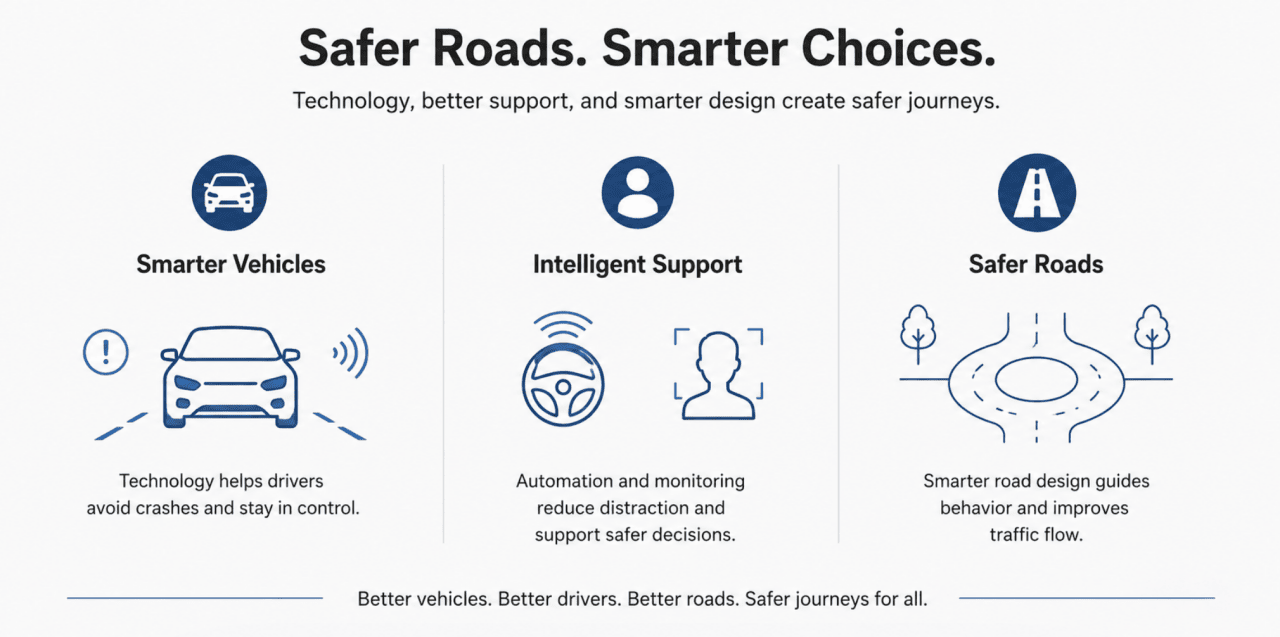
An infographic defining how smarter vehicles and safer roads are beneficial.
Triumph Law Group

Road Accident Statistics Unpacked

Annual figures on traffic safety are produced by the NHTSA and DOT. While the driving data for 2025 is still a statistical projection rather than containing final, firm numbers, the trend toward fewer fatalities is clear. Specifically, it’s estimated that deaths from auto collisions fell 6.7% year on year, from just over 39,000 in 2024 to 36,640 last year.

Q4 of 2025 was the 15th consecutive quarter in which a decline in fatalities was recorded, and researchers are confident that this trend represents a rebalancing of road safety following the unexpected disruption associated with the pandemic. So, while we’re not yet at historic lows, there’s clear, continuous movement in the right direction.

To further cement the improving safety conditions, the report estimates that for every 100 million vehicle miles traveled (VMT) on U.S. roads, just 1.10 fatalities occur. That’s a decline from the 1.19 fatalities per 100 million VMT calculated in 2024. Only one other year in the history of recording traffic safety statistics has had a lower average number of fatalities per 100 million VMT.

The data shows fatality reductions across all regions of the U.S.—even in areas that historically had higher rates. The East Coast saw the largest estimated reductions in fatalities, with areas including Virginia, Kentucky, Washington D.C., and North Carolina even reaching double digits.

The downtrend in road fatalities does not mean there isn’t a need for further improvement.

Technology’s Influence

Mandatory safety tech is part of the story. Tighter vehicle regulations forced automakers to add features that actually prevent crashes. We’re entering a period in which true self-driving cars are a reality in more parts of the country, bringing the potential for even further risk reductions.

Advanced driver assistance systems (ADAS) are now standard in most new vehicles. They range from general aid to direct intervention without taking total control of moment-to-moment driving away from

8 worst states to invest in real estate in 2026

Kraig Pakulski 0 0 Article rating: No rating
8 worst states to invest in real estate in 2026


Buy the same property at the same price with the same tenant in two different states, and you’ll end up with two completely different investments. Property taxes, insurance costs, eviction timelines, and rent control laws vary enough from state to state that location alone can determine whether a deal makes money or bleeds it.

Most investors run the numbers on a potential investment property itself, but fewer consider its location. The legal and financial landscape where you buy shapes every part of the ownership experience, from your first tax bill to the day you need to remove a problem tenant.

TurboTenant has done that research for you. What follows is a breakdown of the worst states to invest in real estate. These eight markets deserve extra scrutiny before you commit. None are necessarily off-limits, but each one comes with homework that investors shouldn’t skip.

What puts a state on this list

To build this list of the worst states to invest in real estate, five factors were weighed against each other. No single factor makes a state a bad place to invest, but when multiple negative factors stack up, the math no longer makes sense for investors.

Effective property tax rate: Property taxes across the U.S. range from 0.27% to 2.2%, and where your property falls on that spectrum determines whether your state is working for or against your tax advantages as a landlord.

Rent control or stabilization laws: Even if you don’t intend to rent out your property, rent control and stabilization laws significantly limit how much you can recoup on your purchase if you change your mind later.

Average eviction timelines: Lengthy eviction timelines can cause major headaches and derail cash flow if squatters, holdover tenants, or other ownership disputes cut off income.

Population and job market trajectories: If you’re focused on long-term property appreciation, plan to buy in an area where both the population and job market are trending upward. Your property is only worth as much as people are willing to pay to live there.

Home price-to-rent ratio: Researchers analyzed up-to-date Redfin research to determine home prices and compared them to average rents in each state. If you decide to rent out a property, buy somewhere with a solid price-to-rent ratio that allows for good returns.

These factors differ slightly from the dealbreakers a landlord weighs on a day-to-day basis. Here, TurboTenant looked at investment returns across the full property lifecycle, from purchase to exit.

8. Massachusetts

Much of Massachusetts’ housing demand is concentrated in the metro Boston area, where Read more

The psychology of a stress-free home renovation

Kraig Pakulski 0 0 Article rating: No rating
The psychology of a stress-free home renovation


Home improvement spending hit record highs in Q1 2026, topping $524 billion, according to the Joint Center for Housing Studies of Harvard University. That’s a lot of money in the ground. Most homeowners who spend that much on renovations are stressed about it. They’re watching budgets tighten, dealing with contractors, and living in half-finished homes with dust everywhere and no kitchen for three months.

According to Reece Windows & Doors, a window and door replacement company, the psychological toll is real—both financial and physical. This can look like missing the peace of their own space, the disruption to routines, and the family tension that comes with a construction zone where the living room used to be. But homeowners don’t have to white-knuckle through it. Research shows there are concrete steps that separate the projects people survive from the ones they regret.

An infographic showing the psychology of a smooth and stress-free home renovation.
Reece Windows & Doors

The Importance of Environment

The intuitive concept of having access to clean and tidy domestic spaces as a way of remaining calm and content at home is supported by extensive research, summarized in a paper published in the International Journal of Environmental Research and Public Health, which concludes that poor physical housing conditions and structural disruption directly correlate with feelings of frustration and irritability, while also leaving people mentally fatigued.

Everything from unusual smells and loud noises to thermal discomfort exacerbates stress. With the proportion of time spent indoors rising from 60% to 85% over the past half-decade, in part due to lingering habit changes brought about by the COVID-19 pandemic, renovation work thus poses a problem from a home-environment perspective.

Proper planning helps address these potential drawbacks of renovation by giving homeowners the chance to plot out where and how they’ll live during the work. How this plays out depends on the scope of the work, the budget, and the size of the property. For instance, designating certain rooms as sacrosanct, keeping them free from the clutter and dirt that can arise even in the best-managed remodeling project, means there’s a place where the temperature and air quality are adequate and a sense of normality still reigns.

The Impact of Communication

A stress-free renovation is as much a function of how homeowners interact with the professionals carrying out the work as it is their management of domestic arrangements. Construction workers and contractors across various disciplines are known to suffer from work-related stress, while also operating in an industry where help-seeking behaviors suffer from a degree of stigma, specifically in relation to mental health challenges.

This is explored in detail in a paper given at the International Conference on Transportation and Development 2024 and Read more

69% of financial institutions have pulled the plug on an AI chatbot. The problem isn't always the AI.

Kraig Pakulski 0 0 Article rating: No rating
69% of financial institutions have pulled the plug on an AI chatbot. The problem isn't always the AI.


The financial institutions many rely on are already using AI to handle some of their customer communications, and every message, from routine payment confirmations to fraud alerts, involves sensitive information. But how well AI handles these interactions doesn’t always depend on the AI itself.

New research from Sinch, which surveyed over 500 financial services leaders across 10 regions in January 2026, examines why nearly 7 in 10 organizations that have deployed AI in communications have had to pull it back at least once, and the impact on both sides of those interactions.

AI is already handling some of our most sensitive financial communications

Financial services is a complex environment in which to introduce AI. For consumers, every financial interaction carries a degree of caution, and for good reason. Financial fraud is an everyday reality for millions of people.

The Financial Trade Commission’s 2025 consumer protection data shows nearly $1 billion in reported losses to business impersonators, with bank impersonators accounting for the highest losses. Juniper even warned about a tidal wave of impersonation fraud in the coming years.

In this environment, trust is earned through decades of reliability, strict regulatory compliance, and accountability. It’s no surprise, then, that almost a third of finance leaders in the Sinch research cite compliance and legal concerns as the number one obstacle to AI deployment.

Despite this, 61% of financial services organizations have gone live with AI communications agents, and 52% say they’re very confident in their readiness to deploy at scale.

The industry is deploying AI through the complexity and with confidence, because the potential rewards are worth it. While customer support is a priority for 50% of financial institutions, the industry isn’t stopping there. It’s pushing AI into the highest-stakes communications, where customer trust and security are on the line. Fraud prevention is the second-most important AI goal at 43%, higher than any other industry. Identity verification follows closely behind at 33%.

A percentage chart showing the customer communication's areas an organization is prioritizing for AI deployment efforts.
Sinch

When a suspicious transaction gets flagged, an AI agent can reach the customer in seconds, confirm if it was them, and resolve it quickly before any permanent damage is done. In fact, in many cases, AI-based fraud prevention will even stop the fraud before it actually happens, blocking certain actions before they impact the customer.

Customer trust hinges on how well AI agents handle these situations

RSS
First2223242527293031Last