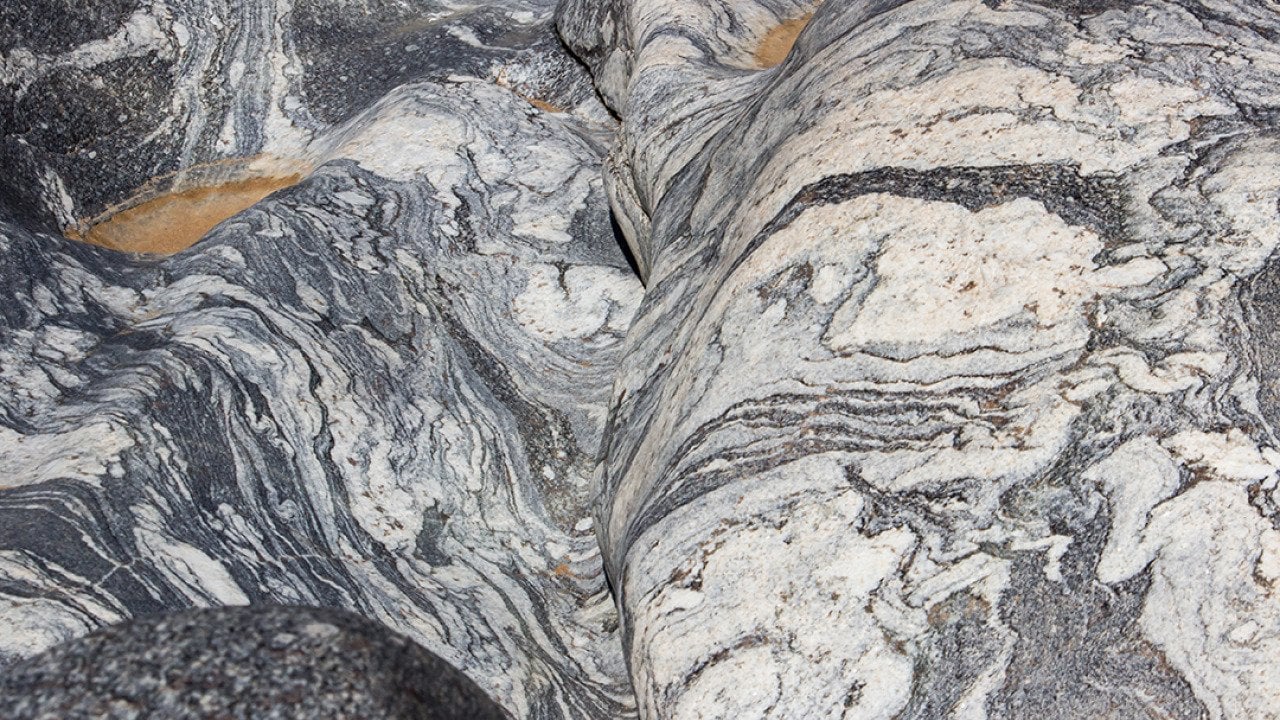
Marieke Peche // Shutterstock
Marcia Bjornerud loves rocks. Not just under a petrographic microscope, but as animated entities with properties and personalities born from their long, eventful lives. “I’ve reached a point in my career where I’m not going to hold back from talking about rocks in an affectionate way,” she said.
Bjornerud, a professor of geology at Lawrence University in Wisconsin, has spent years studying the intricate processes that shape our planet and its deep history. From the smallest grains of metamorphic rock to tectonic plates that span continents, she argues we have much to gain from better understanding the building blocks of the place we call home. It’s why she wrote her newest book, “Turning to Stone,” which examines the ways in which rocks keep the planet functioning. The book is, in many ways, a love letter to rocks—and to the possibility of reconnecting with Earth’s deep wisdom. Rocks, she says, are storytellers, archivists that hold clues to Earth’s histories. Understanding their narratives could inspire us to act with both the patience and foresight that life on this planet demands.
Never has this been more urgent. The climate crisis is fuelled by our misconception that we exist apart from nature, that we dominate it rather than belong to it. But understanding our place within Earth’s long and intricate history could shift this perspective, argues Bjornerud in her earlier book “Timefulness.” In an age of short-term thinking and quick-fix solutions, Bjornerud posits that contextualizing our existence within geological time, which spans billions of years, offers both perspective and hope.
Here, Bjornerud speaks with Atmos about the scale—and wonder—of Earth’s foundations, the spiritual costs of binary thinking, and why time literacy is essential for creating an equitable climate future.
Daphne Chouliaraki Milner:
How can the study of geology help us appreciate the interconnectedness of micro and macro systems on Earth?
Marcia Bjornerud:
Having taught geosciences for more than 30 years, I’ve realized that the most essential thing we can teach our students is the capacity to zoom in and out of scales in time and space, to look at a rock sample under the microscope and make inductive inferences on a regional scale. The geologic mindset requires this polyfocal capacity because all Earth systems are operating at these scales, too. Feeling comfortable traveling back and forth across scales is really central to the geologic worldview.
DCM: I love the word “polyfocal” because it also accurately describes the work that we’re trying to do at Atmos. Climate storytelling has for so long been restricted to one focus, but to fully understand the climate crisis, we need to nurture intersectional, polyfocal thinking. What’s an example of a seemingly small geological process that has a profound macroscale impact on our planet?
MB: Microbes are in charge of global biogeochemistry. The Earth is, in many ways, a microcracy. It’s ruled by the very tiny. We, macroscopic creatures, think we’re the top of the food chain. But the reality