Click on the Manage Content for adding and managing content.
Click on the Rotator Settings and choose what and how it will be displayed.

Why is my truck overheating?

Kraig Pakulski 0 74 Article rating: No rating
Why is my truck overheating?


Imagine this—you’re cruising down the highway on a hot summer afternoon, trailer in tow, when you glance at the dashboard and see the temperature gauge climbing outside its normal range. Maybe you notice a warning light or steam billowing from beneath the hood, urging you to pull over soon before serious damage occurs. Either way, an overheating truck can turn a solid road trip or a productive day on the job into a high-stress, expensive situation.

Overheating isn’t just an inconvenience. Left unchecked, excessive engine temperatures can warp cylinder heads, damage head gaskets, or even fry an engine. The good news? Most overheating issues begin with common, diagnosable problems. This guide from RealTruck.com covers all the reasons your truck may overheat, how to fix them, and the estimated cost to repair each.

What Does a Cooling System Do?

Your truck’s cooling system is crucial to its operation and longevity. This system regulates engine temperature by circulating liquid coolant, or antifreeze, through the engine block and cylinder heads to absorb heat and transfer it to the radiator, where it dissipates.

Core components of the cooling system include:

  • Radiator
  • Water pump
  • Thermostat
  • Cooling fans
  • Heater core
  • Hoses and belts 

When the cooling system functions properly, the engine stays within a safe operating range, preventing overheating. When something fails, heat builds quickly, leading to significant drivability and reliability issues.

What Causes a Truck to Overheat?

Trucks can overheat for several reasons, ranging from simple maintenance issues to major parts failures. Check out the most common failure points below, along with typical fixes and estimated repair costs.
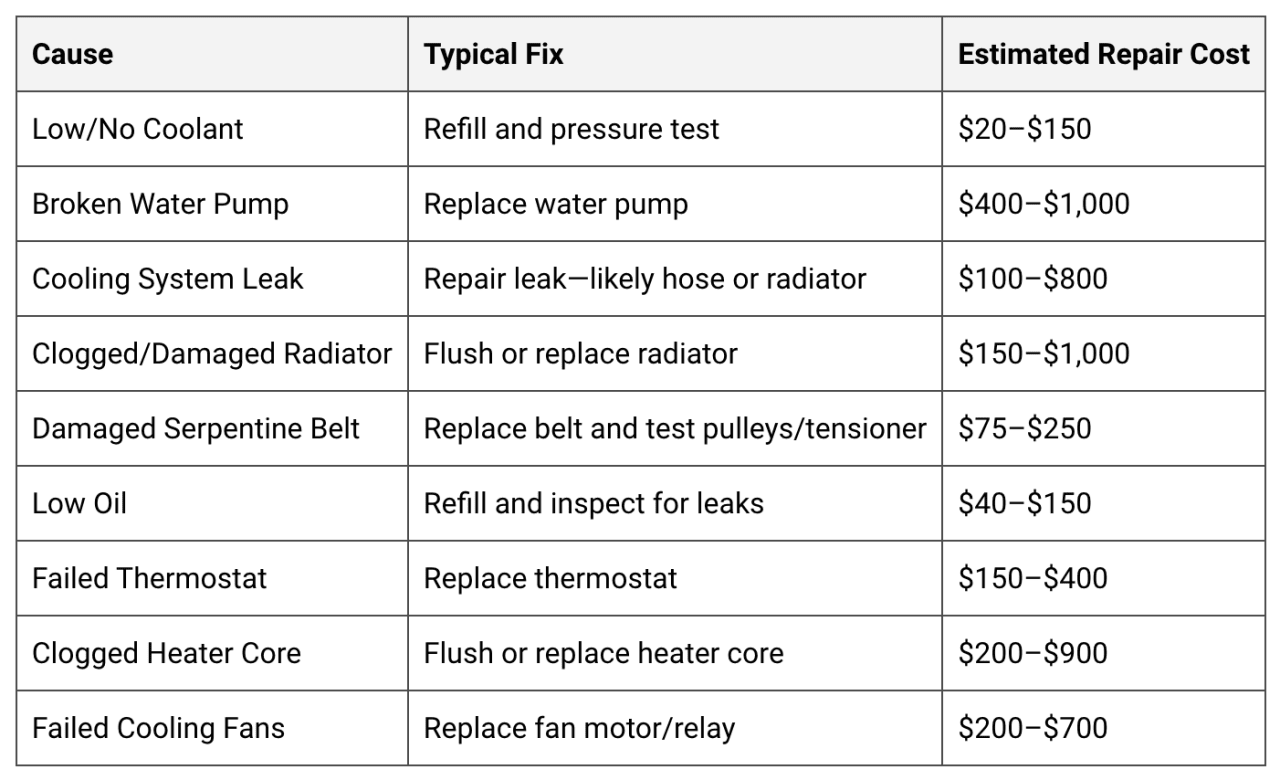
A table showing the common failure points that cause a truck to overheat.
RealTruck.com

Low or No Coolant

Coolant absorbs and transfers engine heat. If levels are low, heat won’t dissipate efficiently, leading to a buildup inside the engine and rapid temperature spikes.

How To Fix It

Top off the cooling system with the manufacturer-recommended coolant, then pressure-test it to locate leaks. Minor fixes, like a loose clamp, can be inexpensive—larger fixes, like leaky radiators, will increase repair costs.

Broken Water Pump

The water pump circulates coolant through the engine. If it fails, coolant flow stops, temperatures rise, and coolant typically leaks from the pump—either externally

Why regular maintenance is the key to extending the life of your boat engine

Kraig Pakulski 0 73 Article rating: No rating
Why regular maintenance is the key to extending the life of your boat engine


Recreational boating has become one of the country’s most reliable leisure markets, and most owners will tell you the appeal is not hard to understand. Being on open water feels like freedom, and whatever pressure follows people through the rest of life tends to stay on shore.

But the financial side of ownership is a different matter, and that reality usually comes into focus where the stakes are highest. For the tens of millions of Americans who go boating each year, the engine is one of the costliest parts of ownership to neglect.

Most experts put annual upkeep at roughly 10% of a vessel’s purchase price, meaning a $50,000 boat runs about $5,000 a year in maintenance, and when owners fall behind on that schedule, the expenses that follow tend to be significantly higher.

A failed outboard requiring full replacement costs anywhere from $11,000 to well over $100,000, depending on horsepower and configuration, and those replacement costs have been rising alongside broader equipment prices throughout the marine industry.

The technicians at RJ Nautical, a Yamaha Marine Service Pro Elite-certified operation based in Southern California, handle the consequences of deferred upkeep regularly. And the engines that arrive after years of skipped service almost always carry repair bills that a fraction of that cost in routine maintenance could have prevented.

Why Preventive Maintenance Matters More Than Ever

Prevention almost always costs less than repair, and for a marine outboard working against saltwater and open-water strain, the distance between those two costs can be wide.

Preventive maintenance is the practice of staying ahead of mechanical failure through scheduled inspections and timely service, including fluid changes and part replacements on a set schedule. Well-maintained four-stroke outboards routinely run 1,500 to 3,000 hours or more, while engines that miss regular upkeep often fall well short of that range.

And the safety side is just as important, because a stalled engine on open water carries consequences a stalled car does not, and many of those situations begin with maintenance that was pushed off too long.

The Most Critical Areas to Maintain

Good engine care does not demand a mechanic’s background, only consistent attention to the systems that cause the most damage when neglected.

Fuel and oil filters are among the first to get overlooked, and the Boat Owners Association of the United States reports that 90% of diesel engine failures trace back to contaminated fuel, because bad fuel rarely stays contained once it moves through the system.

The cooling system carries its own risk since a 300-horsepower engine moves

How AI is changing soccer from the ground up

Kraig Pakulski 0 67 Article rating: No rating
How AI is changing soccer from the ground up


More than two thousand years ago, Chinese players kicked a leather ball across training grounds in a game called Cuju to develop balance, endurance, and precision with their feet. The game evolved gradually until the 1860s when England transformed dozens of local clubs into an organized body with standardized “laws of the game.” Along the way, leather balls became lighter, village squares gave way to massive stadiums, television made local matches into global events, video replay revolutionized officiating, and advances in modern training techniques helped athletes build better bodies. Today, as XbotGo reports below, soccer is undergoing yet another evolution, in the way AI is changing the sport at all levels.

As technology advances, the sport adapts. That includes everything from synthetic playing surfaces to semi-automated offside technology (SAOT). Since FIFA introduced this breakthrough at the 2022 World Cup, review times dropped dramatically as artificial intelligence tracks players using multiple high-speed cameras, generating 3D animations to determine exact positions at the moment of a pass, improving accuracy compared to human linesmen alone. MLS uses AI to evaluate amateur players virtually, making global talent discovery possible without traditional scouting trips. Today, even a young athlete’s earliest development can be captured by any parent who sets up an AI sports camera on the sidelines and lets automated tracking take over the videography, so the parent can enjoy the game.

Artificial intelligence is an edge for players and coaches at the highest professional level. But it is also helping to democratize the pursuit of going pro by bringing video, analysis, and data-driven coaching to millions of players who may never train at an elite academy. AI sports camera companies have developed technologies that can automate game tracking and generate highlights for grassroots soccer.

These technologies can also be used to foster a player’s love of the game at an early age. Today, it’s common for children to embrace dedicated “film review” sessions with their coaches, when watching themselves on screen and sharing highlights become fun elements in training.

Two players using smartphones in a soccer field with the XbotGo Falcon 4K sports camera mounted on a tripod.
XbotGo

Automated tracking systems can now follow every movement on the field without a camera operator. For

Medical school debt and refinancing: How borrowers are managing student loans

Kraig Pakulski 0 52 Article rating: No rating
Medical school debt and refinancing: How borrowers are managing student loans


For health care professionals at all levels, from medical students to attending physicians, student loan debt is as pervasive as the common cold. Unfortunately, it takes a lot longer to go away. Severe student loan debt can affect borrowers’ financial health for years or even decades.

This spring, SoFi surveyed 229 medical professionals across the career spectrum to ask about their loan-related aches and pains. As SoFi reports below, many hope a student loan refinance can bring them some relief.

Key Findings

  • More than 61% of respondents carry student loan debt of more than $100,000, showing that high debt burdens persist even as professionals advance in their careers.
  • At least half of respondents at every career stage owe $50,000 or more.
  • Most respondents’ debt currently involves interest rates between 5.00% and 7.99%.
  • Borrowers who want to refinance student loans are most often motivated by a desire to lower interest rates, a goal shared by nearly half (45%) of respondents.
  • Most respondents are confident that refinancing student loans could save them money over the long term.

Introduction to Medical School Debt and Refinancing

In SoFi’s survey, more than one-quarter (27%) of respondents are medical students and early-career doctors known as residents. About 10% are attending physicians, while almost half (45%) are “other health professionals,” a broad category made up of nurses, dentists, therapists, and other related practitioners.

Almost all of these health care workers have financed their many years of schooling by borrowing. Due to the financial strain, they’re thinking about student loan refinancing for some or all of this debt.

Most Borrowers Are Not Early-Career Health Care Professionals

At first glance, you might expect early-career health care professionals to be carrying more medical school debt than full-fledged doctors do, since they haven’t had as much time in the workforce to earn money and pay back their loans.

But SoFi’s survey found otherwise. Among medical students, only two-thirds (66%) owe more than $100,000. Almost three-quarters (74%) of residents owe that much. And almost 9 out of 10 (88%) attending physicians carry a six-figure debt. Other health professionals — people who may not have medical degrees — also carry a great deal of student loan debt. There’s no indication of how long these borrowers have been out of school, but as a group, their debt load is comparable to that of residents: 89% of residents and 88% of other health professionals owe at least $50,000.

A data graphic visualizing student loan debt among health professionals.
SoFi

The Majority of Borrowers Carry Over $100,000 in Student Loan Debt

Regardless of career stage or role, more than three-fifths (61%) of all survey respondents have medical stu

Jessie Rios of Santa Maria Arrested in Connection with Ongoing Child Sexual Abuse Investigation

Kraig Pakulski 0 55 Article rating: No rating

SANTA MARIA, Calif. (KEYT) – Jessie Javier Rios, 21, of Santa Maria was arrested Thursday in connection with an ongoing investigation into the sexual abuse of a minor.

According to Santa Maria Police, detectives served a search warrant at his home in the 800 block of East Fesler Street yesterday and the 21-year-old was arrested on charges of sexual abuse of a child under the age of 14.

Rios' bail has been set at $250,000 shared the local law enforcement agency with Your News Channel Friday.

Detectives believe there may be additional survivors in the local area and anyone with more information is asked to contact Detective Kevin Ochoa at 805-928-3781 ext. 2460.

The post Jessie Rios of Santa Maria Arrested in Connection with Ongoing Child Sexual Abuse Investigation appeared first on News Channel 3-12.

RSS
First209210211212214216217218Last