Santa Barbara County News and Events

What the Los Angeles housing market looks like at 5 different price points

Kraig Pakulski 0 18 Article rating: No rating

Arina P Habich // Shutterstock


A record rise in home prices across the country was brought about by record-low interest rates on home loans, soaring demand from buyers, and a housing shortage exacerbated by hesitancy among developers.

Sundae looked to its internal database of homes to show what houses look like at five different price points in Los Angeles-Long Beach-Santa Ana, CA, ranging from $100,000 to $1 million. For each price point in Los Angeles-Long Beach-Santa Ana, CA, Sundae lists how many houses are for sale, as well as show an example and characteristics of one of these homes.

In June, properties remained on the market for an average of just 17 days—24 less days than the year prior—and the median price for an existing home was up 23% over June 2020, according to a report from the National Association of Realtors. Out of all homes on the market, 90% have generally been selling within one month.

Continue reading to find out more about the housing market in Los Angeles-Long Beach-Santa Ana, CA.

Sundae

$100,000-$200,000

– Sales of $100,000-$200,000 homes: 966
— Average number of bedrooms: 2.5
— Average square feet: 1,319

Sundae

$200,000-$300,000

– Sales of $200,000-$300,000 homes: 3,233
— Average number of bedrooms: 2.2
— Average square feet: 1,097

Sundae

$300,000-$500,000

– Sales of $300,000-$500,000 homes: 21,784
— Average number of bedrooms: 2.4
— Average square feet: 1,224

California is the #4 state that will need nurses the most by 2030

Kraig Pakulski 0 32 Article rating: No rating

Ringo Chiu // Shutterstock


A perfect storm of factors taken all together could leave the world short of almost 5.7 million nurses by 2030, according to forecasts by Becker’s Hospital Review.

Issues in the United States contributing to this shortage include the baby boomer generation reaching retirement age, an increased need for health care as our population gets older, a lack of qualified educators, and the COVID-19 pandemic. While every state is feeling the effects of these factors, their intensity—and the amount to which they’ll affect the nursing supply—varies immensely.

NursingEducation.org used data from the Health Resources and Services Administration’s Health Workforce Simulation Model, which is an integrated health professions projection model that estimates the current and future supply of and demand for health care providers. The 2017 model, which is the most recent available, looks at the demographics of current health care providers, current and projected population numbers, and the state of the national economy and the labor market.

For this story, the states were ranked by the projected surplus of registered nurses in 2030, which is the percent change between the projected supply of RNs and the projected demand. A positive percentage means there is a projected surplus of nurses in 2030, and a negative percentage means there is a projected shortage of nurses. Any ties are broken by the projected surplus of licensed practical nurses in 2030.

Keep reading to see where your state falls in the rankings and what’s being done to help amend the crisis—whether improving the student-to-professional pipeline or providing monetary incentives.

California by the numbers

– Projected shortage of registered nurses in 2030: 11.5%
— 2030 projected demand for registered nurses: 387,900
— 2030 projected supply of registered nurses: 343,400
– Projected surplus of licensed practical nurses in 2030: 3.1%
— 2030 projected demand for licensed practical nurses: 117,400
— 2030 projected supply of licensed practical nurses: 121,000

While it’s been a known fact for years that California will be at the center of the nursing shortage crisis come 2030, the COVID-19 pandemic has only accelerated the issue. At two separate points over the last year the state, namely the Los Angeles and San Francisco areas, has been the epicenter of the pandemic, and its 300,000 nurses have been stretched to their limits. The concern now is that many nurses, especially older ones, will retire early due to the stress and over concern for their own health and well-being, which will only make the projected 11.5% shortage happen befor

What common medical visits cost in California – and how they compare to nearby states

Kraig Pakulski 0 33 Article rating: No rating

smolaw // Shutterstock


In the patchwork of health care providers in the United States, determining what a medical visit might cost can be confusing at best and life-altering at worst. The vast majority of patients who arrive at the hospital for a service recommended by their doctor do so without knowing the cost of that treatment. The price tag on most medical visits is so high for the uninsured, a full one-third of all money raised on GoFundMe is for health care costs.

A raft of legislation in nearly every state is set on tackling some of these endemic issues, with energy aimed squarely at lowering costs and expanding access. Some of this legislation is grand in scope, notably in states like New York where legislators are looking to put a public option on the table for residents there. Other states are taking a narrower approach, requiring providers to release price lists so patients are aware of what their care will cost.

Stacker analyzed cost data released on June 8, 2021, from the Centers for Medicare & Medicaid Services, common provider data from Verywell Health, and state zip codes from Simplemaps to find the average out-of-pocket cost for three typical medical visits in each state.

California

– Most common family practice visit costs
— Medicare recipients: $114.89 for established patients ($99.50 for new patients)
— Other insurance holders: $28.72 for established patients ($24.88 for new patients)
– Most common internal medicine visit costs
— Medicare recipients: $114.89 for established patients ($147.83 for new patients)
— Other insurance holders: $28.72 for established patients ($36.96 for new patients)
– Most common pediatric medicine visit costs
— Medicare recipients: $114.89 for established patients ($99.50 for new patients)
— Other insurance holders: $28.72 for established patients ($24.88 for new patients)

Health care costs could soon change dramatically for California residents. A current bill is considering a single-payer health system. In such a system, out-of-pocket costs for patients would be outright banned.

Some trends held steady across most states. For family practice and pediatric visits, new patients often pay less than established patients. For internal medicine visits, new patients frequently pay more than established patients. Both of these trends exist regardless of insurance type.

Transparency is increasingly paramount in American health care. Keep reading for a look at what common medical visits cost in neighboring states and the state-level factors that may influence these costs.

Oregon

– Most common family practice visit costs
— Medicare recipients: $100.62 for establi

Most diverse counties in California

Kraig Pakulski 0 55 Article rating: No rating

Canva


The United States has a longstanding reputation as being a melting pot (or salad bowl), with its diversity manifesting itself across many different demographics. However, some places across the country are notably more heterogeneous than others.

Stacker compiled a list of the most diverse counties in California using data from using data from the U.S. Census Bureau. Counties are ranked by the highest Simpson’s diversity index score. Simpson’s diversity index measures community diversity on a scale of 0 (least diverse) to 1 (most diverse), more on the calculation can be read here.

Think you know which counties in your home state might be the most diverse? Keep reading to see if your predictions are correct.

You may also like: Hottest Septembers in California since 1895

DimiTalen // Wikimedia Commons

#50. El Dorado County

– Index: 0.228
– Total population: 188,563
– White: 87.6% (165,234)
– Black or African American: 0.8% (1,516)
– American Indian and Alaska Native: 0.8% (1,532)
– Asian: 4.5% (8,540)
– Native Hawaiian and other Pacific Islander: 0.3% (486)
– 2 or more races: 3.9% (7,263)
– Some other Race: 2.1% (3,992)

Bobak Ha’Eri // Wikimedia Commons

#49. Amador County

– Index: 0.243
– Total population: 38,429
– White: 86.7% (33,327)
– Black or African American: 2.4% (904)
– American Indian and Alaska Native: 0.8% (303)
– Asian: 1.3% (508)
– Native Hawaiian and other Pacific Islander: 0.1% (57)
– 2 or more races: 4.8% (1,830)
– Some other Race: 3.9% (1,500)

Doug Kerr // Wikicommons

#48. Shasta County

– Index: 0.247
– Total population: 179,212
– White: 86.6% (155,124)
– Black or African Amer

California is the #1 state with the fewest registered hunters

Kraig Pakulski 0 19 Article rating: No rating

Canva


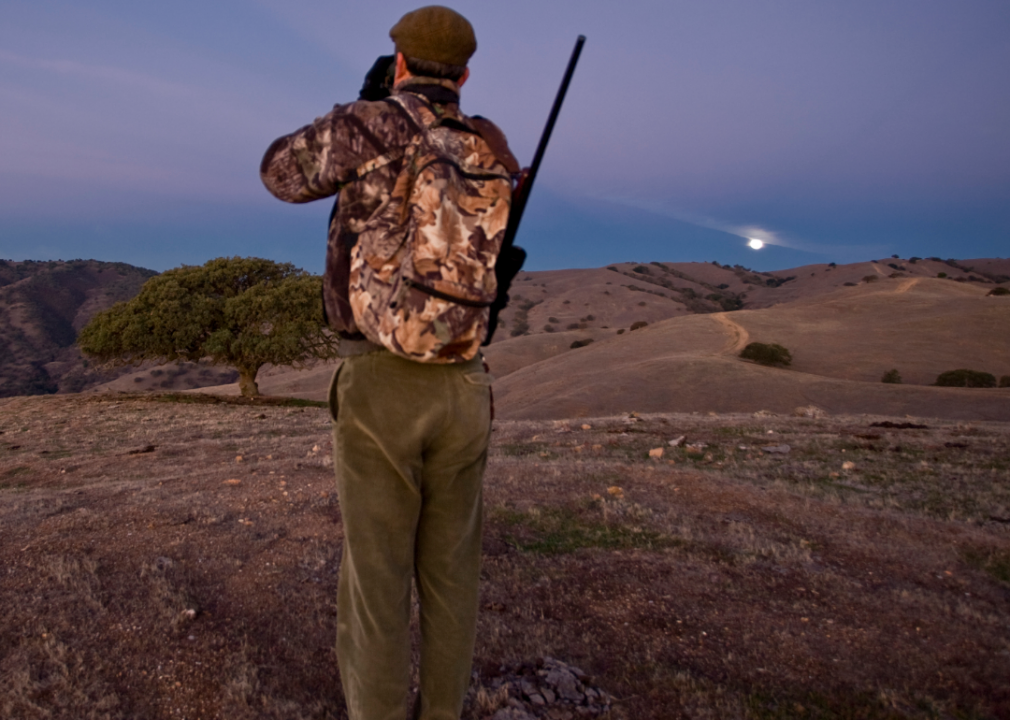
With a 3 million year record of it, it’s safe to say hunting is one of the oldest forms of human activity. Stacker compiled a complete list of the states with the most registered hunters using 2020 data from the U.S. Fish and Wildlife Service. States are ranked by percent of residents with hunting licenses. Population data is from the Census as of 2018.

There are 15.2 million hunting license holders in the United States. Over the centuries, hunting has largely evolved from necessity to sport—although many hunters in the U.S. do process hunted animals for food. As hunting gained popularity as a leisure activity, ecosystems suffered and led to various regulations in order to help preserve and conserve wildlife resources. In the United States, each state has set dates for hunting seasons, thresholds for how many tags or wild game stamps are allowed, and specific areas that are off-limits to hunting in order to help preserve habitats and animal populations.

In the past several decades, the number of people with hunting licenses in the United States has been on a sharp decline. This can be attributed to a few factors, namely the rise in the urbanization of the United States, the development of farmland, a lack of free time among hunters, and limited access to hunting land, writes the Pennsylvania Game Commission. Licenses dropped from a peak of roughly 17 million in the 1980s to 15 million in 2019, according to The Seattle Times.

California by the numbers

– Percent of residents with paid hunting licenses: 0.7%
– Total paid hunting license holders: 267,170
– Total hunting license, tags, permits and stamps: 991,897
– Gross cost of all hunting licenses: $21,107,452

Over the past 50 years, the number of hunting licenses in California has been on a rapid decline, falling 70% from more than 760,000 in the 1970s to under 268,000 in 2020—even as the state’s population has skyrocketed, according to The Mercury News. Urbanization and strict gun laws, in addition to a drop in overall interest, are why California has the fewest number of hunting licenses in the nation.

The drop-off in revenue from hunting licenses is starting to pose a problem for conservation groups. Thanks to the 1937 Pittman-Robertson Act, an 11% excise tax was placed on the sale of firearms, which was then used for conservation. Not only that, but the profits from hunting licenses themselves also go directly to funding for conservation.

There was a slight uptick in the number of hunters earlier in 2020 as some U.S. meat processors stopped operating because of COVID-19. Read more

RSS
First27842785278627872789279127922793Last