
Santa Barbara County News and Events

California is the #1 state with the fewest people living in maternal health care deserts

Kraig Pakulski 0 28 Article rating: No rating

Helen Sushitskaya // Shutterstock


Compared to other developed nations, the United States regularly ranks among the worst countries for maternal and infant health outcomes. Childbirth outcomes are often tied to a birthing parent’s circumstances, fueling wide disparities at the geographic, demographic, and income levels.

Research has shown that access to prenatal care, family planning services, and other contraceptive resources decreases maternal and infant mortality. However, an increasing number of counties throughout the country are losing access to obstetric care. Aging populations, limited staff, and low reimbursement rates for Medicaid patients are factors that have made rural hospital birth units costly to operate.

Stacker followed the March of Dimes’ definition of a maternity care desert, including counties with no hospitals with obstetric care, OB/GYNs, or certified nurse-midwives. To identify affected counties, Stacker analyzed the Area Health Resource Files from the Health Resources and Services Administration and merged this data with county-level birth data collected by the National Vital Statistics System to calculate how many births in each state are to parents who live in maternal health care deserts.

Stacker also used 2020 Census population data to calculate what percentage of a state’s population lives in counties without access to maternal health care. Although maternal health care deserts have a disproportionate impact upon people between the ages 15-44 who can get pregnant, Stacker used population data across all sexes and ages to include county-level demographic data and more deeply compare racial disparities.

Keep reading to learn about the challenges facing maternal health care in your state and how state policies and community-driven programs seek to bridge rural and demographic health care disparities, or find the national list here.

California by the numbers

– Percent of state’s births to parents who live in maternal health care deserts: 0.3% (1,127 births)
– Population who lives in maternal health care desert: 0.3%
— 0.5% of state’s white population
— 0.0% of state’s Black population
— 0.6% of state’s Native American population
— 0.2% of state’s Hispanic population
— 0.1% of state’s Native Hawaiian/Pacific Islander population
— 0.1% of state’s Asian population

Even in areas with access to maternal care, other challenges like poverty, limited transit, lack of insurance, and systematic racism can put families at risk of poor maternal and infant health outcomes. Estimates from the CDC show that 60% of pregnancy-related deaths in the U.S. are preventable, but inadequat

26.0 million votes: See the demographics of California's voting population

Kraig Pakulski 0 26 Article rating: No rating

rawpixel.com // Shutterstock


In 2020, 158.4 million citizens—almost two-thirds of estimated eligible voters—voted in the presidential elections, according to the Pew Research Center. The number represented a higher than average turnout, with people voting in numbers not seen since 1980 and possibly well before.

Stacker compiled voter demographics for each state and Washington, D.C., using the 2019 U.S. Census Bureau’s American Community Survey (released in September 2020). Each slide shows the state’s voting-eligible population (citizens who are 18 or older) and the breakdown of that population by sex, age, race, and education. Economic statistics are not included because the American Community Survey does not account for COVID-19, which affected unemployment, poverty, and medical insurance status for millions of Americans. In order to avoid making any assumptions about the data or the participants of the American Community Survey, Stacker used the exact wording of the “race” and “sex” framework that was provided in the census data.

Keep reading to see the voter demographics of your state.

California by the numbers

– Voting-eligible population: 26,032,160
– Breakdown by sex: 49.1% male, 50.9% female
– Breakdown by age: 22.9% 18-29 years old, 25.0% 30-44 years old, 31.4% 45-64 years old, 20.7% 65+ years old
– Breakdown by race: 63.4% White, 6.7% Black or African American, 14.3% Asian, 30.9% Hispanic or Latino, 0.9% Native American or Alaska Native, 0.4% Native Hawaiian or Pacific Islander, 4.1% two or more races
– Breakdown by education: 4.6% less than high school education, 6.3% some high school (no diploma), 21.9% high school graduate or equivalency, 25.1% some college (no degree), 8.2% associate’s degree, 21.8% bachelor’s degree, 12.1% graduate or professional degree

Famous for being blue and giving its U.S.-leading 50+ electoral votes to every Democratic presidential nominee since 1992, the Golden State has 20.9 million registered voters. The percentage of registered voters increased by 10% since 2016 in California, which has one of the lowest rates of prominent white voters, while male and female balloter proportions are nearly equal, on average.

By percentage, voters aged 45–64 are the highest in every state, with registered voters over the age of 45 comprising more than half the country’s population. Older voters also trend toward turning out to vote at a higher rate and played a significant role in former Read more

13.9 percent of households in California receive food stamps

Kraig Pakulski 0 22 Article rating: No rating

Jonathan Weiss // Shutterstock


Prior to the coronavirus pandemic, food insecurity throughout the United States affected more than 37 million people, among them 11 million children. That number, though staggering, represented the lowest point of food insecurity in the country in almost 90 years. Against the backdrop of the ongoing pandemic, national hunger-relief organization Feeding America expects more than 42 million Americans to face food shortages during 2021. This demand puts additional strain on already-strapped food pantries and hunger-relief organizations, and drives significant need for increases in the country’s Supplemental Nutrition Assistance Program (SNAP, also known previously as food stamps).

Stacker compiled a list of the states where food stamps are used the most using SNAP data released July 10, 2020, by the USDA. The number of households and the poverty rate are current as of 2019 data from the Census Bureau. States are ranked by the percent of households that received food stamps in April 2020. Additional information came from sources like the Center for American Progress, Feeding America, and state websites and local food banks.

California by the numbers

– Percent of households receiving food stamps: 13.9%
– Total households receiving food stamps: 1,824,382
– Average monthly benefit per household: $263 (#7 highest among all states)

The CalFresh Restaurant Meals Program gives those 60 and older, those experiencing homelessness, and those with disabilities to use their food benefits at participating restaurants. Those receiving food stamp benefits in the state are required to recertify every six months in what is widely considered to be a complicated process that creates a barrier between those in need and the benefits they are eligible for.

Here are the states using food stamps the most and least:

States using food stamps the most
#1. New Mexico (27.6% of households)
#2. Rhode Island (22.2% of households)
#3. Washington D.C. (22.0% of households)

States using food stamps the least
#1. Wyoming (5.0% of households)
#2. Utah (7.0% of households)
#3. North Dakota (7.2% of households)

You may also like: How California ranks for most motorcycle fatalities

The post 13.9 percent of households in California receiv

California has seen a 43.6% increase in gas prices since last year

Kraig Pakulski 0 21 Article rating: No rating

Canva


The national average price for a gallon of regular gasoline broke records repeatedly during the first two weeks of May, according to the American Automobile Association. AAA is a privately held not-for-profit national member association and service organization with more than 60 million members in the United States and Canada. AAA’s nationwide survey on gas prices found that, as of May 16, 2022, nearly every state has passed the $4 per gallon price.

Gas price fluctuations—up 30.8% per gallon in the U.S. from one year ago—are felt on a personal level, but they’re often influenced by sudden events and major policy shifts across the country and world. Natural disasters like hurricanes that shut down refineries along the Gulf of Mexico—where roughly half of America’s crude oil is processed—can drive prices up almost immediately. As during the First Gulf War with Iraq in 1990-91 or with Russia’s invasion of Ukraine in February, military conflicts involving oil-producing countries can also cause ripple effects worldwide.

The cost of crude oil, set by global supply and demand, is the country’s most significant determinant for gas prices. Currently, high seasonal demand, rebounding travel in the wake of COVID-19 restrictions, weak domestic output, and international sanctions against Russia—a massive player in the global oil market—are all contributing to ever-increasing prices at the pump.

Route-planning app Routific examined AAA data to see how gas prices have changed in every state over the past year, including in our nation’s capital in response to global events. States on the East Coast have seen the most painful price increases at the pump.

Keep reading below to see how your state has been impacted, or check out national trends here.

California by the numbers

– Regular gas price increase since July 2021: +43.6% (+$1.88 per gallon)
– Midgrade gas price increase since July 2021: +42.6% (+$1.92 per gallon)
– Premium gas price increase since July 2021: +41.6% (+$1.92 per gallon)
– Diesel gas price increase since July 2021: +61.7% (+$2.63 per gallon)

Curious which states have seen the largest gas price hikes? Read on to find out.

States with the largest gas price increases since last year

#1. Arizona: +63.6% regular gas price increase since July 2021 (+$1.98 per gallon)
#2. Massachusetts: +59.7% regular gas price increase since July 2021 (+$1.80 per gallon)
#3. New Hampshire: +59.4% regular gas price increase since July 2021 (+$1.77 per gallon)
#4. Vermont: +59.4% regular gas price increase since July 2021 (+$1.80 per gallon)
#5. Missouri: +59.0% regular gas price increase since July 2021 (+$1.66 per gallon)

This story originally appeared on Routific and was produced and
distributed in partnership with Stacker Studio.

The post Read more

Here are the top-selling used cars in the Los Angeles metro area

Kraig Pakulski 0 34 Article rating: No rating

Canva


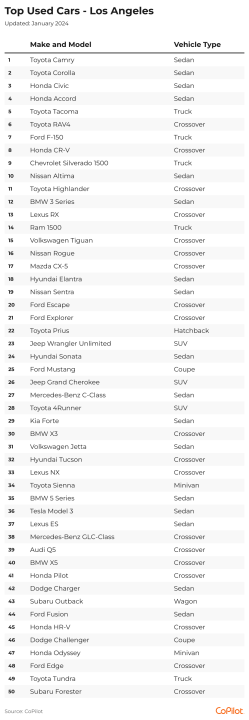
CoPilot analyzed national sales data to uncover the 50 top-selling used cars in the Los Angeles-Long Beach-Anaheim, CA metro area.

Analyzing the top-selling used cars in the Los Angeles metro area reveals a fascinating mix – a focus on fuel efficiency for battling traffic, a touch of luxury for a touch of Hollywood glamor, and a hint of adventure for exploring the surrounding beauty. Let’s delve deeper into the trends and highlights that shape the choices of Southern California drivers – from brand preferences to pricing considerations and the subtle electric revolution!
Copilot

The 50 top-selling used cars in the Los Angeles metro area

Los Angeles, the land of glitz, glam, and perpetual sunshine, offers a used car market as diverse as its sprawling landscape. Whether you’re a Hollywood hopeful, a beach bum, or a busy professional, there’s a pre-owned ride waiting to match your LA lifestyle.

Fuel efficiency reigns supreme. Used Toyota Camrys in Los Angeles take the #1 spot, closely followed by Honda Accords and Civics. Sedans dominate the top of the list, perfectly suited for navigating the sprawling city and crawling through rush hour. The presence of the Toyota Prius, a hybrid hatchback, highlights a growing environmental consciousness, likely driven by rising gas prices or a desire for cleaner air.

However, LA isn’t all about practicality. The inclusion of luxury brands like BMW 3 Series, Lexus RX, and Mercedes-Benz C-Class reflects a niche market that prioritizes a touch of sophistication, even in a pre-owned car. Interestingly, minivans like the Honda Odyssey and Toyota Sienna remain popular, catering to families who value practicality and space alongside a bit of Hollywood style.

Crossovers are the champions of versatility, offering the perfect compromise for many Angelenos. The ever-popular Toyota RAV4 and Honda CR-V provide enough space for weekend adventures to the beach or mountains while remaining nimble for city streets. For those who need even more room, the Toyota Highlander and Honda Pilot provide some extra spaciousness for LA families.

The adventurous spirit of Southern California peeks through with the inclusion of trucks like the Toyota Tacoma and Ford F-150. Popular rugged vehicles go beyond trucks, with the presence of the Jeep Wrangler Unlimited and Toyota 4Runner, showcasing a desire for vehicles that can handle both the daily commute and off-road excursions.

Understanding these trends empowers potential car buyers in Los Angeles to navigate the used car market with confidence. Whether you crave a fuel-efficient sedan for battling traffic, a versatile SUV for exploring the coast, or a touch of luxury for a touch of Hollywood flair, the LA

RSS
First27852786278727882790279227932794Last